Travel. Ukrainian airspace is closed, so there are no commercial flights. Uzhhorod lies right on the border with Slovakia and close to Hungary, so patients usually arrive overland from one of these two countries, by car, bus or train.
Visas. Citizens of the EU, the United Kingdom and the United States do not need a visa for short stays in Ukraine. Rules depend on your citizenship, so check your own before booking.
Safety, plainly. Ukraine is at war. Air raid alerts occur across the country, including in Uzhhorod, and an appointment can be interrupted by one. Several governments advise against travel to Ukraine, and while that advice stands, ordinary travel and medical insurance is often void — confirm your cover with your insurer before you commit to anything.
Language. MediUkraine handles correspondence, scheduling, the written treatment plan and the quote in English. The clinic's team communicates with international patients in English.
Payment. You pay the clinic directly. Our coordination service is free of charge for you.
More on travel, safety and insurance: Safety and travel.
The approach is chosen individually, taking into account the type of cyst (functional, dermoid, endometrioma and others), its size, growth rate, symptoms and your pregnancy plans. Possible strategies are monitoring, short courses of medication for specific indications, and surgery when there is pain, rapid growth, a size usually over 5–6 cm, infertility or a risk of complications.
The method of choice is laparoscopic cystectomy: through a few small punctures the surgeon removes the cyst wall, preserving as much healthy ovarian tissue as possible. Recovery is quick, the risk of adhesions is lower and fertility is usually preserved. Open surgery (laparotomy) is rarely needed: for giant cysts, extensive adhesions or suspected malignancy.
With endometriomas, the operation is often combined with adhesiolysis and coagulation or excision of endometriosis lesions, which reduces pain and the recurrence rate. Puncturing or aspirating the cyst without removing its wall is generally not recommended because of the high risk of recurrence, so it is used only in exceptional cases.
The optimal scope of the procedure is determined together with the gynaecologist after ultrasound/MRI and an assessment of ovarian reserve. MediUkraine will help you arrange cystectomy at the partner clinic in Uzhhorod, where it is performed routinely, and agree a treatment plan with a transparent cost estimate.
In the first week you may have tiredness, mild pain in the abdomen or shoulders and bloating; this is an expected reaction of the body to the procedure. Resume activity gradually: walk often, but avoid lifting heavy objects for the first two weeks. You can usually drive after 3–7 days, once you are no longer taking painkillers and can confidently perform an emergency stop.
When you can return to work depends on its physical demands. For office work it is usually a week; for physically active work, up to several weeks. Your gynaecologist decides when you can take on a full workload after an examination.
Light daily activity speeds up healing. Swimming and sport are resumed after the first outpatient check-up, once the doctor has examined the puncture sites. Stay hydrated, eat a balanced diet and avoid smoking and overheating (hot baths, saunas) until the doctor allows it. If you develop a fever, increasing pain, heavy discharge or redness of the wounds, call the clinic immediately.
Cystectomy removes the cyst while preserving ovarian reserve, which is the main concern for women planning a pregnancy. After the operation the pelvic anatomy is restored, pain and inflammation decrease and pressure on the tubes and ovary disappears, so the chances of conception increase. This is especially noticeable with endometriomas, when endometriosis lesions are treated at the same time.
The doctor decides individually when you can plan a pregnancy. You are usually advised to wait until the ovarian tissue has fully healed: after a simple cystectomy, from one or two menstrual cycles; after removal of large endometriomas or extensive adhesiolysis, up to three to six months. Before surgery and afterwards, it is worth checking AMH and the antral follicle count to monitor ovarian reserve. If the cysts tend to recur or there are other infertility factors, the doctor may suggest a strategy involving assisted reproduction (for example, IVF).
Not all cysts need surgery: some functional cysts regress on their own. The decision is made after ultrasound/MRI, taking into account size, symptoms, age and reproductive plans. MediUkraine will help you agree an examination and treatment route focused on preserving fertility.
Before choosing a country for surgery, look not only at the price of the operation but at the total cost: travel, accommodation, tests and medicines after discharge. In Ukraine the total is mostly lower, and the organisation is simpler: consultations, diagnostics and surgery take place in one centre with a short hospital stay.
Why is the cost lower in Ukraine? First, the cost of medical services (bed-days, consumables, rent, utilities) is lower than in the EU or Turkey. Second, competition in the private sector encourages transparent all-inclusive packages. Third, minimally invasive technique shortens the operation and the hospital stay, which directly reduces the bill.
At the same time, the level of risk is kept low: private clinics work according to European protocols, follow infection control, and provide full anaesthetic support and post-operative monitoring. Teams with extensive experience in organ-preserving surgery perform cystectomies routinely, with predictable results and monitored complication rates.
Key factors behind the lower price in Ukraine:
lower cost of bed-days and consumables;
transparent package offers and competition between private clinics;
a shorter hospital stay thanks to laparoscopy and quick recovery.
Patients choose Ukrainian clinics for ovarian cyst laparoscopy both for the price and for the chance to have the tests and the operation in one place. MediUkraine will help you agree a treatment plan with the partner clinic in Uzhhorod and get a personal cost estimate with no hidden charges.
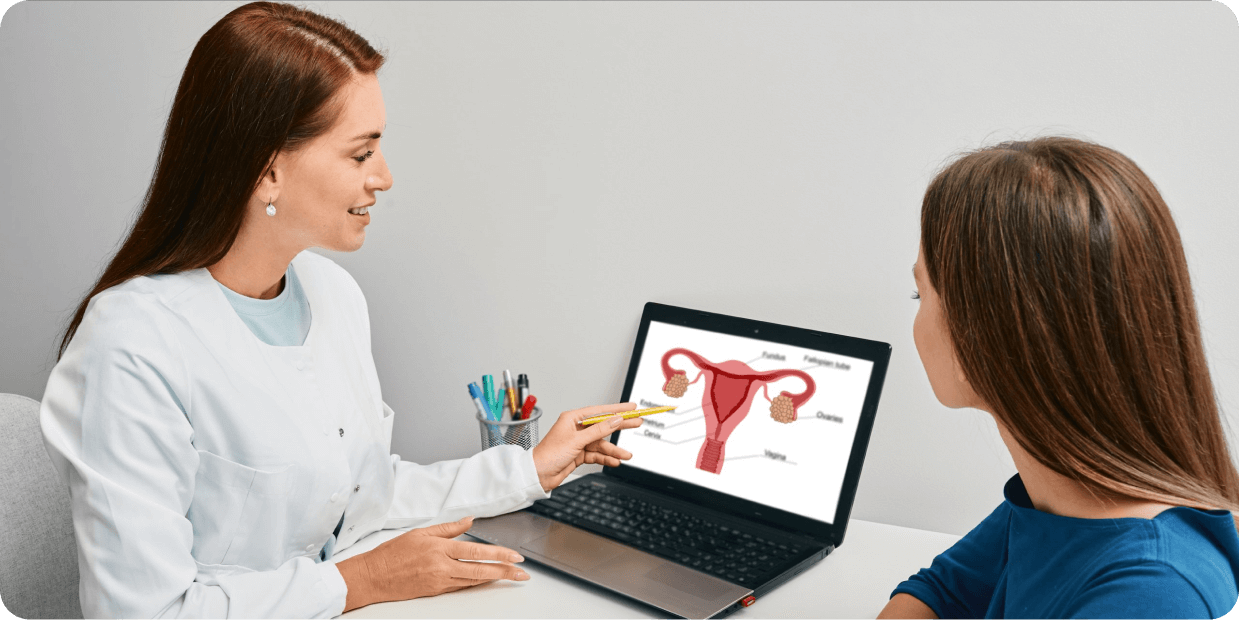
Private clinics in Ukraine work according to European protocols and provide full anaesthetic support and strict infection control, which keeps the risk low. Cystectomies are performed routinely, with a short hospital stay, and at the partner clinic in Uzhhorod you can have the tests and the operation in one place.
To choose a reliable facility, look at the number of operations performed, the gynaecologist's experience and a transparent cost estimate. MediUkraine will help you check these points for the partner clinic in Uzhhorod before you travel.

📍 Uzhhorod, Ukraine
A multidisciplinary hospital in Uzhhorod, part of a network of medical facilities in western Ukraine: an outpatient clinic, a surgical centre covering 15 specialties and a 30-bed inpatient unit. Its 52 doctors include professors and PhDs; many operations are done as day surgery, with discharge after 1–2 days.
It is an organ-preserving operation through a few small punctures: the surgeon shells out the cyst wall (cystectomy) while preserving as much healthy ovarian tissue as possible. It is performed under general anaesthesia, and the result is less pain, a shorter hospital stay and a lower risk of adhesions.
Guide prices: from USD 462 for 1 cyst ≤5 cm; from USD 548 for multiple/bilateral cysts or 6–10 cm; from USD 660 for complex cases (endometrioma, extensive adhesiolysis). The exact amount depends on the scope of the procedure and what the package includes: anaesthesia, materials, the hospital stay and follow-up examinations.
It depends on your citizenship: many countries have visa-free entry for short stays, while others need a type C visa. We will tell you the exact conditions and advise you on the documents you need.
Yes, if the cyst does not go away, grows quickly, is larger than about 5–6 cm, causes pain, pressure or infertility, or gets in the way of planning IVF; also with endometriomas and dermoid cysts. The decision is made after ultrasound/MRI, tests and a consultation with a gynaecologist specialising in endoscopy.
Monitoring (for some functional cysts), supportive medication if indicated, and laparoscopic cystectomy as the method of choice. Open surgery is rarely used: for giant cysts, extensive adhesions or suspected malignancy; puncture without removing the cyst wall is not recommended because of recurrence.
It is usually an outpatient procedure or a 1-day hospital stay. Return to office work takes 3–7 days, to sport 2–4 weeks; heavy lifting is restricted for the first ~2 weeks. Sexual activity, swimming pools and baths only once the doctor allows it.
Yes. Removing the cyst and restoring the pelvic anatomy increase the chances of natural conception and of success with assisted reproduction, especially with endometriomas. You can usually plan a pregnancy once healing is complete: from 1–2 cycles (simple cystectomy) to 3–6 months (large endometriomas/extensive adhesiolysis), as your doctor recommends.
Tell us what you need: we will suggest a clinic and a doctor and send you a cost estimate.
Request a consultation →