| Service | 🇺🇦 Ukraine | 🇨🇿 Czech Republic | 🇹🇷 Turkey |
|---|---|---|---|
| Professional cleaning under a microscope | from USD 44 | from USD 95 | from USD 99 |
| Professional cleaning without a microscope | from USD 37 | from USD 72 | from USD 63 |
| Complex hygiene treatment under a microscope | from USD 59 | — | — |
Prices in the “Ukraine” column come from MediUkraine’s partner clinics. The Czech Republic and Turkey columns show the lower bounds of prices published by clinics there (for Turkey, also the Turkish Dental Association’s recommended 2026 tariff), collected in August 2026 and converted to US dollars at the rate on the day of collection. A dash means we could not find a comparable published price. In any country, the final cost is set by the clinic after an examination.
It is a clinical procedure in which a dentist or hygienist removes dental deposits with instruments. Three different types of deposit are removed, and they should not be confused: biofilm, an organised community of bacteria on the tooth surface; stained plaque from coffee, tea, wine and tobacco; and tartar, which is the same biofilm after it has absorbed minerals and hardened.
A toothbrush can deal only with the first of these. Soft biofilm is removed with a brush and floss while it is fresh, but within a day or two it starts to mineralise, and within one and a half to two weeks it turns into tartar bonded to the enamel and the root. Toothpaste will not remove it and mouthwash will not dissolve it: only an instrument can. The second reason is location: deposits in a gum pocket lie deeper than any bristle can reach.
Routinely the procedure is done once every six months, and there are plenty of reasons to come sooner: gums that bleed when brushing, persistent bad breath, noticeable staining from coffee and tobacco, braces or aligners, implants and removable dentures, planning a pregnancy, diabetes. Hygiene is also a mandatory preparatory stage before implantation, prosthetic treatment, orthodontic treatment and whitening: all of these are done on clean teeth and healthy gums.
In some situations the visit is postponed or the procedure adapted. A routine cleaning is postponed during an acute respiratory infection, a flare-up of cold sores on the lips, or mouth ulcers. Tell the dentist beforehand if you have a pacemaker, asthma or chronic lung disease, follow a low-sodium diet, have a clotting disorder or take anticoagulants: in these cases the instrument or powder is changed, not the procedure refused. Cleaning also has its limits: hygiene does not treat periodontitis, and with pockets deeper than 4 mm separate periodontal treatment is needed.
MediUkraine is a service that finds and coordinates treatment; it is not a clinic. We find the dental practice and the dentist, agree the date of your visit and support you throughout, including if you are coming from abroad. The scope of treatment and the need for further care are decided by the dentist after an examination.

Travel. Ukrainian airspace is closed, so there are no commercial flights. Patients reach Lviv overland, most often from Poland: Rzeszów and Kraków airports are the usual entry points, with a train, bus or private transfer onward to the border and on to the city. Lviv is roughly 70 km from the Polish border, the shortest crossing of any Ukrainian city.
Visas. Citizens of the EU, the United Kingdom and the United States do not need a visa for short stays in Ukraine. Rules depend on your citizenship, so check your own before booking.
Safety, plainly. Ukraine is at war. Air raid alerts occur in Lviv, and an appointment can be interrupted by one. Several governments advise against travel to Ukraine, and while that advice stands, ordinary travel and medical insurance is often void — confirm your cover with your insurer before you commit to anything.
Language. MediUkraine handles correspondence, scheduling, the written treatment plan and the quote in English. The clinic's team communicates with international patients in English.
Payment. You pay the clinic directly. Our coordination service is free of charge for you.
More on travel, safety and insurance: Safety and travel.
Deposits are classified by where they lie. Supragingival tartar is visible to the eye: it is yellowish or whitish and most often sits on the inner surface of the lower incisors and on the cheek-facing surfaces of the upper molars, opposite the ducts of the salivary glands. Subgingival tartar lies in the gum pocket; it is darker, denser and more firmly attached to the root, because it mineralises not from saliva but from gingival fluid. This is the tartar that keeps inflammation going, and it can neither be seen without a probe nor removed at home.
The ultrasonic scaler is the main instrument for removing tartar. The tip vibrates at a frequency of about 25–35 kHz, and tartar is chipped off the surface mechanically rather than "dissolved"; a jet of water cools the tip and flushes out the fragments. Piezoelectric units move the working tip mainly in a straight line, magnetostrictive ones in an ellipse, and this determines which side of the tip the dentist works with. Ultrasound removes dense deposits well, but it does not clear stains from fissures and gaps or smooth the surface: other stages are needed for that.
Hand instruments still have a role after ultrasound. Gracey curettes are a set in which each instrument is designed for a specific group of teeth and surface. They are used to remove whatever ultrasound has left in the pocket and on concave areas of the root, working by touch: the fingers can tell rough tartar from smooth cementum where the eye can see nothing more.
Air-Flow (air-polishing) works differently: a mixture of air, water and fine powder under pressure blasts away biofilm and stains. Powders differ and are not interchangeable. Sodium bicarbonate has the largest particles; it is used only above the gums and not on composite fillings or exposed cementum. Glycine is finer, and erythritol, with particles of about 14 µm, is the gentlest: it is used to treat gum pockets, surfaces around implants and areas next to braces. The key point is that air-polishing does not remove tartar and cannot replace ultrasound.
Polishing is a stage in its own right, not just a finishing touch. After tartar removal, the enamel and root surface is microscopically rough, and plaque sticks more readily to a rough surface, so it is smoothed with a rubber cup or brush and paste, and the contact surfaces are finished with strips and floss. Pastes differ in abrasiveness according to the RDA index: the dentist starts with a coarser one where there were stains and finishes with a fine one. Coarse paste is not used on exposed root cementum, which is softer than enamel. If plaque was removed with erythritol, polishing is sometimes not needed at all.
Fluoride treatment completes the procedure. A fluoride varnish with a fluoride concentration of about 22,600 ppm is applied with a brush to the dried surface; less often a gel in a tray is used. Fluoride is taken up by the surface layer of the enamel, makes it more resistant to acids and noticeably reduces the sensitivity that almost always appears after deposits are removed. Do not eat or drink for two hours afterwards, and do not brush until the next morning, or the varnish will simply come off.
The microscope does not change the stages, but it makes them more precise. Magnification and directed light reveal what an ordinary examination can only guess at: remaining subgingival deposits near the gum line, overhanging margins of old fillings under which plaque is constantly retained, a gap under the edge of a crown, enamel cracks, early decay in the fissures. There is a second benefit too, gentleness: under magnification it is easier to remove tartar without going over the root cementum unnecessarily. At the same time, optics do not replace a periodontal probe or an X-ray: they do not "see through" a deep pocket, and the condition of the bone is visible only on an X-ray.
Now for what cleaning does not do. It does not whiten teeth. Cleaning removes plaque and stains from the surface, and the tooth becomes what it really is, often one or two shades lighter than it looked before the visit. But this is the tooth's natural colour returning, not a change of colour. Whitening is a different procedure: a gel with carbamide or hydrogen peroxide penetrates the enamel and dentine and bleaches the pigment inside the tissue. So asking for "a cleaning to make my teeth white" means asking for two different procedures. If you want a lighter shade after hygiene, whitening is discussed separately and planned no sooner than two weeks later, once the sensitivity has passed.
The second limitation: cleaning does not treat periodontitis. If the probe goes into a pocket deeper than 4 mm, removing deposits is not enough on its own: the root surface within the pocket needs treatment, sometimes under anaesthesia and over several visits, and the result is assessed by repeat probing six to eight weeks later. No procedure restores lost bone; treatment removes the cause of further loss. That is why pocket depth is measured before the work, not after it.
A frequency of once every six months is a guide for a person with healthy gums and careful home care. With periodontitis, braces, implants, smoking, diabetes and dry mouth, the interval is shortened to three to four months, because biofilm matures and mineralises faster. At the same time, a professional cleaning is no substitute for the daily routine: two minutes with a toothbrush twice a day and daily cleaning between the teeth with an interdental brush or floss. The dentist removes the result; at home, you manage the cause.
Straight after the visit your teeth feel smooth, and your gums may bleed slightly: this is expected where there was inflammation under the tartar. Do not eat or drink for two hours after fluoride treatment, and if fluoride varnish was applied, do not brush until the next morning. In these first hours it is also worth avoiding coffee, tea, wine, beetroot and smoking: the protective film on the enamel has not yet re-formed, and stains attach more easily than usual.
Sensitivity to cold and sweet things in the first days is the most common reaction, not a complication. Once tartar is removed, the necks and roots of the teeth it covered are exposed to irritants for the first time. This usually passes within two to seven days; a toothpaste with potassium nitrate or fluoride helps, as does using lukewarm rather than ice-cold water and avoiding acidic drinks for a while. If sensitivity lasts longer than two weeks, or the pain becomes sharp and centres on one tooth, have it checked.
The gums recover in about a week. Bleeding when brushing should decrease over the first days, not increase, provided you keep brushing regularly at home rather than sparing your gums "until they heal". If your gums bleed just as much after two weeks, the cleaning is not the cause: most likely there are pockets or overhanging filling margins, and a periodontist's examination is needed.
One effect worries many people. After large masses of tartar are removed, the teeth may seem longer and noticeable gaps appear between them. The cleaning is not to blame: for years the tartar filled the space left by receding gums, and removing it has revealed what was already there. Slight mobility of the teeth in the first days has the same cause and usually decreases as the swelling goes down, but it is still worth discussing with the dentist.
Colour can be judged straight away, in the chair, in daylight. A cleaning reveals your teeth's natural shade without plaque or stains, and how light it is depends on the enamel itself. If you want them lighter, that is a matter for whitening, which is best planned at least two weeks later.
The next visit is usually scheduled in six months, and with periodontitis, braces or implants in three to four months. One more thing: once deposits are removed, problems hidden beneath them become visible, such as decay on contact surfaces, cracks and defective filling margins. That is why the examination after a cleaning is not a formality, and the dentist may add some of the findings to the treatment plan straight away. For patients from abroad, MediUkraine passes on the records and recommendations so that follow-up can continue at home.
Step 1. Examination and periodontal chart. The dentist examines the teeth and gums, runs a probe around each tooth and records pocket depths and bleeding points, and looks out for overhanging filling margins, crown edges and areas of recession. An X-ray is taken if indicated. This is where the dentist decides whether cleaning will be enough or separate periodontal treatment is needed, and whether anaesthesia will be required.
Step 2. Ultrasonic tartar removal. Dense deposits above the gums and in the accessible areas of the pocket are removed with a water-cooled scaler tip. This is the longest stage: the more tartar, the longer it takes. Anaesthesia is usually not needed; with high sensitivity a topical gel is applied, and occasionally a specific area is numbed by infiltration.
In total, the visit takes from 40 minutes to 1.5 hours. Between the opening examination and the final fluoride treatment come four working stages: ultrasound chips off tartar, curettes under the microscope clean the subgingival areas, air-polishing blasts away biofilm and stains, and polishing smooths the surface. No hospital stay is needed and there is no recovery period: you can return to your usual activities immediately after the appointment, and the only restriction is two hours without food, drinks or smoking.
Hygiene is not a one-off event but a cycle of two parts: a procedure in the dental surgery at a set interval and daily home care between visits. At the clinic, hardened deposits are removed; at home, you stop biofilm from maturing. If only one half works, the cycle breaks down: after a thorough cleaning without home care, tartar returns within a few months.
When teeth have been neglected, the first cycle rarely fits into one visit. With heavy deposits, the dentist splits the work into two appointments a week or two apart: first removing the bulk and letting the gums settle, then working more precisely where swelling got in the way. The gap also shows how the gums have responded to the first stage.
After that, care either continues as routine hygiene or moves on to periodontal treatment. If after deposit removal the pockets are no deeper than 3 mm and the bleeding has stopped, routine visits are enough. If there are pockets of 4–5 mm or more, a separate stage of root surface treatment is needed, and six to eight weeks later the pockets are measured again and compared with the initial figures.
The dentist sets the interval individually, and it is not always six months. Three to four months is the usual rhythm for patients with a history of periodontitis, braces or implants, for smokers and for people with diabetes. The rule of thumb is simple: the interval is shortened until the dentist sees minimal deposits at the next visit.
Cleaning can also be part of another treatment plan. Before implantation, prosthetic treatment, orthodontic treatment and whitening it is done as the first step and then repeated at set points: before crowns are fitted, after braces are removed, during maintenance check-ups on implants. In that case the dates follow the stages of the main plan rather than the calendar, and MediUkraine plans the schedule to match your trips.
The most common after-effect of the procedure is increased tooth sensitivity. Once tartar is removed, the necks and roots of the teeth it covered for years are exposed to cold, sweet and acidic things for the first time. This usually passes within two to seven days, and this is what the fluoride varnish at the end of the visit is for. Longer-lasting sensitivity occurs with marked gum recession and wedge-shaped defects; in that case the dentist will prescribe a course of remineralising treatment rather than tell you to put up with it.
Bleeding during and after cleaning is not a complication but a sign of inflammation that was already there. Healthy gums do not bleed when touched by an instrument, and this is the simplest way to tell what state they are in. At the same time, excessive instrumentation damages soft tissue and can wear away root cementum unnecessarily, so control under magnification and using curettes only when needed, not just in case, matter more than speed.
Air-polishing has its own limitations. Coarse bicarbonate powder is not used on composite fillings, exposed root cementum or implant surfaces: glycine and erythritol exist for those. The jet is not directed at a right angle deep into a pocket or into a fresh wound: cases of subcutaneous emphysema have been described, where air entered the soft tissue and caused sudden facial swelling. The complication is rare and comes down to technique.
Some conditions need discussing before the appointment begins. If you have a pacemaker, tell the dentist in advance: most devices are protected against external interference, but the clinic's protocol may provide for manual tartar removal instead of ultrasound. With asthma and chronic lung disease, extra care is taken with aerosol and water; with a low-sodium diet, sodium bicarbonate is not used; with clotting disorders and anticoagulant use the scope of work is planned with bleeding in mind. A routine cleaning is postponed during an acute infection, a flare-up of cold sores on the lips or mouth ulcers.
Pregnancy is not a contraindication but a reason not to put off cleaning. Hormonal changes make gum inflammation worse, and this is when deposits do the most harm. Routine hygiene is usually carried out in the second trimester, when the visit is easier to tolerate; X-rays are taken only when strictly indicated and with a protective apron. Patients with a strong gag reflex are offered a suitable chair position and shorter stages with breaks.
You have the right to know the limits of the procedure and to get a second opinion. The examination record with pocket depths stays with you and can be shown to another specialist: the figures in the chart are more objective than impressions. You should contact a dentist without waiting for a routine visit if swelling of the gum or cheek appears after cleaning, pain increases instead of fading, bleeding persists for more than two weeks, or you develop a fever.
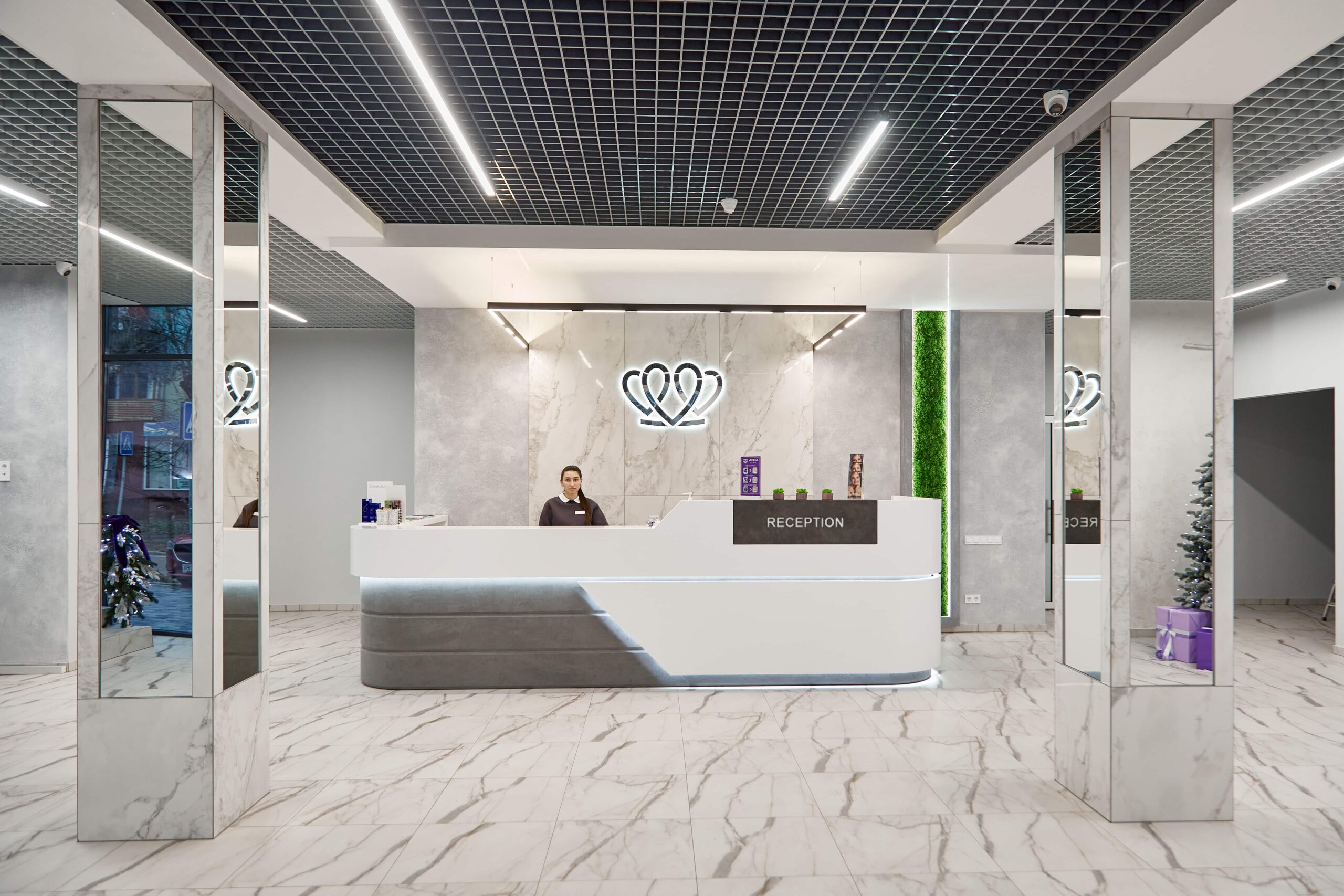
📍 Lviv, Ukraine
A dental clinic in Lviv with a separate doctor for each field: oral surgery and implants, prosthodontics, restorative dentistry, endodontics under a microscope, periodontics, orthodontics and paediatric dentistry.
No. Cleaning removes plaque and stains from coffee, tea, wine and tobacco from the surface, after which the tooth looks as it really is, often one or two shades lighter than before the visit. This is the tooth's natural colour returning, not a change of colour. Whitening works differently: a peroxide gel penetrates the enamel and dentine and bleaches the pigment inside the tissue. These are two different procedures, and if you want a shade lighter than your natural one, whitening is planned separately, no sooner than two weeks after hygiene.
At MediUkraine's partner clinic, cleaning under a microscope costs from USD 44, cleaning without a microscope from USD 37, and complex hygiene treatment under a microscope from USD 59. The price includes the dentist's work and materials for all stages: ultrasound, air-polishing, polishing and fluoride treatment. Anything beyond hygiene is paid for separately: treatment of tooth decay, X-rays, treatment of deep gum pockets. Prices are indicative; the final amount is given by the dentist after an examination.
The usual guide is once every six months, and for a person with healthy gums and careful home care this is usually enough. The interval is shortened to three to four months with periodontitis, braces and aligners, implants, smoking, diabetes and dry mouth: in these situations biofilm matures faster. The dentist sets the exact interval based on the condition of your gums at a check-up, not by the calendar. The procedure at the clinic does not replace brushing twice a day at home and daily cleaning between the teeth.
Usually not. The procedure feels like vibration, cold water and pressure; anaesthesia is not needed, and on request or with high sensitivity a topical gel is applied. Infiltration anaesthesia is used only occasionally, when deposits lie deep under the gums and the gums are inflamed. It feels more unpleasant where there is inflammation or exposed tooth necks, so it is worth telling the dentist about sensitive areas at the start of the appointment: they will adjust the unit's settings and the water temperature.
They are different stages, not synonyms. An ultrasonic scaler mechanically chips off tartar, the dense mineralised deposits above the gums and in the pocket. Air-Flow (air-polishing) uses a jet of air, water and fine powder to blast soft biofilm and stained plaque from fissures, gaps and surfaces around braces, but it does not remove tartar. So one does not replace the other: ultrasound and curettes first, then Air-Flow, followed by polishing and fluoride treatment.
Control where the naked eye sees only the gum line. Under magnification the dentist notices remaining subgingival deposits, overhanging margins of old fillings under which plaque is constantly retained, a gap under the edge of a crown, enamel cracks and early decay. It also makes the work gentler: it is easier to remove tartar without going over the root cementum unnecessarily. At the same time, a microscope does not replace a periodontal probe or an X-ray: pocket depth is measured with a probe, and the condition of the bone is visible only on an X-ray.
Yes, in all three cases, but with adjustments to the protocol. Around braces and implants, fine powders such as glycine or erythritol and special tips are used so as not to scratch the surface of the appliance or the titanium; the interval between visits is shortened to three to four months. During pregnancy, hygiene is usually planned for the second trimester: gum inflammation increases during this period, so postponing the procedure is not advisable. Tell the dentist about all such circumstances before the appointment begins.
Tell us what you need: we will suggest a clinic and a doctor and send you a cost estimate.
Request a consultation →