| Service | 🇺🇦 Ukraine | 🇨🇿 Czech Republic | 🇹🇷 Turkey |
|---|---|---|---|
| Curettage (per tooth) | from USD 13 | from USD 14 | from USD 39 |
| Periodontist consultation | from USD 18 | — | — |
| Professional hygiene under a microscope | from USD 44 | from USD 95 | from USD 99 |
Prices in the “Ukraine” column come from MediUkraine’s partner clinics. The Czech Republic and Turkey columns show the lower bounds of prices published by clinics there (for Turkey, also the Turkish Dental Association’s recommended 2026 tariff), collected in August 2026 and converted to US dollars at the rate on the day of collection. A dash means we could not find a comparable published price. In any country, the final cost is set by the clinic after an examination.
The disease begins with a bacterial biofilm at the junction of tooth and gum. If plaque stays there for more than two days, it mineralises into tartar, and the tissues respond with inflammation. This stage is called gingivitis: the gums swell, redden and bleed when brushed, but the ligament that holds the tooth and the bone around the root are not yet damaged.
Gingivitis is reversible. Once plaque and tartar have been removed and good home hygiene is established, the gums return to normal within a few weeks, with no lasting effects. Bleeding gums are therefore not "just sensitive gums" but a signal to see a doctor while the damage can still be reversed.
When inflammation spreads deeper, periodontitis begins. The attachment of the tooth to the bone breaks down, a periodontal pocket forms between the root and the gum, and the bone around the root is gradually resorbed. This is the crucial difference: lost bone does not come back. Treatment stops the process and preserves what is left; it does not rebuild the jaw. Periodontitis is a chronic disease: it is stabilised and kept under control rather than cured for good.
It is worth seeing a doctor if your gums bleed when you brush or on their own, you have developed persistent bad breath, the necks of your teeth have become exposed, your teeth have become loose or changed position, gaps have appeared between them, or pus is coming from under the gum. People with diabetes and smokers need particular attention: in them the disease progresses faster and more often develops without obvious symptoms. An examination is also needed before prosthetic work, implant placement and orthodontic treatment.
In some situations, full treatment has to wait. An acute abscess is drained first, and only then does planned therapy begin. With uncontrolled diabetes, during the acute phase of an infectious illness, or with severe blood clotting disorders, the surgical stage is put off and treatment starts with basic hygiene; during pregnancy treatment is limited to non-surgical procedures. The biggest limitation is home care: if you do not clean between your teeth every day, no curettage will hold the result, so hygiene training is part of the treatment, not an add-on.
MediUkraine is a service that finds and coordinates treatment; it is not a clinic. We find the clinic and a doctor with the right specialisation, agree the dates of your visits and support you throughout, including if you are travelling from abroad. The diagnosis and treatment plan are decided by the doctor after an in-person examination.

Travel. Ukrainian airspace is closed, so there are no commercial flights. Patients reach Lviv overland, most often from Poland: Rzeszów and Kraków airports are the usual entry points, with a train, bus or private transfer onward to the border and on to the city. Lviv is roughly 70 km from the Polish border, the shortest crossing of any Ukrainian city.
Visas. Citizens of the EU, the United Kingdom and the United States do not need a visa for short stays in Ukraine. Rules depend on your citizenship, so check your own before booking.
Safety, plainly. Ukraine is at war. Air raid alerts occur in Lviv, and an appointment can be interrupted by one. Several governments advise against travel to Ukraine, and while that advice stands, ordinary travel and medical insurance is often void — confirm your cover with your insurer before you commit to anything.
Language. MediUkraine handles correspondence, scheduling, the written treatment plan and the quote in English. The clinic's team communicates with international patients in English.
Payment. You pay the clinic directly. Our coordination service is free of charge for you.
More on travel, safety and insurance: Safety and travel.
Treatment begins not with a procedure but with measurement. A periodontal chart records pocket depth at six points around each tooth, gum recession, bleeding on probing, the degree of mobility and furcation involvement. A healthy sulcus is 1–3 mm; a pocket of 4 mm or more means that attachment has been lost. Without these figures there is no way to plan treatment or, later, to show that it has worked: "my gums feel better" measures nothing.
X-rays complement the chart. A periapical X-ray and a panoramic X-ray show the bone level and make it possible to distinguish horizontal loss, where the bone drops evenly, from a vertical defect, where a hollow forms around an individual root. Not everyone needs cone beam CT, but only CT shows how many bone walls remain around the defect, and that directly determines whether a regenerative technique makes sense.
The first stage of treatment is always non-surgical. This is professional hygiene: ultrasonic removal of tartar above the gums, treatment with an air-polishing device, polishing and fluoride application. At the same time, local factors that sustain inflammation are eliminated: overhanging filling margins, ill-fitting crowns, sharp edges of broken-down teeth. At this stage you are also shown how to clean between your teeth with an interdental brush or floss: that is where most problems begin, and without daily home care the rest of the treatment will not last.
Closed curettage, the removal of deposits from the root surface and smoothing of that surface, is the main procedure for pockets 4–5 mm deep. It is done under local anaesthesia, usually by quadrant or sextant, over several sessions lasting from 40 minutes to 1.5 hours. The doctor works with an ultrasonic tip and Gracey hand curettes, removing tartar and bacterial film from the root below the gum; magnification helps avoid missing residues deep down. The aim is a smooth, clean root surface to which the gum can reattach.
At 6–8 weeks after the non-surgical stage, the doctor repeats the measurements with the same probe at the same points. This follow-up examination decides what happens next. Pockets that have reduced to 3–4 mm and do not bleed on probing are considered stable, and you move on to a maintenance programme. Where deep pockets with bleeding remain, a surgical stage is discussed.
Open curettage and flap surgery are needed when a pocket is 6 mm or deeper: at that depth a root cannot be cleaned blind. Under local anaesthesia the gum is lifted back in a small flap, deposits and granulation tissue are removed under direct vision, the bone edge is smoothed if needed and the wound is sutured. It is important to know the consequences in advance: after healing the gum sits lower, the necks of the teeth are exposed, and gaps and sensitivity to cold appear. This is an expected result of the procedure, not a complication, but it may not look the way you expected.
Regenerative techniques try to restore part of the lost support. Bone substitute material is placed into a vertical defect and covered with a barrier membrane, or enamel matrix proteins are applied, so that the ligament cells can populate the root surface before the epithelium does. This works only in certain cases: narrow two- and three-wall defects respond, whereas with horizontal bone loss regeneration is not indicated. Even in a favourable case it restores part of the defect, not the bone to its original level, and only a doctor who has assessed the CT scan can predict how much will be restored in an individual case.
Splinting is used when teeth have become loose. A fibreglass tape with composite is bonded to the inner side of several teeth, joining them into a block: the load is redistributed, and each individual tooth takes less. It is important to understand the limits of the method: a splint does not treat periodontitis or build bone, it only helps weakened teeth last longer alongside the main treatment. Teeth with third-degree mobility, loss of most of their support and repeated abscesses have to be extracted: a hopeless tooth left in place sustains inflammation in its neighbours.
Antibiotics and antiseptics supplement mechanical cleaning; they do not replace it. Systemic drugs are prescribed for aggressive forms at a young age, necrotising processes, abscesses and marked general symptoms; prescribed without curettage, they give a short-lived effect followed by the return of inflammation, because the biofilm on the root is still there. Chlorhexidine rinses are used as a limited course after treatment, not continuously: long-term use alters taste and stains the teeth.
The last factor is not strictly dental, but it affects the result more than the choice of instrument. Diabetes and smoking are the two factors that most noticeably worsen the prognosis: the first impairs healing and the tissue response to inflammation, the second constricts the gum's blood vessels, masks bleeding and slows recovery after treatment. The link works both ways: controlled periodontitis makes blood sugar easier to manage, while uncontrolled diabetes makes gum disease worse. Without giving up smoking, the result of treatment will be worse: pockets close less well and flare-ups happen more often, so the doctor raises this at the planning stage.
For the first two or three days after curettage the gums remain sensitive; there may be slight bleeding when brushing and an aching discomfort in the treated area. Cold and heat are felt more sharply because part of the neck of the tooth is exposed. An ordinary painkiller is usually enough, and the treated areas should be brushed gently with a soft brush from the very first day: do not stop brushing.
The next stage is one you should be prepared for in advance. When the swelling goes down, the gums settle at their true level: the teeth look longer and gaps open up between them. This is neither a deterioration nor a mistake: the swollen gums were simply hiding bone loss that had already happened.
The result of the non-surgical stage is assessed after 6–8 weeks by repeat measurement, and after flap surgery no earlier than three months, once the tissues have fully healed. An X-ray check of the bone level makes sense after 6–12 months: any earlier and changes will not yet show on the image.
Success is defined in figures, not feelings. The condition is considered stable when pockets do not exceed 4 mm, probing does not cause bleeding and mobility is not increasing. These indicators are compared with the first chart, which is why a thorough baseline chart matters so much.
What you should not expect is the return of lost bone. With a favourable defect geometry, regenerative techniques restore part of the defect, but treatment does not bring back the level of support that existed before the disease. The realistic aim is to stop the destruction and keep the remaining teeth.
The most important part begins after the active phase is over. Maintenance visits with professional hygiene and pocket checks are scheduled every 3–6 months, for life. Missed maintenance visits are the most common reason why well-treated periodontitis returns to its previous state within a year or two. Only a doctor can predict the outcome in an individual case, after an examination.
Step 1. Consultation and periodontal chart. The doctor asks about complaints, other conditions and medicines, examines the gums, then uses a probe to measure pocket depth at six points around each tooth and records bleeding, recession and mobility. X-rays are added to the chart: periapical images, a panoramic X-ray and, if needed, CT. These figures determine the diagnosis, the scope of treatment and the quote, so this step is never rushed.
Step 2. Professional hygiene and home care training. Plaque and tartar above the gums are removed, the surfaces are treated with an air-polishing device, polished and coated with fluoride. At the same visit the doctor or hygienist selects interdental brushes to fit the gaps and demonstrates the cleaning technique. Without this step, the rest of the treatment is pointless: a cleaned root will be covered in biofilm again within a few days.
In total, it usually takes 2–4 months from the first consultation to the start of the maintenance programme. Between the initial charting and hygiene at the start and the maintenance visits at the end come the closed curettage sessions by segment, repeat pocket measurement after 6–8 weeks and, where indicated, open curettage, a regenerative technique or splinting of loose teeth. The exact number of visits becomes clear after the follow-up measurement, not at the first consultation.
Periodontal care has no point at which you are simply discharged. The active phase leads into the maintenance phase, and it is maintenance that determines whether the result will last. This sets gum treatment apart from most dental procedures, which have a clear end point: a filling placed or a crown fitted.
The active phase usually lasts 2–4 months. It includes diagnostics, professional hygiene, closed curettage sessions, a six-week pause for healing and the follow-up measurement. If a surgical stage is needed, the cycle is extended by another month to a month and a half, because after flap surgery the tissues are assessed no earlier than three months later.
Then the maintenance phase begins, with intervals set according to risk rather than the calendar. Smokers, patients with diabetes, and those who still have pockets of 5 mm or more or tooth mobility are seen every three months. Patients who are stable, have good hygiene and no other risk factors are seen every six months.
A maintenance visit is not just a cleaning. The doctor assesses bleeding and the depth of problem pockets, removes deposits above and below the gum, checks how well the patient is using the interdental brushes and adjusts their size if needed. A full periodontal chart is completed once a year, and X-rays are repeated every few years.
Flare-ups happen even with disciplined care: after an illness, prolonged stress, a change of medication or during periods of hormonal change. This is a normal part of a chronic condition: the affected area is treated and the usual schedule resumes. Prosthetic work, implant placement and orthodontic treatment are planned only after stabilisation, because none of them lasts long on inflamed gums.
The most common consequence of successful treatment can look like a problem: gum recession. When the inflammation and swelling subside, the gums drop to the real level of the bone: the necks of the teeth are exposed, sensitivity to cold and sweet things appears, gaps open between the teeth, and sometimes the pronunciation of "s" sounds changes. Sensitivity usually eases within a few weeks and can be managed with fluoride and desensitising products, but the gaps remain, so patients should be warned about them before treatment starts, not after.
After the surgical stage, swelling, bruising on the cheek and moderate pain for two to three days are expected. Less common are bleeding in the first hours, stitches coming loose, wound infection, or prolonged numbness if work was done near a nerve. Teeth may also become temporarily more mobile in the first weeks after curettage: the ligament is remodelling, and this settles if the bone has been preserved.
Some teeth may turn out to be hopeless at the planning stage or after the follow-up measurement. Third-degree mobility, loss of most of the support, repeated abscesses and furcation involvement that cannot be cleaned are grounds for extraction. This is an unpleasant but predictable part of the plan: such a tooth, if kept, sustains inflammation in neighbouring areas and shortens their lifespan.
Restrictions apply mainly to the surgical stage. Planned procedures are postponed during acute infectious conditions, uncontrolled diabetes, severe blood clotting disorders and pregnancy. Particular caution is needed for patients on antiresorptive therapy (bisphosphonates or denosumab) or who have had radiotherapy to the head and neck: their risk of osteonecrosis of the jaw is higher, so the extent of surgery, and whether it is advisable at all, is agreed with the doctor managing the underlying condition. Taking anticoagulants does not rule out treatment, but it requires planning and is not a reason to stop the medicine on your own.
Smoking is not a contraindication but a factor that changes the prognosis. In smokers pockets close less well, healing after treatment is slower, flare-ups are more frequent, and the same treatment will produce a weaker result. The doctor should say this plainly at the planning stage, so that you can decide on surgery with realistic expectations.
The technical side of the risks is controllable. The clinics MediUkraine works with hold a licence from the Ministry of Health of Ukraine for medical practice, use sterile instruments and single-use materials, check for allergy to anaesthetics and obtain written informed consent before the surgical stage. The periodontal chart, X-rays and plan are yours to keep, so you can seek a second opinion from another specialist if needed.
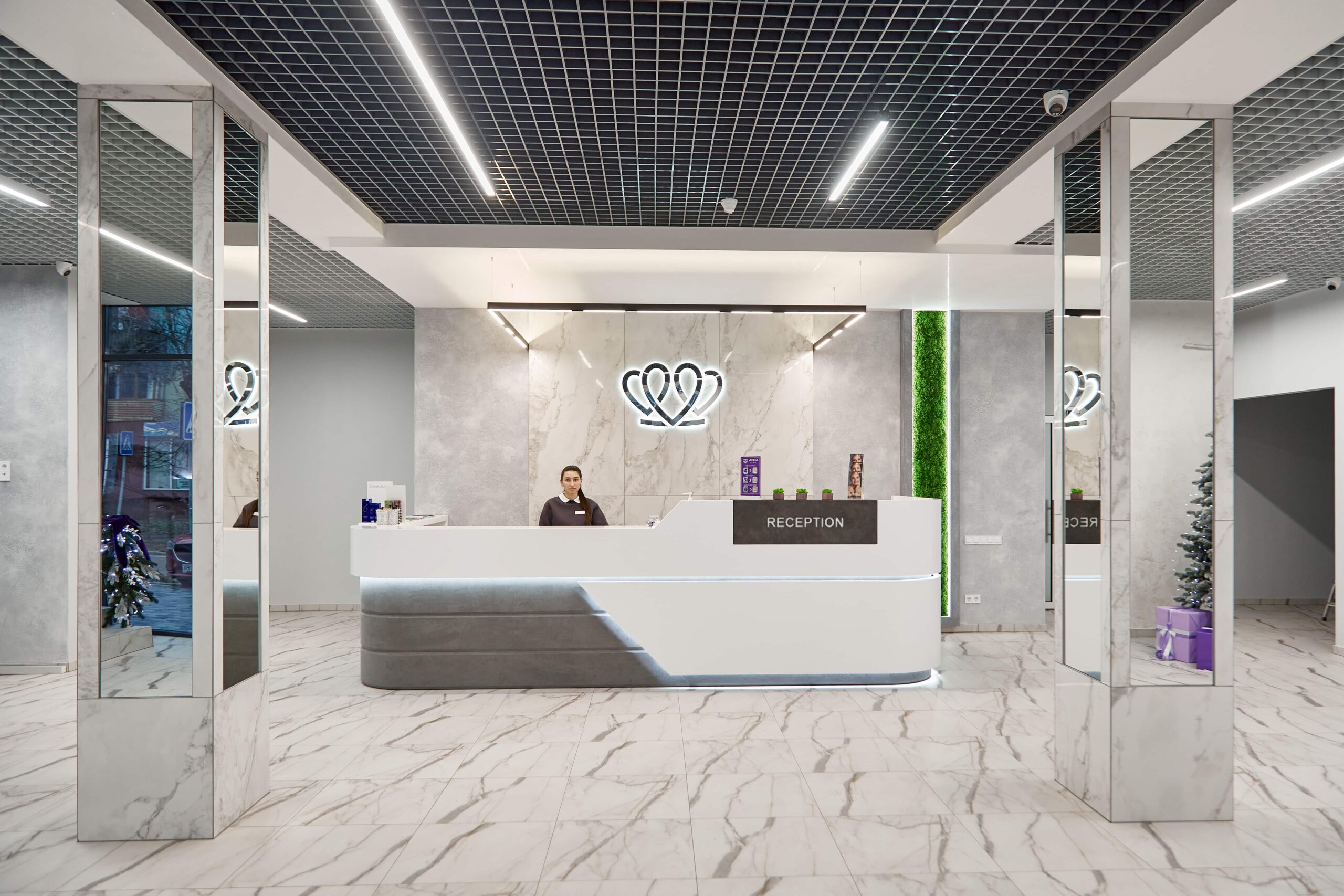
📍 Lviv, Ukraine
A dental clinic in Lviv with a separate doctor for each field: oral surgery and implants, prosthodontics, restorative dentistry, endodontics under a microscope, periodontics, orthodontics and paediatric dentistry.
No. Periodontitis is a chronic disease that is stabilised and then kept under control. Treatment stops the destruction, closes pockets and saves teeth, but the tendency to inflammation does not go away, and lost bone does not grow back. That is why, after the active phase, maintenance visits are scheduled every 3–6 months, for life. Gingivitis, meaning inflammation of the gums without damage to the bone, is reversible and clears up completely once plaque is removed and home hygiene improves.
The difference lies in how deep the damage goes. With gingivitis only the gums are inflamed: they redden, swell and bleed, but the ligament and the bone around the root are intact, so the condition is fully reversible. With periodontitis the attachment of the tooth breaks down, a pocket 4 mm or more deep forms between the root and the gum, and the bone is resorbed. The two cannot be told apart by eye: a periodontal probe and an X-ray are needed. A healthy sulcus is 1–3 mm deep, and it is this threshold that separates the two diagnoses.
At Vidnova Dental Clinic in Lviv, MediUkraine's partner clinic, a periodontist consultation including periodontal charting costs from USD 18, professional hygiene under a microscope from USD 44, and curettage from USD 13 per tooth. Because curettage is charged per tooth, the final sum depends on how many teeth have pockets. X-rays, the surgical stage and splinting are paid for separately. Prices are indicative; the final figure is given by the doctor after an examination and charting.
The procedure itself is done under local anaesthesia, so during the session you feel pressure and vibration but not pain. Discomfort appears later, when the anaesthetic wears off: for two or three days the gums are sensitive, and there may be slight bleeding when brushing and a heightened reaction to cold. An ordinary painkiller is usually enough. The treated areas need to be brushed from the very first day, just with a soft brush and without pressing.
For the most part, no. Bone that has been resorbed around a root does not grow back on its own, and no rinse or gel changes this. Partial restoration is possible only with regenerative techniques, using bone substitute material, a barrier membrane or enamel matrix proteins, and only with a favourable defect geometry: a narrow vertical defect with two or three walls preserved. With horizontal bone loss these techniques are not indicated. The realistic aim of treatment is to stop further destruction and preserve the support that remains.
The process does not stop on its own. Pockets deepen, the bone around the roots continues to be resorbed, and the teeth lose support, become loose, shift and fan out, with gaps opening between them. Recurrent painful abscesses follow. The end point is tooth loss, and usually not of a single tooth but of several. To make matters worse, periodontitis can go on for a long time without marked pain, and smoking additionally masks bleeding, so patients often come in only once their teeth are already loose.
Yes, but only once the inflammation has been stabilised. An implant is placed into the same bone that periodontitis destroys, and with an active process the risk of peri-implantitis rises: inflammation around the implant with subsequent loss of bone and of the implant itself. So the active phase of treatment comes first, pockets are reduced to 4 mm or less without bleeding, and the doctor makes sure you are keeping up with home hygiene. The same applies to prosthetic work with crowns and bridges and to orthodontic treatment.
Tell us what you need: we will suggest a clinic and a doctor and send you a cost estimate.
Request a consultation →