| Service | 🇺🇦 Ukraine | 🇨🇿 Czech Republic | 🇹🇷 Turkey |
|---|---|---|---|
| Dermatovenereologist consultation with trichoscopy | from USD 31 | from USD 50 | from USD 40 |
| Follow-up examination after the course | from USD 27 | from USD 35 | from USD 25 |
Prices in the “Ukraine” column come from MediUkraine’s partner clinics. The Czech Republic and Turkey columns show the lower bounds of prices published by clinics there (for Turkey, also the Turkish Dental Association’s recommended 2026 tariff), collected in August 2026 and converted to US dollars at the rate on the day of collection. A dash means we could not find a comparable published price. In any country, the final cost is set by the clinic after an examination.
Dandruff and seborrhoeic dermatitis are different degrees of the same process. Dandruff is its mildest form: fine flaking of the scalp without noticeable redness, sometimes with itching, not spreading beyond the hair-bearing area. Seborrhoeic dermatitis is the same process with inflammation: pink or reddish patches with yellowish greasy scales, which often also appear on the eyebrows, the sides of the nose, behind the ears and on the chest.
Three factors are involved. The first is yeast-like fungi of the genus Malassezia, which live on the skin of practically everyone and feed on the fatty acids in sebum. The second is the sebum itself: the fungi break down its triglycerides and leave free fatty acids behind. The third, and decisive, factor is the skin's individual reaction to these products: in most people it is neutral, but in some it triggers inflammation and accelerated shedding of the skin. That is why seborrhoea is not contagious: the issue is not the presence of the fungi but the response to them.
There are dry and oily forms. In dry seborrhoea the scales are fine and white and easily fall onto the shoulders, the skin feels tight and the hair is dull and brittle. In the oily form the scales are larger and yellowish, stick together into crusts and stay on the skin, the hair gets greasy quickly and itching is more often a problem. The form guides the choice of product: ketoconazole and selenium sulphide suit the oily form, while the dry form calls for gentler regimens, because aggressive degreasing increases flaking.
Seborrhoea comes in waves, and flare-ups have their own triggers: prolonged stress and lack of sleep, the cold season with dry indoor air, hormonal fluctuations in puberty, during pregnancy and in menopause, and certain medicines. Severe, treatment-resistant seborrhoeic dermatitis can accompany neurological conditions such as Parkinson's disease, the after-effects of stroke or facial nerve palsy, as well as weakened immunity. If the course is unusually severe, the doctor looks for such an underlying condition rather than simply changing the shampoo.
MediUkraine is a service that finds and coordinates treatment; it is not a clinic. We select the medical centre and a dermatologist, agree the appointment date and support you throughout, including if you travel from abroad. The doctor makes the diagnosis and prescribes the regimen after an in-person examination.

Travel. Ukrainian airspace is closed, so there are no commercial flights. Patients enter Ukraine overland, most often from Poland (Rzeszów and Kraków airports are the usual entry points), and continue to Dnipro by train. Dnipro is in the east of the country, a long journey from the border, so plan the route and timing with us before you book.
Visas. Citizens of the EU, the United Kingdom and the United States do not need a visa for short stays in Ukraine. Rules depend on your citizenship, so check your own before booking.
Safety, plainly. Ukraine is at war. Dnipro is attacked more often than western Ukraine, and an appointment can be interrupted by an air raid alert. Several governments advise against travel to Ukraine, and while that advice stands, ordinary travel and medical insurance is often void — confirm your cover with your insurer before you commit to anything.
Before you travel. The centre offers an online consultation, so the plan and the number of grafts can be estimated from photos before you decide to make the trip.
Language. MediUkraine handles correspondence, scheduling, the written treatment plan and the quote in English. The centre's team communicates with international patients in English.
Payment. You pay the centre directly. Our coordination service is free of charge for you.
More on travel, safety and insurance: Safety and travel.
Treatment has two stages, and it helps to understand this before you buy anything at the pharmacy. The attack stage is intensive use of the product two to three times a week for two to four weeks, until the flaking, redness and itching have gone. The maintenance stage is the same, but less often, once a week or twice a month, and it lasts for months. Most failures happen because people stop everything as soon as the scales disappear, and three to four weeks later the symptoms return.
Ketoconazole in a 2% shampoo has the strongest evidence base for seborrhoeic dermatitis of the scalp. It suppresses the growth of Malassezia and reduces inflammation: in the attack regimen it is used twice a week, then once every one to two weeks to maintain remission. The 1% form is usually available without a prescription, the 2% form on a doctor's prescription.
Ciclopirox (1–1.5%) has a broader antifungal spectrum and in studies is comparable to ketoconazole in effectiveness, so it is used as an alternative if there is irritation or the usual regimen works less well. Zinc pyrithione (1–2%) is weaker, but gentle and suitable for long-term use, including in the dry form. Selenium sulphide (2–2.5%) degreases well and suits oily seborrhoea, but it can change the shade of dyed or bleached hair and leave a smell. Tar shampoos reduce flaking and itching, but they stain light hair, have a characteristic smell and increase the skin's sensitivity to the sun.
How you wash matters as much as which bottle you choose. Apply the product to the scalp, not along the length of the hair, spread it with your fingertips and leave it on for 3–5 minutes, the time the active ingredient needs; rinsing it off straight away like an ordinary shampoo turns treatment into a cosmetic routine. Between medicated washes you can use an ordinary mild shampoo, even daily: frequent washing does not increase flaking, because it is the sebum and scales left on the skin that feed the process. If a product stops working, the doctor alternates active ingredients rather than increasing the frequency.
Topical corticosteroids, as lotions, foams or solutions, are prescribed as a short course when redness and itching are too severe to wait for the antifungal to work. This is usually up to two weeks, with a gradual reduction in frequency. Steroids must not be used to maintain remission: long-term use thins the skin, dilates blood vessels and causes a flare-up as soon as they are stopped.
On the face (the eyebrows, the sides of the nose, the nasolabial folds and behind the ears), calcineurin inhibitors such as tacrolimus or pimecrolimus are more often used instead of steroids. They relieve inflammation without the risk of skin atrophy, so they are suitable for repeated courses in areas of thin skin. A burning sensation may occur in the first days and fades after a few applications; avoid strong sun during treatment.
Systemic antifungals such as itraconazole or fluconazole are used only when indicated, not routinely. They are considered for widespread involvement, a severe flare-up or a lack of response to topical therapy when the diagnosis has been confirmed. The course is short and is followed by topical products; before prescribing, the doctor reviews all the medicines you take: itraconazole interacts with many drugs, including statins and certain antiarrhythmics, and is not used in pregnancy.
The process rarely stays confined to the scalp, so the regimen covers all affected areas. For the face and body, creams with ketoconazole or ciclopirox are used; for skin folds, short courses of anti-inflammatory products; for the chest and back, the same shampoo used as a body wash and left on for a few minutes. Skin care is part of the plan too: gentle cleansing without alcohol or harsh detergents, no scrubs on inflamed skin, and a cautious approach to sun exposure, which helps some patients and triggers flare-ups in others.
The key point, stated plainly: seborrhoeic dermatitis is a chronic relapsing disease. Treatment controls it well, and the skin stays calm for weeks and months, but the predisposition does not go away. Flare-ups come back, most often in autumn and winter, or during stress or illness. The sensible goal is to keep the condition under control with minimal treatment, not to search for a regimen that ends flaking for ever.
A note on the link with hair loss. On its own, seborrhoea rarely leads to permanent baldness: it does not destroy the follicles, and flaking and thinning often simply coincide in time. However, itching, scratching and chronic inflammation increase the amount of hair that falls out and make the hair shafts more brittle; once the inflammation is relieved, the loss usually decreases within a few weeks. The reverse also matters: while the scalp is inflamed, other methods work less well. Minoxidil solution irritates it further, injection treatments are postponed while the skin is inflamed, and the effect of hair loss therapy is hard to judge when the scalp is flaking. So when both problems are present, the doctor first calms the inflammation and only then deals with the cause of the thinning.
Itching and redness subside first, usually within a few days of starting a correctly chosen regimen. Flaking recedes more slowly: a noticeable reduction in scales is seen after 2–4 weeks of regular use of the product.
The attack stage is assessed properly after four weeks. If the skin is calm, the doctor moves you to the maintenance regimen and explains which signs mean you should return to more frequent use. Do not stop everything at once: this is when relapse most often occurs.
If there is no change after four weeks, that is a reason to review the diagnosis, not to double the dose. Scalp psoriasis, fungal infection, and atopic and contact dermatitis can masquerade as seborrhoea; in that case a scraping is taken, sometimes a biopsy, and the regimen is changed completely.
A flare-up after remission is an expected part of the course, not a failure of treatment. Flare-ups most often come in the cold season, at a time of stress or during illness. The approach is simple: return to the attack regimen for two to three weeks, then switch back to maintenance; do not wait for the flaking to become severe.
Hair responds more slowly than skin. Increased shedding caused by itching and inflammation usually decreases within one to two months of the skin calming down, and changes in hair density are assessed no sooner than 3–6 months, by comparing trichoscopy images of the same areas.
For patients from abroad, follow-up can conveniently be done remotely: you keep the report, the images and the written regimen, and if needed MediUkraine arranges a video consultation with the same doctor. The decision to switch to maintenance does not always require an in-person visit.
Step 1. Your history of flaking. The doctor asks when the scales first appeared, at what time of year it gets worse, what preceded the last flare-up, what you have already been treated with and with what result. The doctor also asks about past illnesses, current medicines and any neurological diagnoses, as these change the approach.
Step 2. Examination of the scalp under magnification. The trichoscope shows the character of the scales, the state of the follicle openings, redness and the vascular pattern. These signs distinguish seborrhoeic dermatitis from psoriasis, with its dense silvery scales and clear edge, from atopic dermatitis and from a contact reaction to hair dye. The doctor also examines the face, ears and chest, where the condition typically spreads.
The first appointment takes around 30–40 minutes and covers the history, the examination, a scraping where indicated, ruling out psoriasis and a contact reaction, and a written attack-then-maintenance regimen to take away; the follow-up visit is a month later. No anaesthesia is needed, and there is no hospital stay or recovery period: after the visit you can go straight back to your usual activities.
Ukrainian clinics operate with a different cost structure. Premises rent, non-medical staff salaries, utility bills and administration cost a clinic less, and this feeds directly into what patients pay; the table above gives a guide.
The second factor is the cost of the treatments themselves. Shampoos and creams with ketoconazole, ciclopirox, zinc pyrithione and selenium sulphide are available in Ukrainian pharmacies as generics from several manufacturers, so there is a wide choice. The regimen specifies the active ingredient, concentration and frequency of use, so you can choose the product at the pharmacy by price.
The third factor is competition. In Ukraine, including Kyiv and Dnipro, there are private clinics with a dermatology service, and they compete for patients on price and service, not only on reputation.
A lower price does not mean a shortened appointment: the first appointment takes 30–40 minutes, examination under magnification and a scraping where indicated are on the list of services, and you leave with a written attack-then-maintenance regimen and a date for the follow-up. The difference lies in the cost of providing the service, not in what it includes.
There are savings on logistics too: the consultation, the scraping and the follow-up examination take place at one medical centre, without separate referrals or queues between institutions. For a patient from abroad, that means fewer days away and lower travel and accommodation costs.
The examination and trichoscopy are non-invasive: the skin is not broken and no anaesthesia is used, so there is no recovery period afterwards. The dermatoscope probe is disinfected between patients, and disposable tips and contact fluids are used. A scraping of scales also needs no anaesthesia and is done with a disposable sterile instrument.
The clinics MediUkraine works with hold a licence from the Ministry of Health of Ukraine for medical practice in the relevant specialties.
The main risk in this area is not the procedure but incorrect use of medicines. Topical corticosteroids on the scalp are prescribed in short courses, and on the face they are either avoided or limited to a few days. Long-term uncontrolled use thins the skin, dilates blood vessels, provokes perioral dermatitis and causes a flare-up immediately after stopping, so do not keep such a product "just in case" or repeat the course on your own.
Calcineurin inhibitors are used on the face and in skin folds, with a warning about burning in the first days and the need for sun protection. Selenium sulphide and tar shampoos are not applied to damaged skin, after tar shampoo it is best to avoid strong sun, and on dyed and bleached hair both products can change the shade.
Before prescribing systemic antifungals, the doctor checks for other conditions, pregnancy and every medicine you already take. Itraconazole and fluconazole have significant drug interactions and put strain on the liver, so blood tests are monitored on longer courses, and systemic therapy is not prescribed during pregnancy or breastfeeding. The doctor warns about possible side effects before treatment starts, not after.
Checking the diagnosis is another safeguard. If the regimen has no effect within four weeks, the doctor reconsiders the diagnosis rather than increasing doses: psoriasis, fungal infection or a reaction to hair dye can lie behind a similar picture. You receive a written report and are free to seek a second opinion: the images and the examination record can be shown to another specialist, and if needed MediUkraine arranges a consultation at another partner clinic.
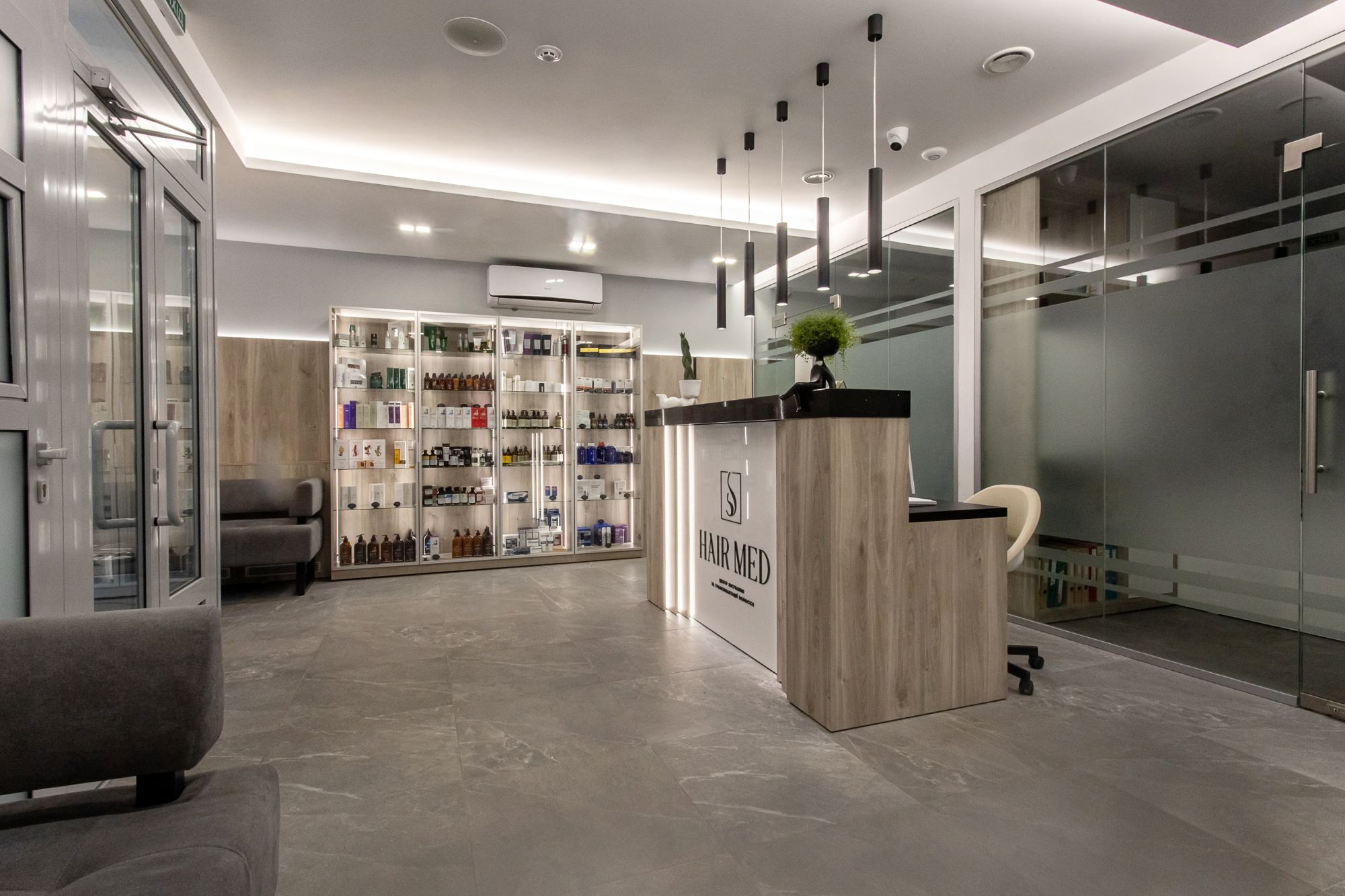
📍 Dnipro, Ukraine
A hair treatment and transplant centre in Dnipro: 430 m², two surgical zones, an SMP room and its own HairHub. Transplants are performed by Ivan Baranov, PhD (member of ISHRS and the World FUE Institute) and transplant surgeon Svitlana Nedbailo. Therapy is led by a team of trichologists and dermatologists.
It is one process of differing severity, not two separate diagnoses. Dandruff is the term used when there is flaking and sometimes itching, but the skin under the scales is not red and the process does not spread beyond the hair-bearing part of the scalp. Seborrhoeic dermatitis is diagnosed when inflammation is added: the skin reddens, the scales become greasy and yellowish, and patches appear beyond the hairline.
The practical difference is that for dandruff a shampoo with zinc pyrithione or ketoconazole is often enough, while dermatitis needs a regimen with an anti-inflammatory component and a follow-up examination after four weeks.
At the clinics MediUkraine works with, a dermatovenereologist consultation with trichoscopy costs from USD 31. A follow-up examination after the course is from USD 27. For comparison, a consultation starts from around USD 50 in the Czech Republic and from USD 40 in Turkey. Medicines are bought separately at a pharmacy. Confirm the final cost with the clinic.
Seborrhoea itself rarely leads to permanent baldness: it does not destroy the follicles. However, itching, scratching and chronic inflammation of the skin increase the amount of hair that falls out and make the hair shafts more brittle, so during a flare-up the loss really is more noticeable. Once the inflammation is relieved, shedding usually decreases within a few weeks.
If the thinning persists, the cause is something else and is investigated separately: seborrhoea and hereditary thinning often simply coincide in time. At the same time, while the skin is inflamed, hair loss treatment works less well, so treatment starts with controlling the inflammation.
They look similar, so the diagnosis is made from details seen under magnification. In psoriasis the scales are dense and silvery-white, the plaques have a clear edge and often extend beyond the hairline onto the forehead or neck, and there may be accompanying changes on the elbows, knees or nails. In seborrhoeic dermatitis the scales are greasier and yellowish, and the edge is blurred.
It is also confused with two other conditions: atopic dermatitis and a contact reaction to hair dye, which begins a few days after dyeing and often affects the skin behind the ears and the neck. The treatment regimens for all four are different, so picking a product off the pharmacy shelf because the symptoms look similar usually just wastes time.
No, and an honest answer is more useful here than promises. It is a chronic relapsing condition linked to the skin's reaction to its own sebum and to the yeast-like fungi that live on everyone's skin. Treatment controls the process well, and the skin stays calm for weeks and months, but the predisposition does not go away, and with stress, a cold or a change of season the flaking returns.
That is why, after the attack stage, a maintenance regimen with less frequent use of the products is prescribed rather than stopping completely. That is the realistic goal of treatment: long-term remission with minimal treatment.
Apply it to the scalp, not along the length of the hair, spread it with your fingertips and leave it on for 3–5 minutes before rinsing: that is the time the active ingredient needs to work. In the attack regimen this is usually two to three times a week for two to four weeks, then once a week or twice a month for maintenance.
Between medicated washes you can wash your hair with an ordinary mild shampoo even daily: frequent washing does not increase flaking, but removes the sebum and scales that feed the process.
Do not increase the frequency or buy a fifth bottle; see a doctor instead. There are usually three reasons for failure: the product is rinsed off immediately and the ingredient has no time to work; the course is stopped once the scales disappear, without a maintenance stage; or the diagnosis is different, such as psoriasis, fungal infection, or atopic or contact dermatitis.
At the appointment the scalp is examined under magnification, a scraping is taken where indicated, and the regimen is changed: a different active ingredient, a short course of an anti-inflammatory product, a calcineurin inhibitor for the face or, on specific indications, a systemic medicine.
Tell us what you need: we will suggest a clinic and a doctor and send you a cost estimate.
Request a consultation →