| Service | 🇺🇦 Ukraine | 🇨🇿 Czech Republic | 🇹🇷 Turkey |
|---|---|---|---|
| Curettage (1 tooth) | from USD 13 | from USD 14 | from USD 39 |
| Advanced hygiene under a microscope | from USD 59 | — | — |
| Periodontist consultation | from USD 18 | — | — |
Prices in the “Ukraine” column come from MediUkraine’s partner clinics. The Czech Republic and Turkey columns show the lower bounds of prices published by clinics there (for Turkey, also the Turkish Dental Association’s recommended 2026 tariff), collected in August 2026 and converted to US dollars at the rate on the day of collection. A dash means we could not find a comparable published price. In any country, the final cost is set by the clinic after an examination.
Between the gum and the tooth there is a shallow groove of 1–3 mm. When plaque mineralises and moves below the gum, the ligament and the bone around the root break down, the groove deepens and turns into a periodontal pocket. From 4 mm a toothbrush can no longer reach into it, and the bacterial film on the root keeps the inflammation going.
Curettage is the mechanical cleaning of the root surface inside such a pocket. The dentist removes subgingival tartar and biofilm, smooths the root and removes granulation tissue, the soft inflamed tissue that fills the pocket. Clinical protocols describe this work as scaling and root planing, while Ukrainian clinics traditionally call it "curettage".
The indications for the procedure are a pocket of 4 mm or more with bleeding on probing, subgingival tartar on an X-ray, persistent bad breath, exposed tooth necks and increased tooth mobility. The scope depends on the periodontal chart, not on symptoms: one tooth may be bothering you, yet pockets turn up around eight, with the deepest ones where nothing hurt.
Who does not need curettage? In gingivitis, when the gums bleed but there are no pockets, professional hygiene and a good home cleaning routine are enough: there is nowhere for the instrument to go below the gum. Nor is it performed as a separate "scraping of the gum from the inside": removing the pocket lining brings no additional benefit and has been dropped from the protocols. For pockets of 6 mm and deeper, closed treatment is usually not enough, and there is no point treating teeth with grade III mobility and loss of most of their support: these are discussed with a view to extraction.
MediUkraine helps patients find and arrange treatment; it is not a clinic. We select the clinic and a dentist with the right specialisation, agree visit dates and support patients throughout, including those travelling from abroad. The scope of treatment and the timelines are determined by the dentist after an examination and measurement of the pockets. The treatment of periodontitis as a whole is a broader topic with several stages; this page covers only the pocket-cleaning procedure.

Travel. Ukrainian airspace is closed, so there are no commercial flights. Patients reach Lviv overland, most often from Poland: Rzeszów and Kraków airports are the usual entry points, with a train, bus or private transfer onward to the border and on to the city. Lviv is roughly 70 km from the Polish border, the shortest crossing of any Ukrainian city.
Visas. Citizens of the EU, the United Kingdom and the United States do not need a visa for short stays in Ukraine. Rules depend on your citizenship, so check your own before booking.
Safety, plainly. Ukraine is at war. Air raid alerts occur in Lviv, and an appointment can be interrupted by one. Several governments advise against travel to Ukraine, and while that advice stands, ordinary travel and medical insurance is often void — confirm your cover with your insurer before you commit to anything.
Language. MediUkraine handles correspondence, scheduling, the written treatment plan and the quote in English. The clinic's team communicates with international patients in English.
Payment. You pay the clinic directly. Our coordination service is free of charge for you.
More on travel, safety and insurance: Safety and travel.
The single word "curettage" covers two quite different procedures. Closed curettage is done without an incision: the instrument is inserted into the pocket through its opening, and the dentist works by feel. Open curettage is a minor surgical procedure: the gum is lifted as a flap, the root is cleaned under direct vision and the wound is sutured. The choice depends not on preference but on the pocket depth measured with the probe.
The criterion is numerical. Up to 3 mm is a healthy groove, and there is no need to go into it with an instrument. Pockets of 4–5 mm clean well by the closed method: at this depth the dentist removes deposits from most of the root surface. From 6 mm the share of areas missed rises sharply, and where the roots of back teeth divide, the surface can rarely be cleaned fully by working blind. Deeper pockets are therefore either treated by the open method from the start, or treated closed first, with the question revisited after the control measurement.
Closed curettage is done under local anaesthesia: infiltration in the upper jaw, a nerve block in the lower. First the bulk of the subgingival tartar is broken down with an ultrasonic tip under constant irrigation, then the dentist moves on to Gracey hand curettes. A curette has one working edge and a bend designed for a specific tooth surface: there are different numbers for the front teeth and for the cheek and tongue surfaces of the back teeth. The dentist draws the instrument from the base of the pocket towards the gum margin in overlapping strokes until the root surface feels smooth.
The term root planing means smoothing the root surface, not scraping the cementum down to the dentine. In the past the root was treated aggressively, on the assumption that all of the cementum was infected; today the aim is different: to remove the biofilm and tartar while preserving the root tissue. Over-instrumentation increases sensitivity, thins the root and brings no benefit. That is why protocols increasingly use a more neutral name for this part of the work: subgingival instrumentation.
The work is divided in one of two ways. The classic approach is by quadrants or sextants: 2–4 visits a week or two apart, each lasting 40–90 minutes. The alternative is treating the whole mouth in one or two days, so that areas already cleaned are not recolonised by bacteria from untreated ones. Clinical comparisons show no substantial difference in outcome between these approaches, so the choice is made for convenience: for a patient on a short visit, the compact option is usually more practical.
Open curettage is needed where the closed method cannot reach. Under anaesthesia the gum is lifted with a small flap, residual tartar and granulation tissue are removed under direct vision, an uneven bone edge is smoothed, the wound is rinsed and sutures are placed; they are removed after 7–10 days. Be aware of the consequence in advance: after healing the gum sits lower than before, the necks of the teeth are exposed, gaps appear between them, and there can be sensitivity to cold. This is an expected result of the procedure, not a complication: the pocket has gone because the gum margin has moved down to the bone.
Understanding how a pocket heals helps keep expectations realistic. After closed treatment the gum attaches to the clean root by a long junctional epithelium: tightly, but not in the way it did before the disease. The lost bone does not come back: the pocket becomes shallower because the swelling subsides and the gum margin tightens, not because new support forms. The average reduction in depth after closed treatment is about 1 mm for initial pockets of 4–6 mm and up to 2 mm for deeper pockets, and these are group averages, not a promise for any individual patient.
Adjunctive techniques work only on top of mechanical cleaning. Antiseptic chlorhexidine irrigation is prescribed as a short course after the procedure; local antibiotics in the form of a gel or chip are placed in individual pockets that have not responded to treatment. Systemic antibiotics are reserved for aggressive forms in young people, abscesses and necrotising processes: prescribed instead of curettage, they give a short-lived effect followed by a return of inflammation, because the biofilm on the root stays where it is. Lasers and photodynamic therapy are offered as add-ons, but systematic reviews do not show a convincing gain over standard treatment, so they are not worth paying for as the main treatment.
The main point about the limits of the method: curettage removes the consequence, not the cause. Biofilm on a cleaned root begins to re-form within 24–48 hours and regains its previous aggressiveness within a few weeks. Without daily cleaning between the teeth with an interdental brush or floss, the pocket returns to its initial depth within a few months, and repeat treatment will change nothing: the process will simply start over. That is why hygiene instruction and checking its quality at every subsequent visit are not an extra to the procedure but part of it.
The result is also affected by things that have nothing to do with instruments. Smoking constricts the blood vessels of the gum, masks bleeding and markedly hinders the closing of pockets; uncontrolled diabetes slows healing. Overhanging filling margins, ill-fitting crowns and tartar under a bridge trap plaque however well you clean, so they are corrected before treatment or straight after it. Only a dentist can forecast the result for a particular patient after assessing the chart, the X-rays and other contributing factors.
The anaesthetic wears off within 2–4 hours, and during this time you should not eat anything or have hot drinks: it is easy to bite your lip or cheek. For the first two days the gums can be tender, with possible slight bleeding when brushing and a feeling of tightness. A painkiller is usually needed only on the first evening, and a non-steroidal painkiller other than aspirin is better, because aspirin increases bleeding.
Brush your teeth from the very first day, with a soft brush and gently in the treated areas. Chlorhexidine rinses are prescribed as a short course of up to two weeks: longer is not advisable, because it stains the teeth and alters taste. It is best to avoid hard, spicy and very hot food for the first two or three days. After open surgery, follow this regimen for longer and do not brush the sutured area until the sutures are removed.
Sensitivity of the tooth necks to cold is the most common complaint after the procedure. It appears because the layer of deposits that covered the root has been removed, and it usually fades gradually over a few weeks. Toothpastes with potassium nitrate or stannous fluoride and fluoride varnish applied at the clinic help; if the sensitivity has not eased after two months, tell your dentist.
Along with sensitivity comes a visible change: swollen gums shrink, the teeth look longer and gaps open up between them. This is not a side effect but the very pocket reduction the treatment aims for. Patients are often more upset by this appearance than by pain, so the dentist warns about it before the procedure, not after.
There is no point assessing the result earlier than 6–8 weeks later: that is how long the remodelling of tissue after treatment takes. At the follow-up visit the dentist repeats the measurement with the same probe at the same points and looks at two indicators: pocket depth and bleeding on probing. The absence of bleeding means the inflammation has settled, and it is a more reliable criterion than the millimetres themselves.
Three scenarios are then possible. Pockets of up to 4 mm without bleeding: the patient moves into a maintenance programme. Residual pockets of 5 mm with bleeding: repeat treatment of the area or a review of home hygiene. Pockets of 6 mm and deeper that have not changed: a reason to discuss open surgery. If there is no improvement anywhere, the dentist looks for the cause in other health conditions and daily care rather than repeating the same course.
Step 1. Measurement and plan. The dentist fills in the periodontal chart: goes round each tooth, measures the depth at six points and records bleeding, recession and mobility. The bone level is assessed from X-rays. From this, the dentist lists the teeth that need treatment and decides where closed curettage will be enough and where open curettage will be needed.
Step 2. Anaesthesia and cleaning of the pockets. The segment is anaesthetised, then the bulk of the subgingival tartar is removed with an ultrasonic tip, and the root surface is smoothed with Gracey hand curettes. The dentist treats each tooth in the segment all the way round, including the surfaces facing its neighbours, and irrigates the pocket with an antiseptic solution. This is the part of the work that is charged per tooth.
In total, one segment takes from 40 minutes to 1.5 hours, and the whole closed treatment from one to four visits depending on the number of teeth with pockets. The control measurement comes 6–8 weeks after the last session; before it come the probe check of root smoothness, interdental brush selection and training, and treatment of the remaining quadrants. No hospital admission is needed: after a session the patient goes home and returns to their usual routine the same day.
Curettage is not a one-off procedure with a completion date but a stage in a cycle. The cycle consists of preparation, an active phase, a control measurement and a maintenance programme, and it is the last of these that decides whether the result will last. This is what distinguishes work on pockets from a filling or a crown, where there is a clear finish.
Preparation takes 1–2 weeks: consultation, X-rays, periodontal charting, professional hygiene and training in home care. The active phase is the treatment sessions themselves, from one to four visits over two to four weeks. Then comes a pause for healing, during which nothing is done: the tissues need time to remodel.
6–8 weeks after the last session the dentist repeats the measurement, and this is the turning point of the cycle. Areas that have come down to 4 mm without bleeding move into monitoring. Where deep pockets remain, the work continues: localised repeat treatment or open surgery with its own healing period of around three months.
The maintenance phase has no end date, and its interval depends on risk, not the calendar. Smokers, patients with diabetes and those with remaining pockets of 5 mm or more are seen every three months. Those whose condition is stable and whose hygiene is good are seen every six months. A missed year of maintenance visits usually brings pockets back to their initial figures, and the cycle starts again.
A maintenance visit is not just a cleaning. The dentist measures the problem areas, removes deposits above and below the gum, checks how you are managing with the interdental brushes and re-treats individual pockets if needed. A full chart is filled in once a year, and X-rays are repeated every few years. Flare-ups happen even with disciplined care: this is a normal part of a chronic process, not a failure of treatment.
Curettage is an invasive procedure, and it always has some expected after-effects: sensitivity of the tooth necks to cold for several weeks, gum shrinkage exposing the necks of the teeth and opening gaps, slight bleeding for the first two days, and a temporary increase in tooth mobility that passes within one to two weeks. The dentist warns about each of these points before the procedure, because otherwise they can look like a setback.
Rarer complications are a periodontal abscess, when drainage from the pocket has closed but the infection remains inside; prolonged bleeding in patients on anticoagulants; and injury to the gum from an instrument. An abscess shows itself as throbbing pain, swelling and a raised temperature a few days after a session, and needs to be examined within hours rather than left until the scheduled visit.
During pocket treatment bacteria enter the bloodstream: this is a transient bacteraemia that poses no threat to most people. It matters for patients with prosthetic heart valves, a history of infective endocarditis and certain congenital heart defects: under current guidelines they are prescribed an antibiotic an hour before the procedure.
There are few permanent contraindications; most restrictions are temporary. The procedure is postponed in the case of an acute respiratory infection, a flare-up of cold sores, uncontrolled diabetes with high glycated haemoglobin, unstable angina, and for six months after a heart attack or stroke. During pregnancy, planned sessions are best done in the second trimester, although emergency care is provided at any stage.
Particular caution is needed for patients taking bisphosphonates or denosumab for osteoporosis or cancer. Closed pocket treatment is not forbidden for them and is in fact desirable: inflammation in a pocket raises the risk of osteonecrosis of the jaw more than careful cleaning of the root does. Open surgery and tooth extractions in these patients, however, are planned together with the doctor who prescribed the medicine. A history of radiotherapy to the jaw area is also a reason to agree the scope in advance.
There are also situations where the procedure is technically possible but pointless. A tooth with grade III mobility, loss of most of its support and repeated abscesses is not worth treating: it is discussed with a view to extraction, because it sustains inflammation in its neighbours. Likewise, treatment will not work if you keep smoking or skip daily cleaning between the teeth: the pocket will come back, and the time and money will have been wasted. An honest conversation about this before starting is part of the treatment plan.
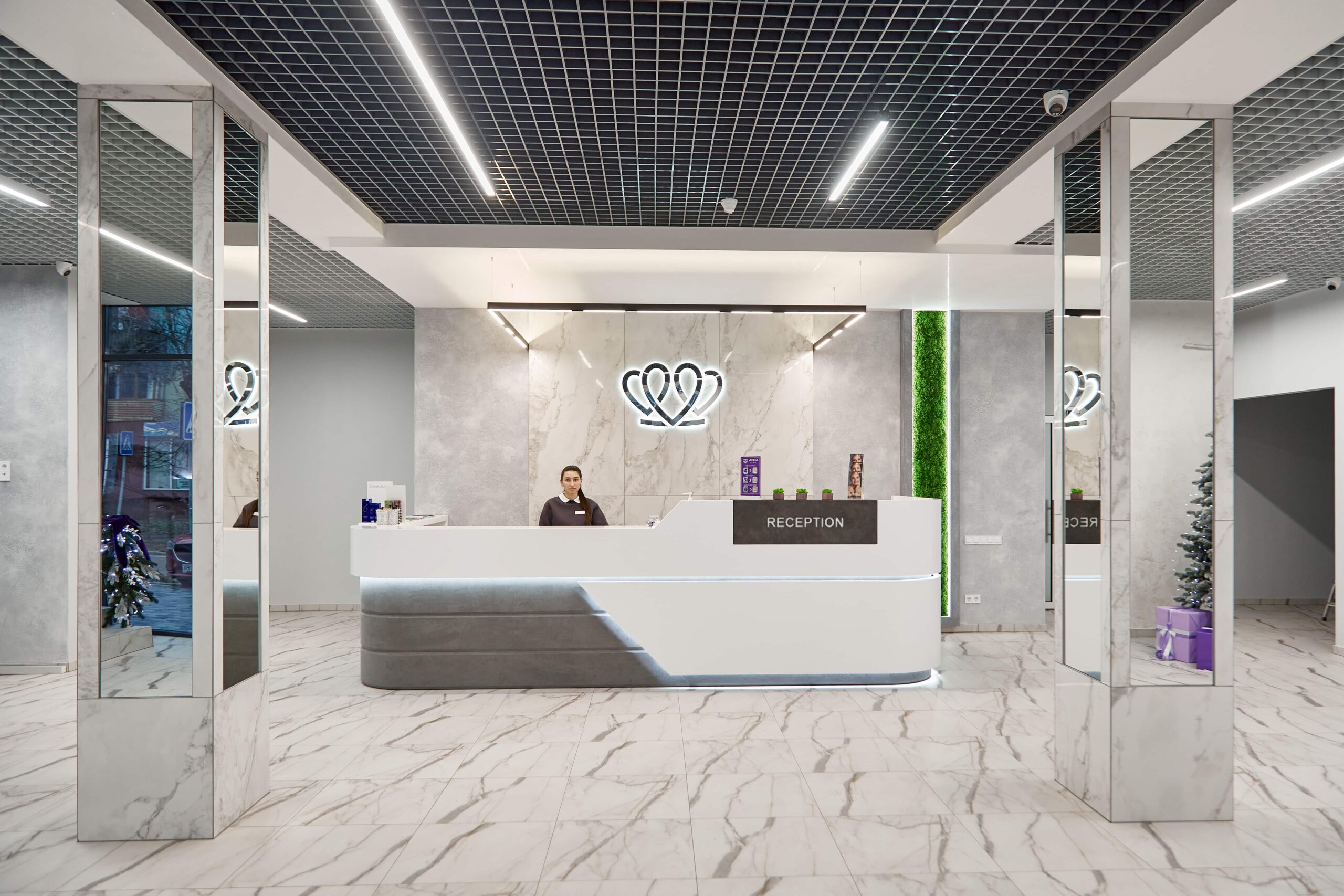
📍 Lviv, Ukraine
A dental clinic in Lviv with a separate doctor for each field: oral surgery and implants, prosthodontics, restorative dentistry, endodontics under a microscope, periodontics, orthodontics and paediatric dentistry.
Closed curettage is done without an incision: the instrument is inserted into the pocket through its opening, and the dentist works by feel. It is indicated for depths of 4–5 mm. Open curettage is a minor operation: the gum is lifted as a flap, the root is cleaned under direct vision, and sutures are placed and removed after 7–10 days. It is chosen for pockets of 6 mm or more, where the root surface can rarely be cleaned fully by working blind. The decision is made on the figures in the periodontal chart, not on complaints.
At MediUkraine's partner clinic curettage is charged per tooth, from USD 13, so the total depends on how many teeth have pockets. Charged separately: a periodontist consultation (including periodontal charting) from USD 18 and advanced hygiene under a microscope from USD 59. Some clinics charge separately for X-rays and anaesthesia. The clinic sets the final cost after an examination and measurement, so the quote is drawn up once the chart is complete.
The procedure itself is done under local anaesthesia, so there is no pain during the session: you feel pressure and the vibration of the ultrasonic tip. Discomfort starts later: on the first evening the gums ache, and a single non-steroidal painkiller is usually enough. Over the next few weeks the tooth necks may be sensitive to cold. If the pain increases a few days after a session and comes with swelling and a temperature, contact the clinic the same day.
The work is divided by quadrants or sextants, so most often it means 2–4 sessions of 40–90 minutes a week or two apart. For patients who have come for a short stay, the whole mouth can be treated in one or two days. Before the active phase a consultation, periodontal charting and professional hygiene are needed, which is another one or two visits. A control measurement is carried out 6–8 weeks after the last session, and this marks the end of the active phase.
Yes, if daily care does not change. The bacterial film on a cleaned root starts to re-form within 24–48 hours, and without cleaning between the teeth with an interdental brush or floss, the pocket returns to its initial depth within a few months. The second factor is maintenance visits: they are scheduled every three to six months depending on risk, and a missed year usually undoes the result. Smoking and uncontrolled diabetes worsen the outlook regardless of the quality of treatment.
Bone lost to periodontitis does not regenerate after curettage. The pocket becomes shallower because the swelling subsides and the gum margin tightens against the bone, while the cleaned root is covered by a long junctional epithelium: a tight attachment, but not the same as before the disease. That is why after treatment the gums usually sit lower rather than rising, and the necks of the teeth become exposed. Regenerating some support in narrow bone defects requires other techniques, and they are not suitable for everyone.
For the first two hours, while the anaesthetic is working, do not eat anything or have hot drinks. Brush your teeth from the first day, with a soft brush and gently in the treated areas; chlorhexidine rinses are prescribed as a short course of up to two weeks. It is best to avoid hard, spicy and hot food for two or three days. After open surgery, do not brush the sutured area until the sutures are removed. Slight bleeding for the first two days is expected, but swelling with a temperature a few days later is a reason to phone your dentist.
Tell us what you need: we will suggest a clinic and a doctor and send you a cost estimate.
Request a consultation →