| Service | 🇺🇦 Ukraine | 🇨🇿 Czech Republic | 🇹🇷 Turkey |
|---|---|---|---|
| Premium zirconia crown | from USD 282 | from USD 298 | from USD 225 |
| Ceramic crown | from USD 280 | from USD 476 | from USD 300 |
| Dentist consultation | from USD 8 | from USD 38 | from USD 34 |
Prices in the “Ukraine” column come from MediUkraine’s partner clinics. The Czech Republic and Turkey columns show the lower bounds of prices published by clinics there (for Turkey, also the Turkish Dental Association’s recommended 2026 tariff), collected in August 2026 and converted to US dollars at the rate on the day of collection. A dash means we could not find a comparable published price. In any country, the final cost is set by the clinic after an examination.
It is an all-ceramic restoration made of zirconium dioxide stabilised with yttrium oxide. There is no metal in it at all, so there is none of the dark line at the gum that metal-ceramic crowns tend to develop over the years. The restoration is milled from a pre-sintered block and then sintered in a furnace, shrinking by roughly a quarter to its planned dimensions.
The material's key property is its high flexural strength. Classic zirconia withstands around 1,000–1,200 MPa, compared with around 400 MPa for lithium disilicate glass ceramic. In practice this means two things: the restoration can be made thinner and less tissue removed from the tooth, and it can span a long gap where pressed ceramic would fail under load.
The indications fall into three groups. The first is back teeth, where biting forces are highest, and patients who clench their teeth. The second is bridges, including long-span ones, and frameworks on several supports. The third is a darkened tooth stump, metal post or titanium abutment under the restoration: the dense material masks the grey.
Zirconia is not always suitable. If the tooth is vital, its walls are intact and the damage is limited to the chewing surface with one or two cusps, a ceramic onlay is often more appropriate: for a crown the tooth is reduced on all sides, and less of its own tissue remains. In the smile zone, on a light-coloured vital tooth stump, lithium disilicate often looks more natural than monolithic zirconia. Prosthetic treatment is postponed with active caries, gum inflammation, untreated apical periodontitis and marked tooth mobility, and if almost no hard tissue is left above the gum, the first decision is whether the tooth can be saved at all.
MediUkraine helps patients find and arrange treatment; it is not a clinic. We select the clinic and the prosthodontist, agree visit dates and support patients throughout, including those travelling from abroad. The doctor chooses the material and design for each tooth after an examination and an X-ray.

Travel. Ukrainian airspace is closed, so there are no commercial flights. Patients reach Lviv overland, most often from Poland: Rzeszów and Kraków airports are the usual entry points, with a train, bus or private transfer onward to the border and on to the city. Lviv is roughly 70 km from the Polish border, the shortest crossing of any Ukrainian city.
Visas. Citizens of the EU, the United Kingdom and the United States do not need a visa for short stays in Ukraine. Rules depend on your citizenship, so check your own before booking.
Safety, plainly. Ukraine is at war. Air raid alerts occur in Lviv, and an appointment can be interrupted by one. Several governments advise against travel to Ukraine, and while that advice stands, ordinary travel and medical insurance is often void — confirm your cover with your insurer before you commit to anything.
Language. MediUkraine handles correspondence, scheduling, the written treatment plan and the quote in English. The clinic's team communicates with international patients in English.
Payment. You pay the clinic directly. Our coordination service is free of charge for you.
More on travel, safety and insurance: Safety and travel.
Zirconium dioxide in its pure form is not suitable for dentistry: on cooling it changes its crystal structure and cracks. That is why yttrium oxide is added to the blank, holding the material in the tetragonal phase at room temperature. Hence the designations 3Y, 4Y and 5Y: this is the approximate content of yttrium oxide in mole percent, and the higher it is, the more cubic phase there is in the structure.
This material has a special strengthening mechanism. When stress arises near a microcrack, the tetragonal grains transform into the monoclinic phase and expand slightly in volume, compressing the crack and stopping it from growing. The cubic phase lacks this ability but lets light through: its grains are optically isotropic and scatter light less at their boundaries. Hence the main trade-off: more translucency means less strength, and vice versa.
In numbers: classic 3Y-TZP gives a flexural strength of around 1,000–1,200 MPa with the lowest translucency; it is used on back teeth, for long-span bridges and for patients who clench hard. 4Y withstands roughly 700–900 MPa and is suitable for premolars and short bridges in the back of the mouth. 5Y is the most translucent, around 550–650 MPa, and is meant for single crowns and onlays in the smile zone, not heavy chewing loads. Exact values differ between manufacturers, so the doctor goes by the data sheet of the specific blank rather than the general name of the generation.
A separate category is multilayer blanks with a gradient of colour and composition. These shift gradually from a denser, more saturated base at the neck of the tooth to a more translucent incisal edge, mirroring the structure of a natural tooth. Such a block offers a compromise without veneering, but requires the technician to position the future crown correctly within the blank: if the orientation is off, the colour transition will fall in the wrong place.
Monolithic work is milled entirely from a single block: the chewing surface, the walls and the margin are all one material. It is coloured by immersion in dye solutions before sintering, characterised on the surface if needed and glazed. The main advantage is obvious: there is nothing to chip, because such a restoration simply has no separate veneering layer that could delaminate.
Veneered work is built differently: only the framework is milled from zirconia, and the technician applies feldspathic ceramic on top layer by layer and fires it. This offers the most scope for shade, translucency of the incisal edge and internal effects, which is why such work remains common in the smile zone. The downside is chipping of the veneer, the most common mechanical complication of this design. A compromise option: the chewing surface is left monolithic, and ceramic is applied only to the facial side.
The comparison with pressed glass ceramic comes down to a few specific situations. Zirconia wins where strength is needed at small thickness: a monolithic crown is made about 0.5–1 mm thick on the chewing surface, whereas lithium disilicate needs at least 1–1.5 mm, and therefore more removal of healthy tooth tissue. It wins on bridges, where glass ceramic is not used because of the risk of fracture at the connector. It wins on a darkened stump, over a metal post and on a titanium abutment, where a translucent material would show greyness. And it wins with bruxism, where veneering layers and glass ceramic chip sooner.
Zirconia loses on the aesthetics of a single front tooth on a light-coloured vital stump. Natural enamel is opalescent: with light shining through it has a bluish tint, in reflected light a warm one. Monolithic zirconia conveys this play less well, and next to the neighbouring natural teeth the work can look dense and flat. Lithium disilicate is closer to enamel optically, and with adhesive cementation some of the light passes through the crown into the tooth tissue, which a dense framework does not allow. That is why, when a single central incisor is restored next to a healthy one, the choice often falls on glass ceramic, a more translucent generation of zirconia or a veneered framework.
Zirconia also needs its own cementation protocol, and the details matter. Hydrofluoric acid has no effect on it and silane does not work, so the surface is sandblasted with aluminium oxide at low pressure and a primer with the phosphate monomer MDP is used. The cement can be glass ionomer, composite or adhesive: with sufficient stump height and normal retention, zirconia does not require adhesive bonding, unlike lithium disilicate, which does not work without it. Polishing matters too: a polished zirconia surface wears the opposing tooth less than a glazed one, whereas a rough surface after adjustment with a bur in the chair does the opposite, so any adjustment of the bite is finished by polishing with a special kit.
Studies show good longevity: most monolithic zirconium dioxide restorations last more than ten years, and the reason for replacement is usually not a fracture of the restoration but secondary caries at the margin, loss of cementation or problems with the root underneath. But the method has limits. A crown does not treat a tooth but covers it: under it there remains a living pulp that can become inflamed, or a filled canal that may make itself felt years later. It does not correct the position of teeth: that is the task of orthodontics, and straightening teeth with crowns costs healthy tissue. And it does not save a tooth that has almost no support left above the gum: the strength of the material does not compensate for the absence of tissue. Only a doctor, after an examination, can forecast the result for a particular patient.
In the first days after preparation a vital tooth may react to cold and pressure: this is an expected reaction of the exposed dentine, which usually fades within one to two weeks. The temporary crown needs care: do not chew hard and sticky food with it, and pull floss out sideways next to it rather than upwards, so as not to dislodge the restoration.
After final fitting do not eat for the first two hours, and avoid hard food for a day while the cement reaches full strength. Mild sensitivity in the first days can occur here too. If it increases, or pain on biting appears, that is a reason to come for a check rather than wait.
The bite is checked right away in the chair, but you only get a full sense of it after a few days. Zirconia is harder than enamel and does not wear down during chewing, so a high contact will not "wear in" over time, as can happen with temporary plastic. If the crown gets in the way when you close, the tooth aches or discomfort appears in the jaw joint, an adjustment with articulating paper is needed, always followed by polishing.
The gums around the crown settle into shape within two to four weeks. Slight bleeding in the first days after the impression and the fitting can happen, but persistent inflammation, swelling or an unpleasant smell are not normal and need a check. The aesthetics are finally judged after the gums have healed, once the contour has stabilised.
A follow-up check is usually scheduled after one to two weeks, then every six months together with professional hygiene. At it the doctor checks the crown margin, the condition of the gums and the occlusion, and takes an X-ray where indicated. A root-treated tooth under a dense restoration can develop inflammation at the root tip without pain, and this can be seen only on an X-ray.
The tooth under the crown can still develop problems, so daily cleaning between the teeth matters more than it seems: the toothbrush does not reach there. For patients from abroad, MediUkraine sends you the X-rays, the product passport with the name of the blank and the treatment report, so that follow-up checks can be done at home and the doctor where you live understands what material they are dealing with.
Step 1. Examination, X-ray and plan. The doctor assesses how much hard tissue has survived, whether the tooth is vital, and the condition of the canals and the bone around the root. This is where the main decisions are made: zirconia or glass ceramic, monolithic work or a veneered framework, a single crown or a bridge, and which generation of blank suits this tooth. You see the X-ray and receive a quote broken down by stage.
Step 2. Preparing the tooth. The old filling or crown is removed, affected tissue is cleared and, where indicated, the canals are treated. If too few walls remain, the tooth is rebuilt with a post and core or a post, which is a separate visit. Without this stage the restoration has nothing to hold on to, and no strength of material compensates for the lack of support.
In total, prosthetic treatment of one tooth fits into two to three visits of 40–60 minutes. Preparation and fitting are 1–2 weeks apart: during this time the tooth is covered with a temporary crown, the laboratory mills and sinters the work, and at the try-in the doctor checks the fit of the margin, the shade and the bite. Anaesthesia is needed only at the reduction stage, no hospital stay is needed at all, and after each visit you can return to your usual activities.
The cycle begins with diagnostics and ends not with the fitting but with a follow-up check. From the first appointment to the finished crown usually takes two to six weeks, depending on whether root canal treatment is needed and how many units are in the plan.
The shortest scenario is a vital tooth without complications: consultation, preparation, fitting 1–2 weeks later. If endodontic treatment is needed, one or two visits are added along with a pause for observation: after the canals have been filled, the prosthetic stage is sometimes deliberately postponed for a few weeks to make sure the tooth has settled.
A bridge lengthens the cycle. The abutment teeth are prepared in one visit, but the framework try-in is usually done separately: this confirms that the framework fits all the abutments evenly, because a distorted framework will not seat properly later. Work on an implant is tied to the healing timeline, and the abutment and crown are placed only after it.
Part of the work can be moved outside the trip: a consultation based on existing X-rays is held remotely, the plan and the quote are agreed in advance, and only the clinical stages remain on site. This way, a patient from abroad arrives knowing which procedures are planned and how long they will take.
After fitting, the cycle moves into monitoring: a check after one to two weeks, then every six months with professional hygiene and a bite check. At some point the work will need replacing, and this is a normal part of the cycle, not the result of a mistake: the reasons are secondary caries at the margin, gum recession exposing the margin, or a change in the situation of the neighbouring teeth.
The most common complication after prosthetic treatment of a vital tooth is pulp inflammation. Preparation is traumatic for the tissues: some teeth react with persistent sensitivity, and a small percentage later need root canal treatment under the finished crown. That is why the doctor tests pulp vitality beforehand and uses cooling and pauses during reduction.
Mechanical complications differ between the two designs. A monolithic crown rarely cracks, while the veneering ceramic on a framework chips noticeably more often, and this is the main complication of veneered work. The second scenario is loss of cementation, which occurs more often on short stumps with little retention. The main risk factor in both cases is bruxism or habitual clenching, so a protective night guard is discussed before the restoration is made.
There are complications specific to this material. A rough, unpolished surface after a bite adjustment with a bur wears the opposing tooth faster than a polished one, so adjustment is always finished with polishing. A cemented zirconia crown is practically impossible to remove without destroying it: it is cut off, and this takes longer than with glass ceramic. The ageing of zirconia in a moist environment with a gradual loss of strength, described in the literature, concerns mainly early generations of the material, but it is one more argument in favour of a blank with a known data sheet rather than an unnamed block.
Biological complications develop slowly and quietly. Secondary caries starts at the junction between crown and tooth, where plaque accumulates; gum recession exposes the margin of the restoration over the years; a root-treated tooth can develop inflammation at the root tip without pain. That is why six-monthly check-ups, with X-rays where indicated, really matter.
Contraindications are mostly temporary. Prosthetic treatment is postponed with active caries, inflammation of the gums and periodontium, untreated apical periodontitis and poor hygiene. Permanent limitations concern teeth with marked mobility and those with almost no hard tissue left above the gum: first it is decided whether such a tooth can be saved, and only then is a crown discussed. The space to the opposing tooth is assessed separately: if there is not enough room for the restoration, orthodontic preparation or a change of plan is needed.
Tell the doctor about your general health before work begins: about pregnancy, clotting disorders, anticoagulant or bisphosphonate use, allergy to anaesthetics or latex. Planned prosthetic stages during pregnancy are usually postponed, with care limited to emergencies. You have the right to a second opinion: the X-rays, the treatment plan and the quote stay with you, and you can show them to another specialist before the tooth is reduced, because this step is irreversible. If after fitting there is pain on biting, a chip, movement of the restoration or a smell from under the margin, contact the clinic straight away rather than waiting for a scheduled check-up.
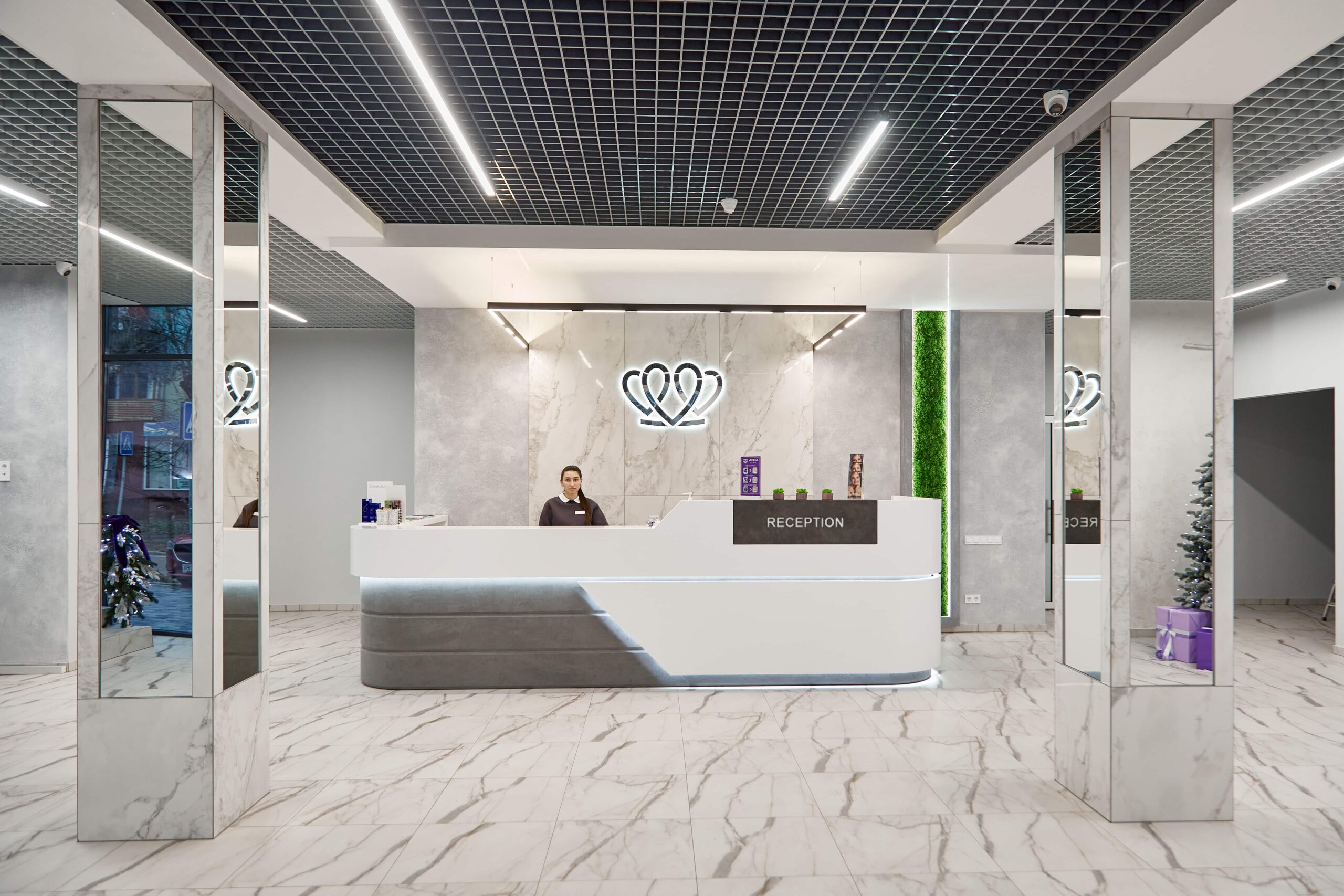
📍 Lviv, Ukraine
A dental clinic in Lviv with a separate doctor for each field: oral surgery and implants, prosthodontics, restorative dentistry, endodontics under a microscope, periodontics, orthodontics and paediatric dentistry.
The difference is in the material and in what can be made from it. Classic zirconium dioxide withstands around 1,000–1,200 MPa in flexure, lithium disilicate glass ceramic around 400 MPa. That is why zirconia is used on back teeth, on bridges and on darkened stumps, where density and a thin restoration are needed. Glass ceramic wins on optics: it is closer to natural enamel and in the smile zone often looks more natural. The choice for a particular tooth is made by the doctor after an examination and shade matching.
At MediUkraine's partner clinic a premium zirconia crown costs from USD 282 a ceramic crown from USD 280, and a dentist consultation from USD 8. Preparing the tooth is charged separately: hygiene, treatment of caries and canals, a post and core, X-rays. It is this part that changes the total most, so the quote is drawn up after an examination. Prices are a guide; the clinic's doctor confirms the final cost.
They are the approximate content, in mole percent, of yttrium oxide, the additive that stabilises the structure of the material. The more of it there is, the more cubic phase the zirconia has: it lets light through better but does not take part in the mechanism that stops microcracks. That is why 3Y gives around 1,000–1,200 MPa with the lowest translucency, 4Y roughly 700–900 MPa, and 5Y around 550–650 MPa with the highest translucency. Values differ between manufacturers, so the doctor goes by the data sheet of the specific blank, not just the name of the generation.
That depends on the design. Monolithic work, milled entirely from one block, has nothing to chip: it has no separate veneering layer, and cracks are rare. In a restoration with a framework and layered ceramic, chipping of the veneer is the most common mechanical complication. That is why for back teeth and with bruxism the monolithic option is chosen more often, with ceramic left only on the facial side. A protective night guard noticeably reduces the risk.
The material is hard, but what matters is not hardness itself but surface quality. Polished zirconia wears the opposing tooth less than glazed zirconia, and much less than a rough surface after adjustment with a bur. That is why any adjustment of the bite in the chair must be finished by polishing with a special kit. The second factor is occlusion: an overloaded contact wears the opposing tooth faster than any material, so the bite is checked both at the fitting and at the follow-up check.
According to studies, most monolithic zirconium dioxide restorations last more than ten years. However, the material is not the main factor: restorations are most often replaced not because they break but because of secondary caries at the margin, loss of cementation or problems with the root underneath. Hygiene, load distribution, bruxism and the amount of preserved tissue matter more than the name of the blank. Only the doctor can estimate the lifespan for a particular tooth, after an examination.
Yes, within certain limits. On a darkened stump, over a metal post or on a titanium abutment, zirconia is even more appropriate than translucent ceramic: it does not let the greyness show through. But when a single incisor is restored next to a healthy light-coloured tooth, monolithic work can look dense and conveys the opalescence of enamel less well. In that situation a more translucent generation, a multilayer blank or a veneered framework is chosen, and sometimes glass ceramic. The decision is made by the doctor after an examination.
Tell us what you need: we will suggest a clinic and a doctor and send you a cost estimate.
Request a consultation →