| Service | 🇺🇦 Ukraine | 🇨🇿 Czech Republic | 🇹🇷 Turkey |
|---|---|---|---|
| Zoom whitening, in-office | from USD 269 | from USD 181 | from USD 94 |
| Zoom whitening, in-office + at-home | from USD 367 | from USD 390 | from USD 310 |
| Zoom at-home whitening with trays | from USD 122 | from USD 215 | from USD 52 |
| Professional cleaning under a microscope | from USD 44 | from USD 95 | from USD 99 |
Prices in the “Ukraine” column come from MediUkraine’s partner clinics. The Czech Republic and Turkey columns show the lower bounds of prices published by clinics there (for Turkey, also the Turkish Dental Association’s recommended 2026 tariff), collected in August 2026 and converted to US dollars at the rate on the day of collection. A dash means we could not find a comparable published price. In any country, the final cost is set by the clinic after an examination.
Zoom is an in-office whitening system from Philips that combines two things: a gel with a high concentration of hydrogen peroxide and a blue-light lamp that speeds up its breakdown. The gel is applied to the dried enamel of the front teeth in cycles of 15 minutes; between cycles the residue is removed and a fresh portion is applied.
Whitening happens inside the tooth, not on its surface. Peroxide breaks down into reactive oxygen species, which pass through the enamel into the dentine and break the double bonds of chromogens, large pigment molecules that have accumulated there over the years. These molecules break into smaller colourless fragments, and the tooth becomes lighter without any layer being removed.
The indications are straightforward: age-related darkening, when the enamel thins and the yellowish dentine shows through more strongly; staining from coffee, black tea, red wine and tobacco; evening out the shade before prosthetic work on the front teeth. Warm yellowish teeth respond best, while grey shades lighten more slowly and need a longer at-home course.
The procedure is not done, or is postponed, for children and teenagers under 18, pregnant and breastfeeding women, and people allergic to peroxide. It is also postponed if there is active caries, leaking margins of old fillings, enamel cracks, exposed tooth necks and wedge-shaped defects, gum inflammation and erosion caused by reflux: the cause is treated first. People with many fillings and crowns in the smile zone are a special case: for them the procedure changes the colour of their own tissues only and makes the difference from the restorations more noticeable.
MediUkraine is a treatment search and coordination service, not a clinic. We select the clinic and the dentist, arrange the visit dates and support you throughout, including if you are travelling from abroad. Whether whitening is appropriate, and which protocol to use, is decided by the dentist after an examination.

Travel. Ukrainian airspace is closed, so there are no commercial flights. Patients reach Lviv overland, most often from Poland: Rzeszów and Kraków airports are the usual entry points, with a train, bus or private transfer onward to the border and on to the city. Lviv is roughly 70 km from the Polish border, the shortest crossing of any Ukrainian city.
Visas. Citizens of the EU, the United Kingdom and the United States do not need a visa for short stays in Ukraine. Rules depend on your citizenship, so check your own before booking.
Safety, plainly. Ukraine is at war. Air raid alerts occur in Lviv, and an appointment can be interrupted by one. Several governments advise against travel to Ukraine, and while that advice stands, ordinary travel and medical insurance is often void — confirm your cover with your insurer before you commit to anything.
Language. MediUkraine handles correspondence, scheduling, the written treatment plan and the quote in English. The clinic's team communicates with international patients in English.
Payment. You pay the clinic directly. Our coordination service is free of charge for you.
More on travel, safety and insurance: Safety and travel.
The method is based on hydrogen peroxide. In-office gels contain a high concentration, around 25%, while at-home gels contain several times less, and concentration together with contact time determines how fast the reaction proceeds. Peroxide breaks down into reactive oxygen species, which pass through the enamel prisms into the dentine and break the double bonds of chromogens, large pigment molecules that absorb light. The breakdown products are colourless and smaller, so the tissue becomes lighter without any layer being ground away.
The in-office visit is built around cycles. The gel is applied in a layer of about 1 mm to the outer surface of the front teeth, usually from the sixth tooth on one side to the sixth on the other, counting from the midline, that is, the area visible when smiling; it is left for 15 minutes under the lamp, then removed with suction and a fresh portion is applied. The standard protocol is three cycles; where indicated the dentist adds a fourth or, conversely, stops at two if there is pain.
It is worth being realistic about the lamp's role. Blue light speeds up the breakdown of peroxide and slightly warms the gel, so the reaction is more intense within the visit. At the same time, in clinical studies the difference between whitening with and without light activation at high gel concentrations after a week or two is often small or not statistically significant, whereas light noticeably increases sensitivity during the procedure. In practice, the result depends mainly on gel concentration, contact time and the number of cycles; the lamp adds to them but does not replace them.
Isolation is not a formality: it is what prevents a chemical burn. A liquid barrier is applied to the gums and cured with the lamp, the lips and cheeks are held back with a retractor, the mucosa is coated with a protective cream and the eyes are covered with glasses. If the barrier does not seal properly, the gel seeps underneath it and the gum turns white and starts to burn; it heals within a few days, but the visit has to be stopped.
The at-home version works more slowly and gently. Custom trays about 1 mm thick with reservoirs for the gel are made from impressions or a scan; you fill them with gel at home and wear them for 30 minutes to several hours, while gels with low-concentration carbamide peroxide are designed to be worn overnight. The course lasts 10 to 14 days. Concentrations here are several times lower, so the result builds up gradually, and sensitivity is usually milder than after an in-office visit.
The combined protocol uses both. The in-office visit gives a quick, visible improvement, and the at-home course after it consolidates and evens out the shade, working on areas that lighten more slowly: the zone near the gum line and the canines, which are almost always darker than the incisors. This scheme usually lasts longer than in-office treatment alone, and you keep the trays for future top-ups.
Now for the main question: how many shades. The result is measured on the Vita Classical shade guide arranged by brightness: it has 16 shades, from the lightest, B1, to the darkest, C4. In one in-office visit teeth usually become 3–6 shades lighter on this guide, and more with the combined protocol. The forecast depends on the starting colour: yellowish teeth in group A respond faster and more noticeably, grey shades in group C more slowly, and they almost always need an at-home course. No one can give an exact figure in advance; the dentist outlines the likely range after an examination and records the starting shade so that there is something to compare against.
Peroxide acts only on the natural tissues of the tooth. Composite fillings, veneers, crowns, ceramic onlays and the artificial teeth of dentures do not change colour: after the procedure they stay as they were and, against lightened teeth, begin to look darker or more yellow. This is not a side effect but an expected property of the materials, and the plan is drawn up in advance: first whitening, then a pause of at least two weeks, then replacement of the restorations to match the new shade. The pause is not a matter of convenience: residual oxygen in the surface layer of the enamel weakens the bond of the adhesive, and a filling placed immediately after the procedure holds less well.
Some types of discolouration respond poorly to whitening. Tetracycline staining, grey or purple bands in the dentine after taking the antibiotic in childhood, responds only to a long at-home course lasting several months, and even then only partly. Fluorosis and white chalky spots behave differently: during the course they may become more contrasting, because they lighten faster than the rest of the enamel, and the picture evens out only after the course ends, sometimes several weeks later. Persistent white spots are treated not with peroxide but with resin infiltration or microabrasion. A darkened root-filled tooth is a special case: it is whitened from the inside, with the agent placed in the tooth under a temporary filling; in-office gel will not help.
How long the result lasts depends on aftercare, not on the system. The effect usually lasts from one to two years, noticeably less in smokers and in people fond of coffee and red wine. It is maintained not by repeating the full course but by short sessions in the same trays: one or two nights every six months or once a year. The full in-office protocol is not done more than once a year, because repeated cycles with a high peroxide concentration serve no purpose when maintenance is enough.
The most important thing to know in advance: the colour you see in the mirror immediately after the visit is not final. During the procedure the enamel temporarily dries out, so it looks lighter and more opaque than it will actually be. Over the next day or two the tissue absorbs moisture and part of the visible effect fades; this is normal, not a loss of the result.
That is why the shade is assessed after two weeks, on the same guide and preferably in daylight rather than under the dental chair lamp. At the follow-up examination the dentist measures the shade again and compares it with the starting value in the record. Before and after photos should be taken under the same conditions: under different lighting and white balance the same tooth looks different.
Sensitivity is the most common reaction, and it is expected. Teeth respond with brief shooting twinges to cold, air and sweet things; the peak is on the first day, and it usually settles within one to three days. A toothpaste with potassium nitrate helps, as do the fluoride gel or varnish the dentist applies at the end of the visit, warm water instead of ice-cold, and a break from acidic drinks. If needed, take a painkiller as advised by the dentist.
The white diet applies for at least 48 hours. During this time the enamel lacks its usual protective film, the pellicle, and pigment attaches more easily than at any other time. Coffee, black tea, red wine, juices and drinks with colourings, beetroot, tomato and soy sauces, berries, turmeric and curry, chocolate are all off the menu, and so is smoking. Chicken, fish, rice, pasta, potatoes, cottage cheese, cauliflower and bananas are fine.
Replacement of fillings, veneers and crowns to match the new shade is planned no earlier than two weeks later. The reason is technical: after contact with peroxide, oxygen remains in the surface layer of the enamel for some time and weakens the bond of the adhesive, so a restoration placed immediately holds less well and more often develops staining at the margins.
Then maintenance begins. Deposits are removed professionally every six months, and the shade is refreshed with one or two nights in the trays roughly every six months or once a year, depending on how much coffee, tea and wine there is in your diet. For patients from abroad, MediUkraine provides the record with the documented shades and photos, so that your dentist at home can see the starting point and does not have to start the assessment from scratch.
Step 1. Examination and shade measurement. The dentist examines the teeth and gums, checks old fillings for leaks and looks for cracks, exposed necks and wedge-shaped defects, taking an X-ray if indicated. The starting shade is then recorded on the Vita guide, shown to you and photographed. This is when the dentist decides whether whitening can go ahead today, how many cycles are planned and what to do about restorations in the smile zone.
Step 2. Soft tissue isolation. The lips and cheeks are held back with a retractor, the mucosa is coated with a protective cream, a liquid barrier is applied to the gums and cured with the lamp, and both you and the staff wear protective glasses. This is the most critical part of the preparation: the high-concentration peroxide gel must not touch the mucosa, and a poorly sealed barrier is what causes burning and a white patch on the gum.
Altogether the visit lasts 60–90 minutes. After the examination, the starting shade measurement and gum isolation come three or four 15-minute cycles, with fresh gel each time; the visit ends with removal of the barrier, application of the desensitiser, a repeat shade measurement on the guide and instructions on the white diet. No anaesthesia is needed and there is no hospital stay: you can return to your usual activities straight after the appointment, and for the first two days the only restrictions are on coloured food and drink, and smoking.
Whitening is not a one-off service but a short cycle of five stages, of which the in-chair procedure is just one. Everything begins with a consultation: the dentist assesses whether there are indications, outlines the likely range of results and immediately discusses what will happen to restorations in the smile zone, since these are what most often change the quote.
The second stage is treatment of existing problems and hygiene. Caries, leaking fillings, gum inflammation and cracks are treated before the procedure, and professional cleaning is done one or two weeks beforehand. Only then is the starting shade measured; it becomes the reference point for the whole cycle.
The third stage is the in-office visit of 60–90 minutes. There is always just one: there is no point splitting the cycles over different days, because the effect builds up within a single session, while the enamel is prepared and isolated.
The fourth stage, which not everyone needs, is an at-home course with trays for 10–14 days. It is prescribed when the starting shade is grey, when a longer-lasting result is wanted or when the canines have remained noticeably darker than the incisors. The trays are made in advance so you can take them home.
The cycle ends with a check-up after two weeks: a repeat shade measurement, a comparison with the value in the record and a decision on replacing restorations to match the new colour. After that the cycle moves into maintenance: hygiene every six months and one or two nights in the trays roughly every six months or once a year. The full in-office protocol is repeated no more than once a year, and MediUkraine takes these dates into account when planning further trips.
The most common consequence is increased tooth sensitivity. Reactive oxygen species pass through the enamel and dentine to the pulp and cause short-lived, reversible inflammation; it feels like shooting twinges from cold, air or sweet things. The peak is on the first day, and it usually settles within one to three days. The risk is higher in patients with exposed necks or enamel cracks and with four cycles instead of three, so the dentist sets the number of cycles for each patient individually rather than following a standard package.
The second most common is irritation of the gums and mucosa. If the liquid barrier does not seal properly or the retractor shifts, the gel comes into contact with soft tissue and the area turns white and burns. This is a chemical burn of the surface layer: it heals on its own within a few days, sometimes needing a healing gel, but the visit is stopped at that point. That is why isolation takes longer than patients expect, and it should never be rushed.
The procedure is not done under the age of 18, during pregnancy and breastfeeding, or in case of allergy to peroxide. In teenagers the pulp chamber is large and the mineralisation of the enamel is not complete, so the risk of prolonged sensitivity is higher; for pregnant women there are insufficient data, and clinics follow the precautionary principle. The procedure is temporarily postponed in the presence of active caries, leaking fillings, cracks, exposed necks and wedge-shaped defects, gingivitis and periodontitis, and enamel erosion caused by reflux or eating disorders.
It is worth knowing the method's limits so that you do not pay for results it cannot deliver. Restorations do not lighten at all. Tetracycline staining responds only partly, and only to a long at-home course. White fluorosis spots may temporarily become more contrasting during the course. A darkened root-filled tooth needs a different technique, internal whitening. Only a dentist can forecast the result for a particular patient after an examination, and an honest consultation ends with a range, not a promise.
The question of enamel damage has two sides. With an in-office protocol under a dentist's supervision, changes to the surface layer are transient: the mineral content is restored from saliva over the following weeks, and the fluoride at the end of the visit is there precisely for this. Risk arises when peroxide is used without an examination and without moderation: strips and gels bought online used on top of cracks, erosion or leaking fillings, repeats that are too frequent, trays worn longer than prescribed. That is why the full course is not repeated more than once a year.
You have the right to know the limits of the treatment and to get a second opinion: the record with the documented shades and photos stays with you and can be shown to another specialist. You should see a dentist without waiting for the follow-up examination if sensitivity has not eased after three or four days or the pain is concentrated in one tooth, if an area of gum has not healed within a week, or if swelling appears. Sharp pain in one tooth after the procedure more often points to a crack or caries missed before the procedure than to a reaction to the gel.
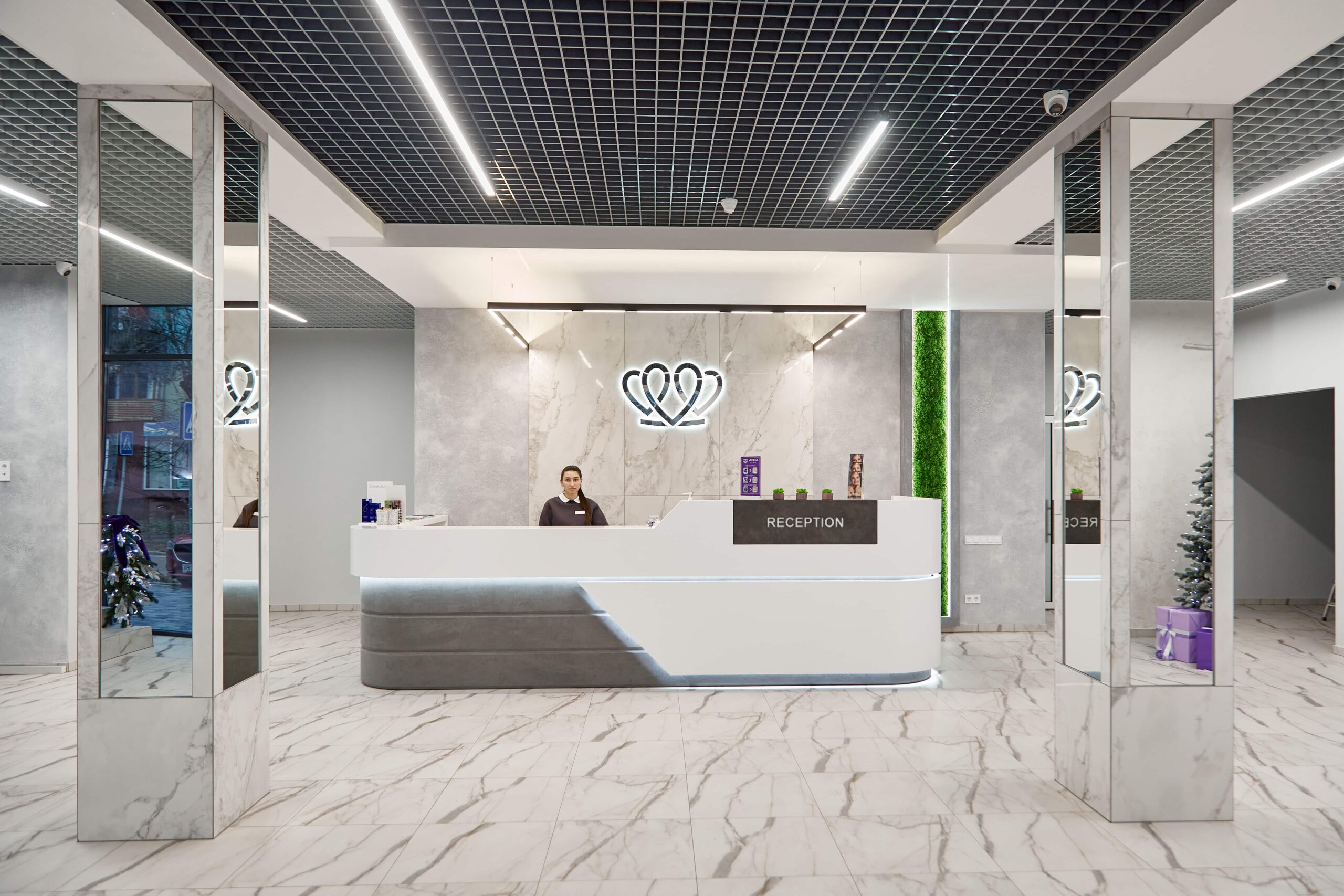
📍 Lviv, Ukraine
A dental clinic in Lviv with a separate doctor for each field: oral surgery and implants, prosthodontics, restorative dentistry, endodontics under a microscope, periodontics, orthodontics and paediatric dentistry.
In one in-office visit teeth usually become 3–6 shades lighter on the Vita Classical guide arranged by brightness, and the combined protocol with an at-home course gives more. The exact figure depends on the starting colour: yellowish teeth respond faster, grey ones more slowly and need trays. The result always looks more impressive straight after the visit than it really is, because the enamel dries out during the procedure; the final shade is assessed after two weeks on the same guide.
At MediUkraine's partner clinic the in-office protocol costs from USD 269, the "in-office plus at-home" scheme from USD 367, and at-home whitening alone with custom trays from USD 122. Professional cleaning under a microscope, from USD 44, is charged separately and is required before the procedure. Replacing fillings, veneers and crowns to match the new shade is not included in this amount. The prices are indicative; the dentist gives the final amount after an examination.
Yes. The gel needs to be in contact with the enamel, not with plaque and tartar: under deposits it works unevenly, and the colour comes out patchy. The second reason is that plaque itself has a shade, so the true starting shade can be seen only after cleaning, and it is this shade that is recorded on the guide and used for comparing the result. Hygiene is done as a separate visit one or two weeks before the procedure, so that the sensitivity after deposit removal has time to pass.
The procedure itself is painless and needs no anaesthesia. Sensitivity usually appears after the visit: brief shooting twinges from cold, air and sweet things, peaking on the first day and passing within one to three days. It is reduced by a potassium nitrate toothpaste used for two weeks before the procedure, a fluoride gel at the end of the visit, and warm water instead of ice-cold. If sharp sensitivity occurs during a cycle, the dentist stops it early. If the pain has not eased after three or four days or is concentrated in one tooth, an examination is needed.
For the first 48 hours the white diet applies: the enamel temporarily lacks its protective film, and pigment attaches more easily than at any other time. Coffee, black tea, red wine, drinks with colourings, beetroot, tomato and soy sauces, berries, turmeric and curry, chocolate are all off the menu, and so is smoking. Chicken, fish, rice, pasta, potatoes, cottage cheese, cauliflower and bananas are fine. Coffee with milk is no exception: milk makes the drink lighter but does not remove its colourings.
They do not change colour: peroxide acts only on the natural tissues of the tooth. After your own teeth are lightened, the difference from the restorations becomes more noticeable, so they are replaced to match the new shade; this is planned at the consultation and included in the quote as a separate item. The replacement is scheduled no earlier than two weeks after the procedure: residual oxygen in the surface layer of the enamel weakens the bond of the adhesive, and a filling placed immediately holds less well.
Usually from one to two years, and noticeably less in smokers and people who drink coffee, tea or red wine every day. The shade is maintained not by a repeat in-office visit but by one or two nights in the same trays roughly every six months or once a year. The full in-office protocol is repeated no more than once a year and only after an examination: frequent cycles with a high peroxide concentration serve no purpose when brief maintenance is enough.
Tell us what you need: we will suggest a clinic and a doctor and send you a cost estimate.
Request a consultation →