| Service | 🇺🇦 Ukraine | 🇨🇿 Czech Republic | 🇹🇷 Turkey |
|---|---|---|---|
| Zoom home whitening with trays | from USD 122 | from USD 215 | from USD 52 |
| Zoom whitening, in-office + at-home | from USD 367 | from USD 390 | from USD 310 |
| Professional cleaning without a microscope | from USD 37 | from USD 72 | from USD 63 |
| Dentist consultation | from USD 8 | from USD 38 | from USD 34 |
Prices in the “Ukraine” column come from MediUkraine’s partner clinics. The Czech Republic and Turkey columns show the lower bounds of prices published by clinics there (for Turkey, also the Turkish Dental Association’s recommended 2026 tariff), collected in August 2026 and converted to US dollars at the rate on the day of collection. A dash means we could not find a comparable published price. In any country, the final cost is set by the clinic after an examination.
Home whitening is a course in which you wear a thin, clear tray filled with gel at home on a schedule set by your dentist. The tray is custom-made from an impression or a digital scan of the jaws, so it follows the shape of each tooth and holds the gel on the enamel rather than on the gums.
The active ingredient is low-concentration carbamide peroxide or hydrogen peroxide. Peroxide passes through the enamel into the dentine and breaks down the pigment molecules that have accumulated there over the years. Because of the lower concentration, each session needs more time, so the shade builds up gradually, over 10–14 days, rather than in a single visit to the chair.
The method suits teeth that have darkened evenly: age-related yellowing, staining from coffee, tea, red wine or tobacco, discolouration after braces are removed. It is often chosen by patients with sensitive teeth who find it hard to tolerate a single high-concentration procedure, and by those who want to stop at a shade they are comfortable with: the course can be stopped on any day.
In some situations, trays will not help or the course has to be postponed. The gel does not change the colour of fillings, veneers and crowns: after the course they will stand out against the lighter teeth, and the restorations will have to be redone. A single darkened root-filled tooth cannot be matched with trays: it needs a separate technique in which the agent is placed inside the tooth. The course is not done under the age of 18, during pregnancy and breastfeeding, or with untreated caries, a gum flare-up, exposed tooth necks or enamel cracks.
MediUkraine is a treatment search and coordination service, not a clinic. We select the clinic and the dentist, arrange the visit dates and support you throughout, including if you are travelling from abroad. Whether the method suits your case, and which gel concentration to use, is decided by the dentist after an examination.

Travel. Ukrainian airspace is closed, so there are no commercial flights. Patients reach Lviv overland, most often from Poland: Rzeszów and Kraków airports are the usual entry points, with a train, bus or private transfer onward to the border and on to the city. Lviv is roughly 70 km from the Polish border, the shortest crossing of any Ukrainian city.
Visas. Citizens of the EU, the United Kingdom and the United States do not need a visa for short stays in Ukraine. Rules depend on your citizenship, so check your own before booking.
Safety, plainly. Ukraine is at war. Air raid alerts occur in Lviv, and an appointment can be interrupted by one. Several governments advise against travel to Ukraine, and while that advice stands, ordinary travel and medical insurance is often void — confirm your cover with your insurer before you commit to anything.
Language. MediUkraine handles correspondence, scheduling, the written treatment plan and the quote in English. The clinic's team communicates with international patients in English.
Payment. You pay the clinic directly. Our coordination service is free of charge for you.
More on travel, safety and insurance: Safety and travel.
The custom-made tray is at the heart of the method. A dental technician casts a model of the jaw from an impression or prints it from an intraoral scanner file, and then moulds a soft sheet 0.8–1 mm thick over the model on a vacuum former. The finished tray is trimmed along the scalloped gum line with a margin of about 0.5 mm: the gel must stay on the teeth and not run onto the gums. If needed, the technician adds small reservoirs on the front surface: recesses that hold a drop of gel.
Thermoplastic "boil and bite" trays and ready-made strips are different: they are designed for an average jaw. On crowded or rotated teeth a strip does not fit against the side surfaces, and those areas stay darker than the rest. A one-size-fits-all tray has no scalloped edge, so excess gel ends up on the gums and causes a chemical burn: a whitened patch of gum that then hurts and peels. Another problem is that the concentration in kits bought online is not always stated honestly, and people apply an unknown substance to their enamel without an examination, sometimes on top of caries or a crack.
Tray protocols use one of two active ingredients. Carbamide peroxide is used in concentrations of 10, 16 and 22%: in the mouth it gradually breaks down into urea and hydrogen peroxide, so it acts more slowly and gently. Hydrogen peroxide is used in home gels in concentrations of roughly 6–9.5%: it works faster, but its wearing time is also shorter. As a rough guide, 10% carbamide peroxide yields about 3.5% hydrogen peroxide.
The wearing regimen depends on the concentration, not on how quickly you want results. A 10% carbamide peroxide gel is worn for 6–8 hours, usually overnight; 16% for 2–4 hours a day; daytime hydrogen peroxide gels for 30–90 minutes twice a day. A standard course lasts 10–14 days. There is no point keeping the tray in longer than prescribed: the gel releases its active oxygen in the first hours, after which only a viscous mass remains under the tray, while the gums are put under unnecessary strain.
You need less gel than you might think. For each tooth, squeeze a drop about half the size of a grain of rice into the front wall of the tray: that is enough to cover the front surface. Put the tray in, press it into place and wipe away any excess along the edge straight away with a finger or a dry tissue. Brush your teeth before putting the tray in; after removing it, rinse the tray in cold water (hot water deforms it), clean it with a brush and store it dry in its case.
Manufacturers add anti-sensitivity components to modern gels: potassium nitrate, fluorides, amorphous calcium phosphate compounds. They do not speed up whitening but make the course noticeably more comfortable. Product lines such as Zoom NiteWhite and DayWhite are built this way: one system offers several concentrations, and the dentist matches it to the patient's sensitivity, not the other way round.
In-office whitening is a separate procedure: a high gel concentration, isolation of the gums with a protective barrier, one or two visits of about an hour each. The combined protocol uses both: a noticeable initial change is achieved in the chair, and the trays at home complete and consolidate it. This option is chosen for marked discolouration or when there is little time before an event; with a home course alone the shade builds up more slowly, but more evenly and with less sensitivity.
No concentration changes the colour of artificial materials. Composite fillings, veneers, crowns and bridges stay the shade they were, so visible restorations are redone after the course, no sooner than two weeks after the last day of wear, when the colour of the enamel has stabilised and the bonding of filling material to it has returned to normal.
Some types of discolouration respond poorly to trays. Tetracycline-stained teeth with grey-blue bands respond slowly: they need months of overnight wear, and the result will be partial, so such cases are discussed before the course is paid for. With fluorosis and white spots the picture can even look worse in the first days, as the spots become more contrasting against dehydrated enamel, and the shade evens out over a few weeks. A single tooth that has darkened after root canal treatment cannot be lightened with a tray: internal (intracoronal) bleaching is used instead, with the agent placed inside the tooth.
A realistic change with a home course is usually 2–5 shades on the VITA shade guide, and it depends on the starting shade, enamel thickness, age and the cause of discolouration. Yellow and brownish shades respond better than grey ones. Only a dentist can predict the result for a particular patient, after an examination; someone else's smile in a photo is not a benchmark.
Right after the tray is removed, the teeth look whiter than they really are: under the gel the enamel partly dehydrates and becomes temporarily more opaque. Water returns within a few hours, and the final shade settles over 1–2 weeks after the last day of wear. That is when it makes sense to compare photos and the shade guide, not on the fourth day of the course.
Increased sensitivity to cold and brief shooting sensations in the first days are an expected reaction, not a complication. It usually passes within 1–3 days after the end of the course. If it becomes uncomfortable during the course, the regimen is adjusted: shorter wear, a day's break, and a gel with potassium nitrate and fluorides applied in the tray.
A follow-up examination is scheduled about two weeks after completion. The dentist compares the shade with the starting one on the same shade guide and under the same lighting, examines the gums and enamel and decides whether additional days of wear are needed. If individual teeth lag behind, the course is sometimes extended for those teeth only.
At this point, replacement of visible restorations is planned if they now stand out. Composite is not placed sooner than two weeks later: residual oxygen in the enamel reduces the bonding of the material, and the filling risks falling out or developing a dark margin within a few months.
How long the shade lasts depends on your habits, not the gel brand; 1–2 years is typical. Coffee, black tea, red wine, turmeric and tobacco bring pigment back faster; daily hygiene, cleaning between the teeth and a professional cleaning every six months help.
You keep the custom tray after the course: it is exactly what you need for maintenance. Once every 6–12 months, one or two nights with gel are usually enough, and this takes one syringe rather than a full kit. The gel has a shelf life and is stored in the fridge, so there is no point stocking up for years ahead. For patients from abroad, MediUkraine provides the record with the product name and concentration so that maintenance can continue at home.
Step 1. Examination and recording of the starting shade. The dentist examines the teeth and gums, looks for caries, cracks, exposed necks and leaking fillings, and assesses enamel thickness and the likely cause of discolouration. The shade is determined on the VITA shade guide and photographed under standard lighting: this is the reference point against which the result will be compared. The dentist also discusses what will happen to visible fillings and crowns after the course.
Step 2. Treatment of the mouth and professional hygiene. Caries is treated, leaking fillings are replaced and gum inflammation is treated, otherwise the peroxide will cause pain instead of results. A professional cleaning follows: tartar is removed with ultrasound, stained plaque with an air-polishing unit. The course begins a few days after the cleaning, once the enamel has restored its pellicle.
In total, it takes about three to four weeks from the first examination to the follow-up visit: three short visits to the clinic (an examination with shade recording, hygiene with impressions, and collection of the finished trays with instructions) plus 10–14 days of wear at home. No anaesthesia is needed, and there is no hospital stay or recovery period: during the course you can work and live at your usual pace, and the restrictions apply only to food and drinks with colourings.
The cycle consists of four parts: preparation, making the trays, the course itself and maintenance. The first two take from a few days to two weeks, depending on whether caries treatment is needed; wear lasts 10–14 days; a check-up is scheduled two weeks after the last day.
There are usually three visits to the clinic: the examination, preparation with impressions, and collection of the trays with instructions. The fourth, the follow-up, can be in person or remote, using photos taken under the same lighting as at the start.
If after two weeks the shade has shifted less than planned, the course is extended by a few more days or switched to a different gel concentration. This is normal, not a mistake: how quickly the enamel will respond is not known in advance, and that is exactly why the home protocol is planned with room for adjustment.
The cycle then moves into maintenance: one or two nights with gel every 6–12 months using the same tray. The tray is replaced when it has deformed, cracked or no longer fits, usually after several years or after new restorations that have changed the shape of the teeth.
For patients from abroad, the cycle is planned so that the in-person part fits into one short trip: the examination and hygiene are done on the first day, impressions on the same or the next day, and the trays are handed over 1–3 days later. Wear and maintenance continue at home, and MediUkraine stays in touch for questions about the regimen and documents.
The most common side effect is increased tooth sensitivity. It occurs in roughly half of patients, usually on the second to fourth day of wear, and passes within 1–3 days after the end of the course. The mechanism is reversible: peroxide temporarily increases the permeability of the enamel and dentinal tubules. The risk is reduced by a lower concentration, shorter wear, breaks every other day and gels with potassium nitrate and fluorides.
The second most common is gum irritation. The cause is almost always mechanical or dose-related: too much gel squeezing out past the edge of the tray, or an edge trimmed without a margin from the gum line. It looks like a whitened, painful patch of gum that peels within a few days. That is why the excess is removed immediately after putting the tray in, and if the gums turn white, pause the course and see the dentist.
Swallowing a little gel during wear is not a cause for concern, but in large amounts peroxide causes nausea and irritation of the lining of the throat and stomach. Do not apply gel generously, and do not eat or drink with the tray in your mouth. Keep the kit out of children's reach: concentrated peroxide gels are not intended for use without a dentist's supervision.
The course is not done under the age of 18 or during pregnancy and breastfeeding, not because harm has been proven but because research in these groups is lacking and there is no reason to take the risk. Contraindications in the mouth are untreated caries, pulpitis, a flare-up of periodontitis and active gum inflammation, enamel cracks and chips, marked erosion, and allergy to peroxides. Each of these can be treated, after which the course can go ahead.
There are also limitations that are not complications but can disappoint if not explained in advance. Restorations do not get lighter; tetracycline discolouration responds slowly and only partly; with fluorosis, white spots become more noticeable in the first weeks. After a properly conducted course with low concentrations the enamel usually undergoes no irreversible changes (the microhardness of the surface layer recovers within a few weeks thanks to saliva and remineralising products), but with existing erosion or exposed necks the gel causes pain, and it is not prescribed.
Gels of unknown origin bought online are a risk in themselves: their actual concentration is not always stated, and no one controls their storage conditions or shelf life. The kit is issued by a clinic that holds a licence from the Ministry of Health of Ukraine to practise medicine, and the name and concentration of the product are recorded in your record. You have the right to a second opinion: the record, photos and shade guide readings can be shown to another dentist, and if needed MediUkraine arranges a consultation at another partner clinic.
📍 Lviv, Ukraine
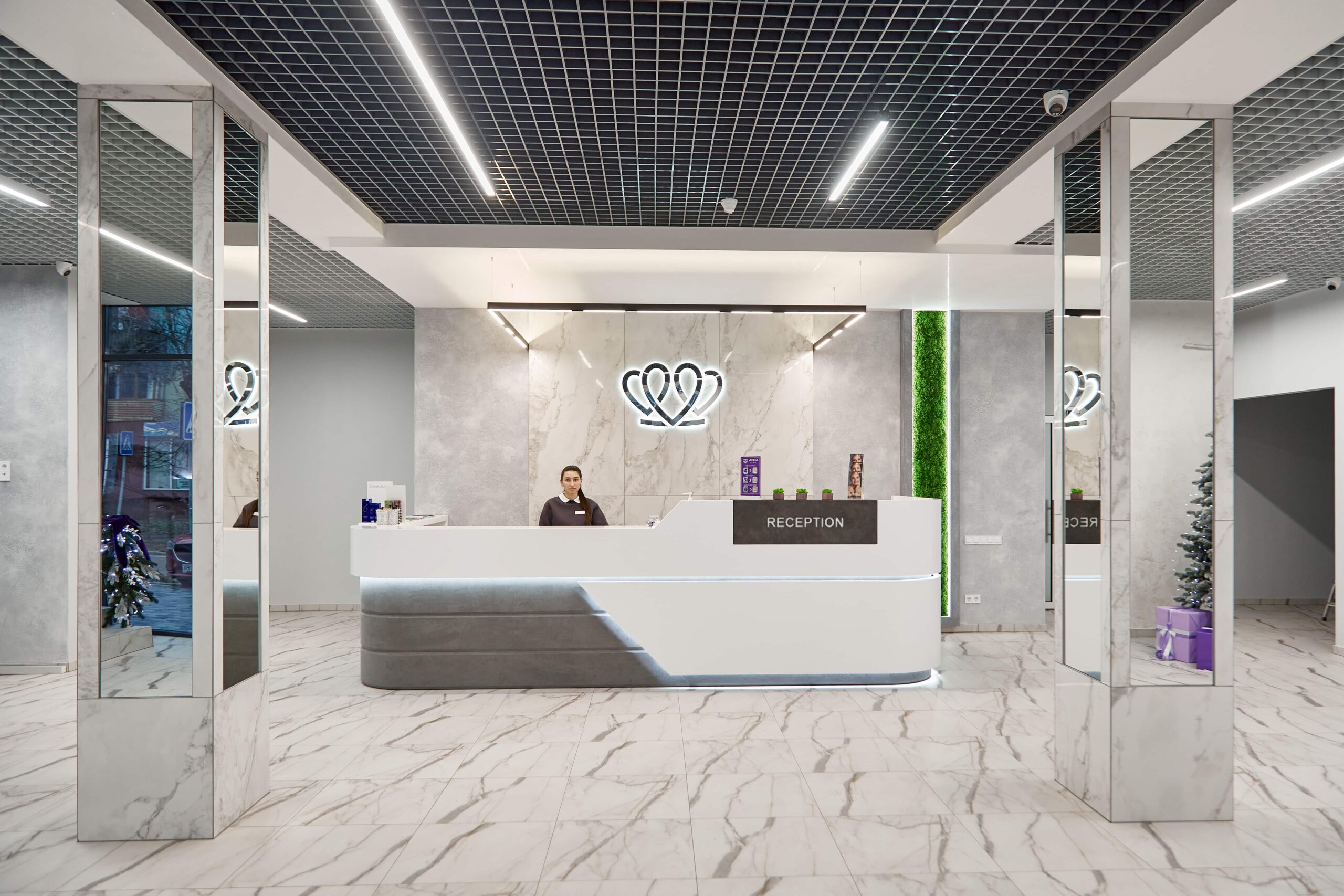
A dental clinic in Lviv with a separate doctor for each field: oral surgery and implants, prosthodontics, restorative dentistry, endodontics under a microscope, periodontics, orthodontics and paediatric dentistry.
In the gel concentration and who applies it. In the chair, the dentist works with a high concentration over one or two visits, isolating the gums with a protective barrier. At home, you wear a custom-made tray with a lower-concentration gel for 10–14 days on a set schedule. The shade builds up more slowly, but more evenly and usually with less sensitivity, and the course can be stopped at a level you are comfortable with. The two approaches are often combined: starting in the chair and finishing with trays at home.
At MediUkraine's partner clinics, a home course with custom-made trays costs from USD 122, covering impressions, two trays and a gel kit. The combined protocol, in-office plus home, is from USD 367. Preparation is charged separately: a dentist consultation from USD 8 and a professional cleaning from USD 37, without which the gel will not work evenly. If the course is extended, additional syringes are charged separately. The final cost is set by the clinic after an examination.
The regimen is set by the gel concentration. Carbamide peroxide at 10% is worn for 6–8 hours, usually overnight; at 16% for 2–4 hours a day; daytime hydrogen peroxide gels for 30–90 minutes twice a day. A standard course lasts 10–14 days. There is no point keeping the tray in longer than prescribed: the gel releases its active oxygen in the first hours, and extra time under the tray puts strain on the gums. If sensitivity appears, the dentist shortens the wear time or switches the course to every other day.
Technically yes, but the risks are serious. One-size-fits-all thermoplastic trays and ready-made strips do not follow the gum contour: gel leaks onto the gums and causes a chemical burn, a whitened painful patch that later peels. On crowded teeth a strip does not fit against the side surfaces, and the shade comes out patchy. The concentration in kits sold online is not always stated honestly, and above all no one examines the teeth before starting, so the gel ends up on caries or a crack.
Gels in tray protocols work at low concentrations, and changes to the surface layer of the enamel after a properly conducted course are usually reversible: microhardness recovers within a few weeks thanks to saliva and remineralising products. Problems begin where the enamel is already damaged: erosion, cracks, exposed necks, untreated caries. That is why the course is prescribed after an examination, not on the basis of a smile photo sent via a messaging app.
This is the most common reaction: it usually appears on the second to fourth day and passes within 1–3 days after the end of the course. It can be reduced in several ways: shorten the wear time, take a day's break or switch to every other day, apply a gel with potassium nitrate and fluorides in the tray, and temporarily avoid very cold and very hot food and drinks. If the pain is sharp, concentrated in one tooth and does not go away, stop the course and see the dentist: this points to caries or a crack, not the usual reaction to peroxide.
Usually 1–2 years, and this depends above all on habits: coffee, black tea, red wine, turmeric and tobacco bring pigment back faster. You keep the custom tray after the course, and it is all you need for maintenance: one or two nights with gel every 6–12 months usually restore the shade, and this takes one syringe instead of a full kit. Daily hygiene including cleaning between the teeth and a professional cleaning every six months also help.
Tell us what you need: we will suggest a clinic and a doctor and send you a cost estimate.
Request a consultation →