| Service | 🇺🇦 Ukraine | 🇨🇿 Czech Republic | 🇹🇷 Turkey |
|---|---|---|---|
| Beard transplant, up to 1,500 grafts | from USD 1,356 | from USD 2,800 | from USD 1,100 |
| Beard transplant, 1,500–2,500 grafts | from USD 2,033 | from USD 3,800 | from USD 1,400 |
| Consultation with zone planning and graft count | from USD 22 | from USD 70 | from USD 40 |
Prices in the “Ukraine” column come from MediUkraine’s partner clinics. The Czech Republic and Turkey columns show the lower bounds of prices published by clinics there (for Turkey, also the Turkish Dental Association’s recommended 2026 tariff), collected in August 2026 and converted to US dollars at the rate on the day of collection. A dash means we could not find a comparable published price. In any country, the final cost is set by the clinic after an examination.
A beard transplant moves your own hair follicles from the back of the head to areas of the face where hair does not grow or is too sparse. The follicles take root and keep following their own growth cycle, so the result is long-lasting and needs no maintenance medication.
What sets it apart from scalp surgery is the composition of the grafts and the angle of the channels. On the face the surgeon works mainly with single-hair grafts, because a natural beard consists of individual hairs. The channels are made at an acute angle, almost parallel to the skin, with a direction specific to each zone: on the cheeks the hair runs downwards and slightly outwards, on the chin downwards, below the lower lip upwards, in the moustache area towards the midline, and in the sideburns it continues the line of the temple hair.
The reasons vary. The most common is a genetically sparse beard: patches that have never filled in despite age and normal testosterone levels. Next come scars from injuries, burns, deep acne or facial and neck surgery, which leave a hairless strip along the suture line. Alopecia areata of the beard is a separate group: surgery is considered only after a long remission. Transplants are also done after masculinising hormone therapy, when facial hair has started to grow but remains patchy.
Before you decide, bear in mind that transplanted hair keeps the properties of the donor hair. It grows continuously rather than to a fixed length, so it needs daily shaving just like your own beard. Its texture may also differ, being finer and straighter than the surrounding hair; this shows mainly in the first year, until the hairs take on the coarseness typical of their new area.
MediUkraine is a service that finds and coordinates treatment; it is not a clinic. We select the medical centre and a surgeon experienced in facial work, agree the date and support you throughout, including if you travel from abroad. Whether the operation can go ahead is decided by the doctor after an in-person examination.

Travel. Ukrainian airspace is closed, so there are no commercial flights. Patients enter Ukraine overland, most often from Poland (Rzeszów and Kraków airports are the usual entry points), and continue to Dnipro by train. Dnipro is in the east of the country, a long journey from the border, so plan the route and timing with us before you book.
Visas. Citizens of the EU, the United Kingdom and the United States do not need a visa for short stays in Ukraine. Rules depend on your citizenship, so check your own before booking.
Safety, plainly. Ukraine is at war. Dnipro is attacked more often than western Ukraine, and an appointment can be interrupted by an air raid alert. Several governments advise against travel to Ukraine, and while that advice stands, ordinary travel and medical insurance is often void — confirm your cover with your insurer before you commit to anything.
Before you travel. The centre offers an online consultation, so the plan and the number of grafts can be estimated from photos before you decide to make the trip.
Language. MediUkraine handles correspondence, scheduling, the written treatment plan and the quote in English. The centre's team communicates with international patients in English.
Payment. You pay the centre directly. Our coordination service is free of charge for you.
More on travel, safety and insurance: Safety and travel.
The procedure uses the FUE method: follicular units are extracted from the donor area one at a time with a micropunch, with no strip of skin removed and no linear scar. Technically it is the same operation as on the scalp, but three things change on the face: graft composition, channel angle and placement density.
Graft composition. A natural beard consists mainly of single hairs, each emerging from its own opening. So the surgeon uses mostly single-hair grafts: two- and three-hair units are split into single ones under the microscope. Two-hair grafts, if used at all, go only into the body of the chin where density is needed and never along the edge: two hairs from one opening look tufted at close range.
Angle and direction. On the scalp, hair emerges at about 40–45 degrees; on the face, at 15–20 degrees, almost parallel to the skin. A channel made too steeply produces a hair that sticks out and will not lie flat when shaved. The direction also differs from zone to zone: on the cheeks downwards and slightly outwards, on the chin downwards, below the lower lip upwards, in the moustache towards the midline and downwards, in the sideburns as a continuation of the temple hair. The surgeon makes each channel individually, checking against this map.
How many grafts each zone takes. A moustache takes roughly 300–500 grafts, the chin 500–800, the cheek and jawline 300–600 on each side, the sideburns 150–300 on each side, the area below the lower lip 50–150. Covering a single scar rarely needs more than 200–400. A full beard usually needs 2,000–3,000 grafts, which does not always fit into a single session.
Density. On the face, roughly 25–35 grafts per square centimetre are implanted, fewer than on the scalp. This is not about saving grafts: facial skin is thinner and has a poorer blood supply, and overly dense placement impairs graft survival. Density is higher in the centre of the chin and in the moustache area and lower at the edges, so that the transition to hairless skin is gradual.
Donor area. The main source is the back of the head, the area below the line joining the tops of the ears: the hair there is genetically resistant to androgens. For the face, finer hairs are selected from the lower edge of the back of the head; their structure is closer to beard hair than the coarse hair from the crown.
If there is not enough donor hair at the back of the head, body hair can be considered: from the chest, abdomen, back or the area under the chin. It is important to be frank about the limitations: body hair has a shorter growth phase, so it does not grow long; it is often curlier and finer, and its survival rate is lower and less predictable. These grafts supplement those from the back of the head and go mainly within the body of the beard rather than along the visible contour. You should be told about this before the operation, not after.
Placement. Grafts are inserted either into pre-made microchannels or with a Choi-type implanter, which makes the puncture and places the follicle in a single movement (the DHI method). On the face the implanter is convenient because it makes it easier to keep a low angle and causes less trauma to the skin, but the choice of instrument matters less than the surgeon's experience: the result is determined by the marking and the angle, not by the name of the technique.
Work on scars follows its own rules. Scar tissue has a poorer blood supply, so graft survival in it is lower; two stages are often planned, or a small test implantation is done first to see how many grafts take, followed by the main session. The scar must be mature, at least a year after the injury or surgery, and inactive, without redness or hardening.
Surgery is not advisable in several situations: active acne in the growth area, where the skin is treated first because inflammation destroys newly placed follicles; a history of keloid scars, since even micropunctures can trigger a new keloid; active alopecia areata of the beard, where a long remission is awaited; and an insufficient donor reserve. A separate case is unrealistic expectations about density. The operation does not turn sparse areas into the dense coverage seen in advertising: it adds a controlled number of hairs to defined zones. If, after discussion, expectations still exceed what the available donor hair can deliver, it is better to decline than to operate.
Swelling lasts for the first two or three days and may spread to the cheekbones and eyelids. This is an expected reaction to the anaesthetic solution, not a complication. Sleep with your head raised and avoid touching your face. A small crust forms around each placed graft.
You start washing your face on day 3–4, following the clinic's routine: foam, warm water with no pressure, pat dry, no rubbing. The crusts fall off on their own on day 7–10; do not pick them, because the follicle comes out with them. The skin stays slightly pink for a few more days, which is why the first week is noticeable when you go out.
After 2–4 weeks the transplanted hair falls out. This is a normal stage, not a loss of the result: the follicle remains in the skin and enters a resting phase, while the hair shaft separates. Most patients go through this, and by around the second month the area looks almost the same as before the operation.
Growth begins at around month 3–4, at first as fine, light hairs that gradually coarsen. By six months the contour and direction are visible, and the outcome is assessed after 8–12 months, once the hair has reached its final thickness and colour. Comparisons are best made from photos taken at the same angle and in the same lighting.
You can shave after 10–14 days at the earliest, and only with a trimmer at first; leave the razor until about the third week, when the punctures have fully healed. The donor area at the back of the head heals faster: the crusts there come off within a week, and a short haircut hides the marks by day 10–14.
Needing a second session is normal, not a sign of failure. It is planned no earlier than 8–12 months after the first, once it is clear which areas are sparser than intended. For patients from abroad, MediUkraine organises remote photo follow-up at months 1, 3, 6 and 12, so there is no need for extra trips.
Step 1. Consultation and marking. The doctor examines the growth areas and the donor area, counts the available grafts and discusses contours and density. The marking is drawn on the face with you sitting upright, in daylight, and shown to you in a mirror before anything else happens. This is where unrealistic expectations are ruled out.
Step 2. Harvesting grafts from the back of the head. The donor area is cut short, numbed locally, and follicular units are extracted one by one with a 0.7–0.9 mm micropunch; for the face, finer hairs are selected from the lower edge of the back of the head. This stage takes about one and a half to two hours; you lie face down and can listen to music or watch a film.
In total the procedure takes 4–6 hours under local anaesthesia, with a break for lunch. Between harvesting and placement the grafts are sorted under a microscope and stored in a chilled solution, and the microchannels are made at an angle of 15–20 degrees in the direction set by the marking for each zone of the face. No hospital stay is needed: you return to your hotel the same evening, come back the next day for a check-up and the first wash, and can travel home on the third day.
Ukrainian clinics operate with a different cost structure. Renting an operating theatre, salaries for non-medical staff, utility bills and administration cost a clinic several times less than in Germany, Austria or the UK, and this feeds directly into what patients pay.
The second factor is the cost of the team's working hours and of consumables. An operation lasting several hours needs a surgeon and two or three assistants who sort and place the grafts; these hours make up most of the price, and in Ukraine they cost less. Punches, implanters and graft storage solutions are bought in as consumables; on request, the clinic will name the manufacturer and show this part of the quote as a separate line.
The third factor is competition. Hair transplant centres operate across Ukraine, including Kyiv and Dnipro, and they compete for patients on price, what the package includes and waiting times.
A lower price does not mean a cut-down operation: the number of grafts is fixed in the contract, the duration is the same, and the clinic sets out the pre-operative tests and check-up schedule in writing on request. The difference lies in the cost of an hour of work, not in what the service includes.
There are savings on logistics too: the consultation, operation and check-up take place at one centre over three days, without separate referrals or queues between institutions. For a patient from abroad this means fewer days of travel and therefore lower costs for the journey and accommodation.
The operation is performed under local anaesthesia: the donor area and the face are numbed with a solution of lidocaine with adrenaline, often combined with a longer-acting anaesthetic. General anaesthesia is not needed, so neither are the risks associated with it. Before the procedure, the doctor asks about allergies (including to local anaesthetics), other medical conditions, anticoagulant use and blood glucose levels.
The clinics MediUkraine works with hold a licence from the Ministry of Health of Ukraine for medical practice in the relevant specialties, and the operation itself is carried out in an operating theatre with sterile single-use instruments.
The punctures on the face are microscopic, 0.7–0.9 mm; they heal without stitches and usually leave no noticeable marks. Risks the doctor should warn you about: swelling in the first days, temporarily reduced skin sensation, folliculitis in the growth area a few weeks later, ingrown hairs, and occasional light dots in the donor area. Infection is rare; to keep it that way, an antibiotic and a wound care routine are prescribed.
A tendency to keloid and hypertrophic scars is assessed separately. A history of keloids (after ear piercing, surgery or a burn) is a reason to decline the procedure, or at least to start with a test implantation of a few grafts on a small area and wait for it to heal. Active acne in the growth area also postpones the date: the skin is treated first, remission is achieved and only then is the operation planned.
Stay in touch with the clinic after you return home. Message the doctor without waiting for the scheduled check-up if you notice: pain that increases instead of subsiding; pus or pustules in the growth area; a temperature above 38 °C; redness spreading beyond the operated area. These are treated quickly if reported straight away.
You receive a report with the number of grafts placed per zone, before-and-after photos and written prescriptions. These documents let you get a second opinion from another specialist, including one at home. If needed, MediUkraine arranges a further consultation at another partner clinic.
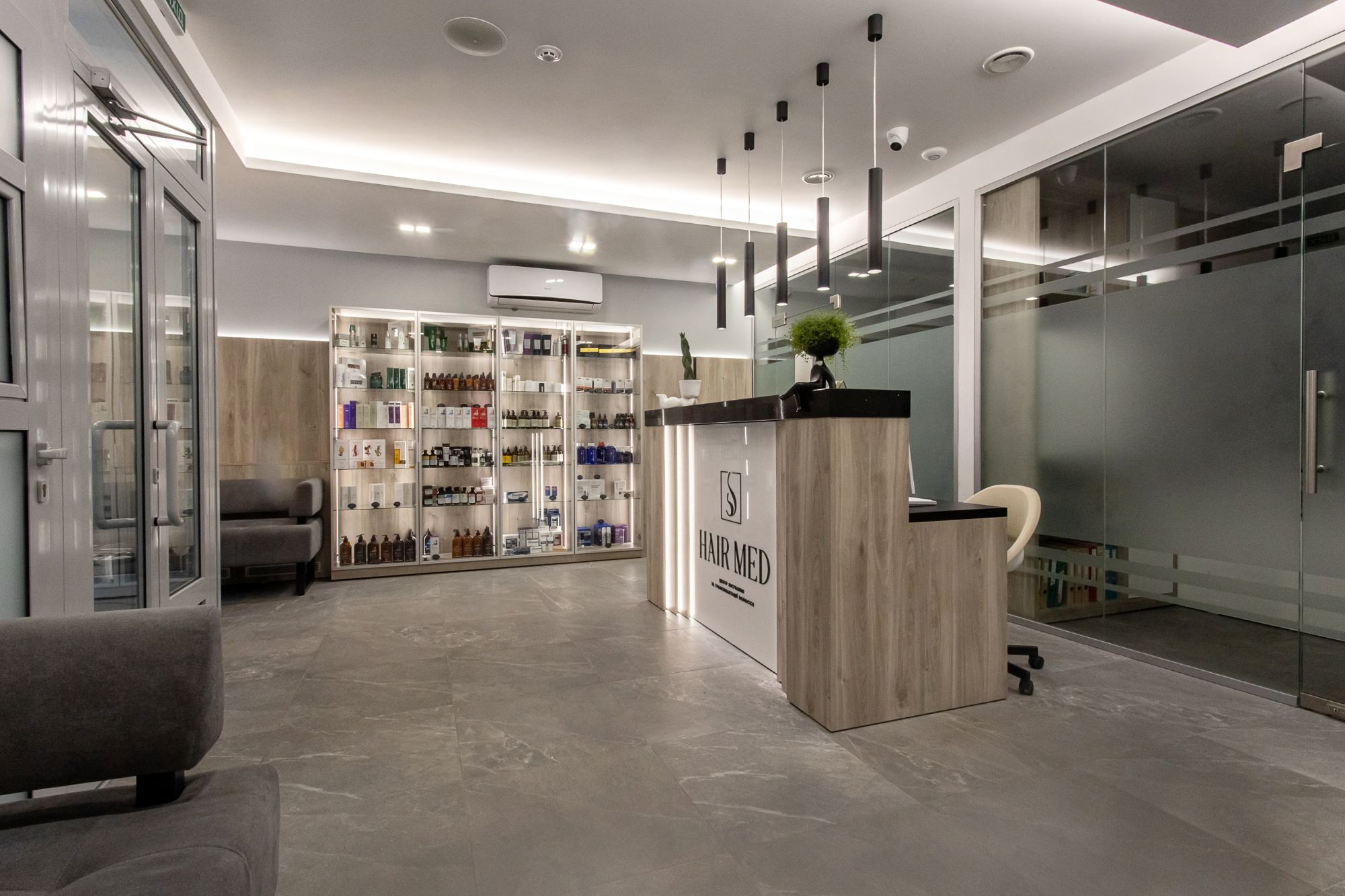
📍 Dnipro, Ukraine
A hair treatment and transplant centre in Dnipro: 430 m², two surgical zones, an SMP room and its own HairHub. Transplants are performed by Ivan Baranov, PhD (member of ISHRS and the World FUE Institute) and transplant surgeon Svitlana Nedbailo. Therapy is led by a team of trichologists and dermatologists.
Mostly men with a genetically sparse beard where some areas have never filled in, and those with scars from injuries, burns, deep acne or facial and neck surgery. It is also done after alopecia areata of the beard, but only during a long remission, and after masculinising hormone therapy when hair growth has started but remains patchy.
Two conditions apply: enough donor hair at the back of the head and calm, non-inflamed skin in the growth area. Active acne, a tendency to keloids and expectations of solid density that the available donor hair cannot provide are reasons to postpone the operation or not to do it.
At the clinics MediUkraine works with, up to 1,500 grafts costs from USD 1,356, and 1,500–2,500 grafts from USD 2,033. A consultation with zone planning and a graft count costs from USD 22 and is often credited towards the price of the operation. For comparison: in the Czech Republic a similar procedure starts from around USD 2,800, and in Turkey from USD 1,100. The clinic confirms the final price after an in-person examination, once the exact number of grafts is known.
They are counted by zone, according to area and the desired density. As a guide: moustache 300–500 grafts, chin 500–800, cheek and jawline 300–600 on each side, sideburns 150–300 on each side, the area below the lower lip 50–150. Covering a small scar usually needs 200–400.
A full beard from scratch needs 2,000–3,000 grafts, which is not always possible in one session: if donor hair is limited, the priority zones are done first and a second session is planned 8–12 months later.
Yes, daily, just like your own. Transplanted follicles keep the properties of the donor ones: hair from the back of the head grows continuously rather than to a fixed length, so it is cared for like an ordinary beard: shaved, trimmed and shaped. The first shave is allowed after 10–14 days at the earliest, and only with a trimmer at first; save the razor for about the third week.
The crusts around each graft last 7–10 days and come off by themselves; they must not be picked off. A pink tinge to the skin remains for a few more days. In the first week the changes are obvious, so plan at least two weeks off: that is a realistic time before you feel comfortable in company, not over-caution. If you work remotely, you can get back to work sooner.
Yes. Most patients shed the transplanted hairs at 2–4 weeks: the follicle remains in the skin and enters a resting phase, while the hair shaft itself separates. Until about the second month the area looks almost the same as before the operation. The doctor warns about this stage in advance, because it is the stage that worries patients most.
Growth resumes from month 3–4 with fine, light hairs; by six months the contour is visible, and the outcome is assessed after 8–12 months. If after a year some areas have remained sparser than intended, a second session is planned.
There are two options. The first is to reduce the area: cover the priority zones, for example the chin contour and the moustache, and give up on filling in the cheeks completely. The second is harvesting from the body: the chest, abdomen, back or the area under the chin.
Be aware of the limitations of the second option: body hair has a shorter growth phase and does not grow to a great length, it is more often curly and finer, and its survival rate is lower and less predictable. That is why such grafts are placed within the body of the beard as a supplement to those from the back of the head, not along the visible contour.
Tell us what you need: we will suggest a clinic and a doctor and send you a cost estimate.
Request a consultation →