| Service | 🇺🇦 Ukraine | 🇨🇿 Czech Republic | 🇹🇷 Turkey |
|---|---|---|---|
| Scalp mesotherapy, single session | from USD 42 | from USD 110 | from USD 70 |
| Mesotherapy course, 6 sessions | from USD 253 | from USD 600 | from USD 380 |
| Trichologist consultation with trichoscopy | from USD 31 | from USD 50 | from USD 40 |
Prices in the “Ukraine” column come from MediUkraine’s partner clinics. The Czech Republic and Turkey columns show the lower bounds of prices published by clinics there (for Turkey, also the Turkish Dental Association’s recommended 2026 tariff), collected in August 2026 and converted to US dollars at the rate on the day of collection. A dash means we could not find a comparable published price. In any country, the final cost is set by the clinic after an examination.
Hair mesotherapy is a course of injections into the superficial layers of the scalp. Using a needle or a device, the product is distributed over a grid of points at a depth of a few millimetres, in the layer containing the vessels that nourish the hair follicles. The logic is simple: deliver the active substances straight to the follicles rather than wait for them to arrive via the bloodstream from a tablet.
What is injected is not the patient's own plasma but a ready-made cocktail. Most often it contains B vitamins, zinc, biotin, the amino acids cysteine, arginine and methionine, copper peptides, dexpanthenol and low molecular weight hyaluronic acid as the base. The formulation is chosen according to the cause of hair loss: for telogen effluvium caused by deficiencies the emphasis is on vitamins and amino acids, and for dryness and flaking on moisturising ingredients.
The usual indications are: diffuse thinning linked to deficiencies; telogen effluvium after childbirth, illness or a strict diet; dry and brittle hair shafts; preparing the scalp before a hair transplant and caring for it after the operation. The second major scenario is as an addition to the main regimen in androgenetic alopecia, when the patient is already taking evidence-based medicines.
It is important to be honest here. The evidence base for the method is weaker than for minoxidil and finasteride: systematic reviews describe small samples, differing cocktail formulations and a lack of blinding, so cocktail injections are not included in international guidelines for treating alopecia. It is a supporting procedure, and in hereditary thinning it does not solve the problem on its own: without core therapy the process will continue.
MediUkraine is a service that finds and coordinates treatment; it is not a clinic. We select a medical centre and a doctor with the relevant expertise, agree the dates of the sessions and support patients, including those travelling from abroad. The decision to prescribe a course, and on the composition of the product, is made by the doctor after an in-person examination.

Travel. Ukrainian airspace is closed, so there are no commercial flights. Patients enter Ukraine overland, most often from Poland (Rzeszów and Kraków airports are the usual entry points), and continue to Dnipro by train. Dnipro is in the east of the country, a long journey from the border, so plan the route and timing with us before you book.
Visas. Citizens of the EU, the United Kingdom and the United States do not need a visa for short stays in Ukraine. Rules depend on your citizenship, so check your own before booking.
Safety, plainly. Ukraine is at war. Dnipro is attacked more often than western Ukraine, and an appointment can be interrupted by an air raid alert. Several governments advise against travel to Ukraine, and while that advice stands, ordinary travel and medical insurance is often void — confirm your cover with your insurer before you commit to anything.
Before you travel. The centre offers an online consultation, so the plan and the number of grafts can be estimated from photos before you decide to make the trip.
Language. MediUkraine handles correspondence, scheduling, the written treatment plan and the quote in English. The centre's team communicates with international patients in English.
Payment. You pay the centre directly. Our coordination service is free of charge for you.
More on travel, safety and insurance: Safety and travel.
Let us start with composition, because that is what distinguishes one procedure from another. The basic components of most scalp cocktails are B vitamins (thiamine, riboflavin, pantothenic acid, pyridoxine, cyanocobalamin), zinc, biotin, the amino acids cysteine, arginine and methionine, copper peptides, dexpanthenol and low molecular weight hyaluronic acid as a carrier. Manufacturers add plant extracts, coenzyme Q10 and organic silicon; some clinics prepare the mixture themselves from separate ampoules.
The formulation is chosen according to the cause of hair loss, not on a one-size-fits-all basis. In telogen effluvium caused by deficiencies the emphasis is on B vitamins, amino acids and zinc. For dryness, flaking and a feeling of tightness, hyaluronic acid and dexpanthenol are added. In androgenetic alopecia the cocktail is considered only as an addition to minoxidil or a systemic medicine prescribed by a doctor, and this is agreed before the course begins, not after it.
The papule technique is the classic approach for the scalp. The needle is inserted at an angle of about 45 degrees to a depth of 1–2 mm, and 0.05–0.1 ml of product is left at each point, forming a small papule, a bump that resolves within 20–60 minutes. The points are placed on a grid with a spacing of roughly 1–1.5 cm, covering the area of thinning and a few centimetres around it.
Nappage is the superficial variant: frequent quick injections at a depth of about 0.5–1 mm with a minimal volume at each point. It is less painful and leaves almost no marks, but it also delivers less product, so it is used more often at the start of a course, in sensitive patients or along the hairline. Injections into the scalp do not go deeper than 4 mm: below that lies subcutaneous fat, and injecting there serves no purpose.
The instrument affects how the procedure feels no less than the composition does. Manual work with a 30–32G needle gives the doctor full control: they feel the resistance of the tissue and decide the depth at each point themselves. A mesoinjector is a device with a cartridge in which depth, volume and delivery speed are set; it works faster, doses more evenly and shortens the session, but has a fixed step. A mesoroller with microneedles creates microchannels through which the product penetrates from the surface; depth is less well controlled, and this is not a true injection.
The standard course is 6–10 sessions. The first four are usually done once a week, after which the interval is extended to 10–14 days. Once the course is completed the doctor suggests maintenance procedures every 4–8 weeks, because the effect of the injected substances does not last indefinitely. A repeat course, if needed, is planned after 6–12 months and after a follow-up trichoscopy, not by the calendar.
Now for how it feels. Injections into the scalp are noticeable but tolerable: brief pricking, burning for a few seconds after each injection and pressure at the site of the papule. The most sensitive areas are the temples, the front hairline and the back of the head. Anaesthesia is usually not needed; if you wish, a topical lidocaine cream is applied 30–40 minutes before the session. For one or two days after the procedure the scalp is tender to touch and when combing, and there is sometimes a mild headache.
A few simple restrictions apply for the first day. Do not wash your hair for 12–24 hours, so as not to introduce infection into the puncture sites; do not rub the skin with your hands, comb the treated areas or apply masks and styling products. For two days avoid saunas, steam baths, swimming pools, hot baths and intense workouts: dilation of the blood vessels increases swelling and bruising. It is also best to avoid alcohol for the first day. Colouring, chemical straightening and peels are postponed for at least 3–5 days, and direct sun and tanning beds for a few days, especially if the skin has reddened.
Now to the evidence; the less welcome part is better heard in advance. Systematic reviews of injection therapy for the scalp agree on one thing: there are few studies, the samples are small, the cocktail formulations differ from study to study, blinding is often absent and the control groups are not always appropriate. That is why the method is not included in international guidelines as core treatment for alopecia. For comparison: topical minoxidil and finasteride are backed by dozens of randomised trials and regulatory approval, PRP therapy has a moderate evidence base, while here it is weak for now. The practical conclusion: a cocktail is appropriate as an addition when the main treatment has already been prescribed, not as the only treatment.
The difference from PRP therapy comes down to three things. The first is what is injected: with PRP it is platelet-rich plasma obtained from the patient's own blood immediately before the procedure; here a ready-made cocktail of external origin is injected. The second is price and number of visits: a PRP session at Ukrainian clinics starts from around USD 56 and the course is shorter; here a session is cheaper, but more procedures are needed. The third is evidence: for plasma therapy it is moderate, for cocktails weaker. We deliberately do not describe the PRP protocol here: it has a separate page on the site.
Immediately after a session the scalp turns red, and small papules are visible at the injection sites; they resolve within 20–60 minutes. For one or two days the skin is tender to touch, and a feeling of tightness is possible. Not everyone bruises; bruises last 3–7 days and are usually hidden by the hair.
The first thing to change is the intensity of hair loss. Patients notice less hair on the brush and in the drain roughly 4–6 weeks after the start of the course. This is a subjective observation that coincides with natural fluctuations in the hair cycle, so on its own it is not proof of an effect.
Visible density changes much later, no earlier than 3–4 months, because hair grows about a centimetre a month. The result is usually assessed properly after 6 months: a shorter period simply does not allow enough time to show whether density has changed.
Judge by figures rather than memories. A phototrichogram or standardised photographs are taken before the course starts and repeated on the same areas, under the same lighting. If density has not changed after a full course, the right response is to go back to the diagnosis and review the regimen, not to pay for a second course.
In androgenetic alopecia it is important to be realistic about the limits of the method. Injections can improve the condition of the scalp and somewhat reduce hair loss, but they do not affect the sensitivity of the follicles to androgens. Without core therapy thinning will continue, and what has been achieved usually reverses within a few months of the last session.
Patients from abroad are given the record with the product name, batch, number of sessions and images to take home, so that a doctor at home can continue monitoring without repeating diagnostics from scratch. If needed, MediUkraine arranges a video consultation with the same doctor before a maintenance session.
Step 1. Examination and choice of formulation. The doctor examines the scalp under a trichoscope, checks the test results and decides whether a course makes sense right now. At the same stage the product, the number of ampoules per session, the injection areas and the number of procedures are determined. The patient signs an informed consent form listing the composition and possible side effects.
Step 2. Skin preparation and anaesthesia if needed. The hair is divided into partings and the skin is treated with an antiseptic. If the patient is sensitive to pain, a topical lidocaine cream is applied 30–40 minutes before the session and covered with film; in most cases it is not needed.
Altogether a session takes 20–30 minutes: between choosing the formulation and the final advice, the doctor treats the skin with antiseptic, works across the area on a grid at a depth of 1–2 mm and applies antiseptic again. No hospital admission is needed and there is no recovery period: you can leave the room and go about your usual business, with restrictions applying only for the first day.
A Ukrainian clinic operates with a different cost structure. Rent, the salaries of non-medical staff, utility bills and administration make up a smaller share of its costs, and with procedures like this it shows immediately, since most of the price is the staff's work itself.
The second factor is the cost of consumables and products. The clinic buys European-made ampoules, 30–32G needles and mesoinjector cartridges from official suppliers and, on request, names the manufacturer and the product code, while trade mark-ups and storage costs are lower here, so each ampoule costs less on the final bill. Over a course of six sessions the difference becomes noticeable.
The third factor is competition. In Ukraine, including Kyiv and Dnipro, there are private clinics offering dermatology and trichology, and they compete for patients on price and service, not on reputation alone.
A lower price does not mean a shorter session: the number of injection points, the volume of product and the doctor's time are the same. The difference lies in the cost of providing the service, not in what it contains.
There are noticeable savings on logistics too: trichoscopy, the phototrichogram and all the sessions of the course take place at one medical centre, without separate referrals and queues between facilities. For a patient from abroad that means fewer days of travel, and therefore lower travel and accommodation costs.
The procedure is invasive, so sterility is the main concern. Needles, syringes and device cartridges are single-use and are opened in front of the patient; the skin is treated with an antiseptic before and after injection; the doctor works in gloves. The ampoule is opened immediately before the session and is not kept for the next visit.
The clinics MediUkraine works with hold a licence from the Ministry of Health of Ukraine for medical practice in the relevant specialties, and the products injected must be approved for use in Ukraine. You can check the facility's licence yourself in the Ministry of Health Licence Register.
Before the course the doctor checks for contraindications. The procedure is not performed during pregnancy and breastfeeding, with an allergy to any component of the cocktail, with inflammation on the scalp (pustules, a flare-up of dermatitis or eczema, active herpes), or with blood clotting disorders and while taking anticoagulants without the agreement of the doctor who prescribed them. The session is postponed in case of fever or acute infection; cancer in its active phase and decompensated diabetes are also grounds for refusal.
Allergy is a separate topic, because a multi-component mixture is injected. The doctor should name each component and show the ampoule, and the patient should mention all known reactions, including to lidocaine if topical anaesthesia is planned. If in doubt, the first session is done with a smaller volume on a small area, and the patient stays at the clinic for 20–30 minutes after the injection.
The doctor warns about side effects before the course starts, not after it. The expected ones are pain during the injections, redness, swelling, bruising, tenderness of the skin for one or two days and sometimes a headache. Less common are prolonged tenderness, a temporary increase in hair loss in the first weeks and an allergic reaction to a component. Rare but serious complications are infection of the puncture sites and nodules in the skin when the product is injected too deep or in too large a volume; that is precisely why the depth is kept within a few millimetres.
You receive a written record with the name of the product, the batch and the injection areas, and have the right to a second opinion: this information can be shown to another specialist. If the doctor declines to start a course and suggests addressing the cause of hair loss first, that is not a refusal but sound medical practice. If needed, MediUkraine arranges a consultation at another partner clinic.
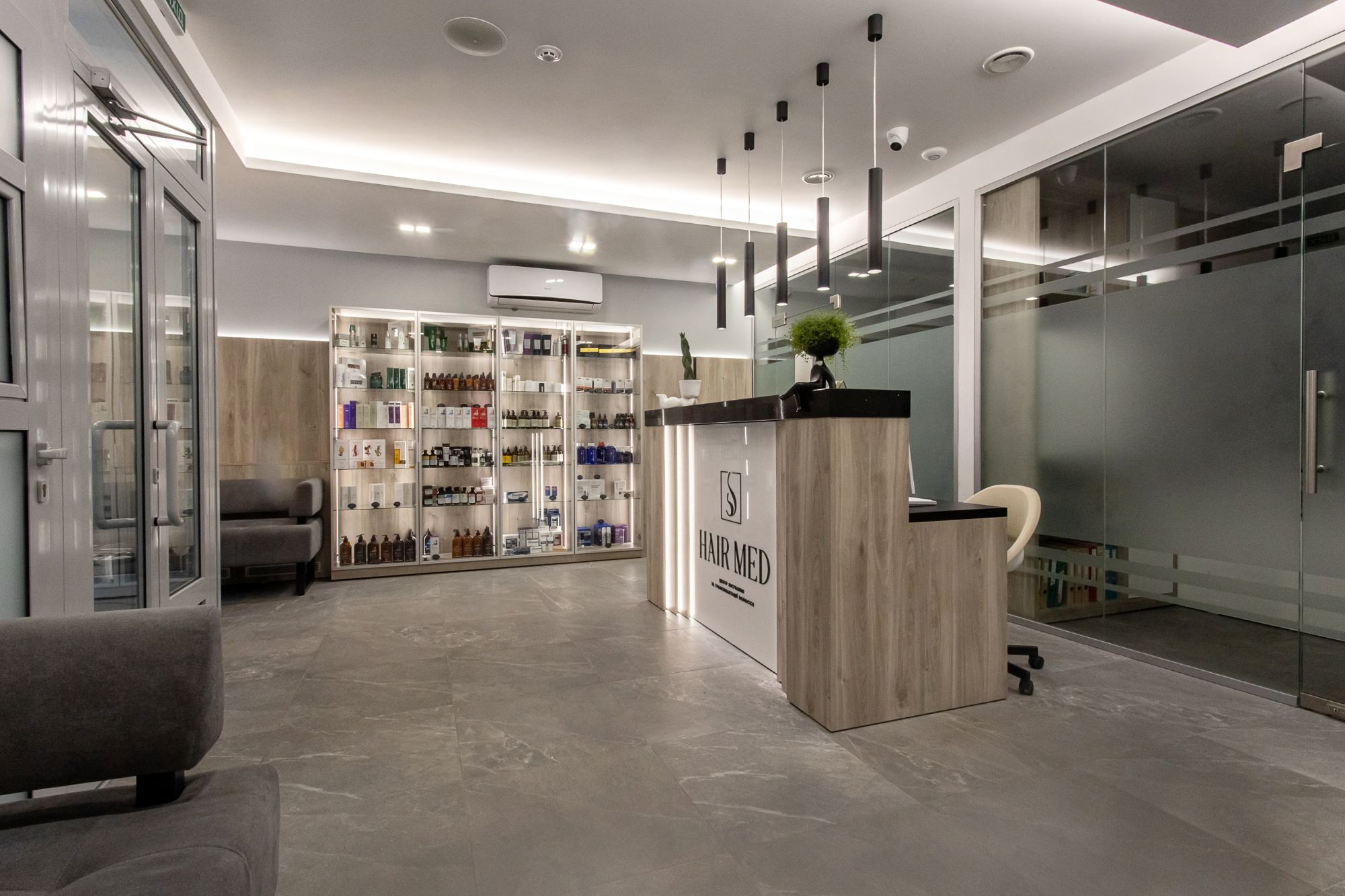
📍 Dnipro, Ukraine
A hair treatment and transplant centre in Dnipro: 430 m², two surgical zones, an SMP room and its own HairHub. Transplants are performed by Ivan Baranov, PhD (member of ISHRS and the World FUE Institute) and transplant surgeon Svitlana Nedbailo. Therapy is led by a team of trichologists and dermatologists.
A ready-made cocktail, not the patient's own plasma. A typical formulation contains B vitamins, zinc, biotin, the amino acids cysteine, arginine and methionine, copper peptides, dexpanthenol and hyaluronic acid as the base. The proportions depend on the cause of hair loss: for telogen effluvium caused by deficiencies the emphasis is on vitamins and amino acids, and for dryness and flaking on moisturising ingredients. The doctor should name each component and show you the ampoule with its labelling and expiry date before opening it.
A single session at the clinics MediUkraine works with starts from USD 42, and a course of six procedures from USD 253. For comparison: in the Czech Republic a session costs from around USD 110 and a course from USD 600; in Turkey from USD 70 and from USD 380 respectively. A trichologist consultation with trichoscopy (from USD 31) and a phototrichogram, which is needed to compare density before and after the course, are paid for separately. Please confirm the final cost with the clinic.
The standard course is 6–10 sessions. The first four are usually done once a week, after which the interval is increased to 10–14 days. After the course the doctor suggests maintenance procedures every 4–8 weeks, because the effect of the injected substances does not last indefinitely.
A repeat course is planned no earlier than 6–12 months later and only after a follow-up trichoscopy. If there are no objective changes after a full course, it is not worth continuing: it is more sensible to go back to diagnostics and review the treatment plan.
The injections are noticeable but tolerable: brief pricking and burning for a few seconds at each point. The most sensitive areas are the temples, the front hairline and the back of the head. Most patients go through the session without anaesthesia, especially as it lasts 20–30 minutes.
If you wish, a topical lidocaine cream is applied 30–40 minutes before the start; this is arranged in advance, because the cream needs time to work. For one or two days after the session the scalp is tender to touch and when combing; this is an expected reaction.
Do not wash your hair for the first day: the puncture sites need to close. Do not rub or comb the treated areas, and do not apply masks, oils or styling products. For two days avoid saunas, steam baths, swimming pools, hot baths and intense workouts: dilation of the blood vessels increases swelling and bruising.
It is also best to avoid alcohol for the first day. Colouring, chemical straightening and peels are postponed for at least 3–5 days, and direct sun and tanning beds for a few days after the session.
The main difference is the product. With PRP, the patient's own platelet-rich plasma is injected: blood is taken from a vein and centrifuged immediately before the procedure. Here a ready-made cocktail of vitamins, amino acids and peptides is injected, that is, a formulation of external origin chosen according to the cause of hair loss.
The second difference is price and number of visits: a PRP session is more expensive (from around USD 56 at Ukrainian clinics), but the course is shorter. The third is evidence: plasma therapy has a moderate evidence base, cocktails a weaker one. The PRP protocol is covered on a separate page of the site.
On its own, no. In androgenetic alopecia the follicles gradually shrink because of their sensitivity to androgens, and a vitamin cocktail does not affect this mechanism. Topical minoxidil and, if prescribed by a doctor, a systemic medicine for men remain the basis of treatment.
Injections are considered an addition to this regimen: they can improve the condition of the scalp and somewhat reduce hair loss, but after the course ends what has been achieved usually reverses. If a clinic offers the course as a replacement for core therapy, that is a reason to seek a second opinion.
Tell us what you need: we will suggest a clinic and a doctor and send you a cost estimate.
Request a consultation →