
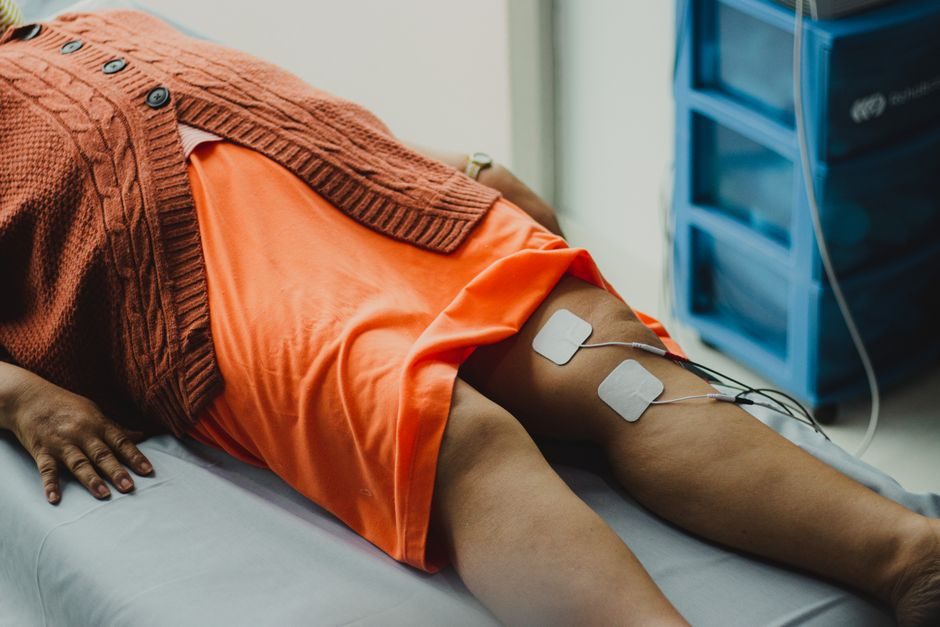
Knee arthroscopy ends with a few small punctures and sticking plasters, and that is exactly why many people underestimate what comes next. For the patient, the operation itself is a short episode, while recovery stretches out for a long time and largely determines whether the joint regains full movement. Below is a detailed account of what happens after discharge: how the first days go, the principle by which load is returned, what the physiotherapist is responsible for and which symptoms must not be sat out at home.
- What recovery depends on: not the word “arthroscopy” but what was done inside
- What to find out before discharge: a list of questions worth writing down
- The first days at home: swelling, cold, raising the leg and pain relief
- Crutches and weight on the leg: how load is returned gradually
- Exercises and physiotherapy: how a recovery programme is built
- Meniscus, cartilage, ligaments: why recovery differs
- Driving, work, sport: the criteria for going back
- Common mistakes that slow recovery
- Warning signs: when not to wait for a scheduled visit
01What recovery depends on: not the word “arthroscopy” but what was done inside
The first question patients ask on the ward usually sounds like this: “When will I walk normally?” The honest answer is uncomfortable in its uncertainty: it depends not on the word “arthroscopy” itself but on what the surgeon did inside the joint. Arthroscopy is a way of access, a minimally invasive entry into the knee through a few punctures instead of a large incision. The procedures carried out through this access, however, vary a great deal, and it is these, not the size of the punctures, that set the rehabilitation schedule.
The easiest way to picture the difference is this: there are operations after which the damaged tissue is removed, and there are those after which the tissue is stitched or repaired. This is a fundamental difference. When a non-viable part of the meniscus is removed, there is no stitch left inside that needs to heal: the knee has to cope with post-operative swelling and regain the strength of muscles that had already weakened before the operation. When the meniscus is stitched, a ligament is reconstructed or a cartilage defect is treated, the joint gains an area that needs time to take hold and withstand load. Rushing does not speed anything up here; it only risks destroying what the operation was done for.
The second variable is the state of the knee before surgery. A joint that has hurt and barely bent for months recovers differently from the knee of an athlete who was injured recently and was in shape before that. While a person is sparing the leg, the thigh muscle noticeably loses bulk, and part of rehabilitation is not healing after the operation but getting back what was lost before it.
The third group of factors is age, weight, other conditions, the nature of your work and your sporting goals. A person who needs to get back to a desk job and a person who plays football will be given different readiness criteria by the doctor, even if exactly the same thing was done inside the joint.
That is why average time frames found on the internet are not a guide but a source of unnecessary anxiety. The main document for you is the discharge summary and rehabilitation protocol from the surgeon who operated: they saw the joint from the inside and know exactly what they did there. If the discharge summary has no clear instructions about load, crutches and movement restrictions, that is a reason not to guess but to call the clinic and ask again.
02What to find out before discharge: a list of questions worth writing down
Most of the confused calls to a clinic a week after the operation concern things that could have been clarified on the ward. A discharge summary often contains the diagnosis and general recommendations, but it does not always answer the everyday questions that come up at home. Below is a list worth going through with the surgeon before you leave and writing down, rather than keeping it in your head after anaesthesia.
- What exactly was done in the joint. Not “arthroscopy” but the exact name of the procedure: whether tissue was removed, whether it was stitched, whether the cartilage or a ligament was treated. Everything else depends on this answer.
- Weight on the leg. Whether you can put weight on it and how much, whether you need crutches, how long to use them and the principle by which load will be increased.
- Movement restrictions. Whether there are bending angles to avoid for now, whether a brace has been prescribed, what settings it was issued with and who is allowed to change them.
- Wounds and dressing. Who changes the dressing and when, whether there are stitches and when they are removed, when you are allowed to get the leg wet and take a shower.
- Medicines. What to take and for how long, what must not be combined with what has been prescribed, and whether you need thrombosis prevention in your case.
- Rehabilitation. When to start, according to what plan and with whom; whether there is a written protocol you can show a physiotherapist where you live.
- Follow-up. When your next check-up is and which number to call if something goes wrong, separately for working hours and for evenings or weekends.
The last point is not a formality. It is the lack of a contact that most often leads patients either to put up with a worrying symptom until the scheduled visit or to look for an answer online and find someone else’s case. If you are having the operation away from home, also agree in advance how you can ask questions remotely.
Not sure which clinic to start with?
A MediUkraine coordinator will help you choose a clinic and a doctor for your case, free of charge.
03The first days at home: swelling, cold, raising the leg and pain relief
The first days after arthroscopy are above all a story about swelling. The joint responds to the procedure by accumulating fluid, and this reaction in itself is expected. The knee looks bigger than the healthy one, the skin over it feels tight and bending is limited. There may be several reasons for this at once: the swelling itself, pain, protective muscle tension, a mechanical obstacle inside the joint and, after some procedures, the surgeon’s direct instructions to deliberately limit the range of movement. What exactly limits bending in your case, and within what limits it can be regained for now, is decided by the doctor, not by how it feels to you. Typically the swelling varies during the day: in the morning the leg looks better, and by the evening, after several hours upright, it gets bigger again. More often this pattern is an expected reaction, but only a doctor can tell it apart from a complication. It is also a convenient way to check whether you have overdone your activity.
The tools against swelling in the first days are simple: rest, raising the leg and cold, if it has been prescribed. Raising the leg means resting it on a pillow or roll so that the shin and foot are higher than when you are simply sitting. How high and for how long to lie like this will be advised by your doctor; there is no universal rule here. Keeping the leg down for hours, sitting at a table or in an armchair, is the least helpful thing in the first days: the fluid goes down and the knee fills up.
Cold is applied as your doctor has prescribed: how often and for how long are set individually and differ depending on what was done in the joint. There is one general safety rule: ice is never put on bare skin, only through fabric, and it is not left on for long without checking, because skin sensation after anaesthesia and with swelling may be altered. A separate point about sensation: if there is numbness, tingling or an area of reduced sensation in the leg, cold is not used at all. You simply will not feel cold injury to the skin, so the warning to “remove the ice if it becomes unpleasant” does not work in this situation. The numbness or reduced sensation itself is a reason to see a doctor, not a reason to work out your own cold-pack routine.
Pain relief in the first days is neither a whim nor a weakness. Pain that you put up with makes you spare the leg, and sparing it leads to even more stiffness and faster muscle loss. The medication regimen is prescribed by the doctor: it is important not to improvise or add “something of your own” from the home medicine cabinet, especially if you are already taking medicines that affect blood clotting. You should tell the doctor about all your regular medicines before the operation.
A separate word about the dressing and punctures. The arthroscope entry points are covered with plasters or a dressing, and the question of when you can get the leg wet and take a shower is decided by the clinic, not by a universal rule: it depends on the type of closure, whether there is a drain and how healing is going. The same applies to compression stockings and thrombosis prevention: some people are prescribed them and some are not, and the decision is made by the doctor based on your specific risks. It is best to ask about this at discharge, while there is someone on hand to answer.
On a purely practical note: plan the first days so that someone at home can pass you things and help. Not because you are helpless, but because walking on crutches, if they have been prescribed, while carrying a cup of tea is genuinely awkward.
04Crutches and weight on the leg: how load is returned gradually
Not everyone needs crutches after arthroscopy, and not for the same length of time. Sometimes they are simply a safety measure for the first days, while the leg is less steady because of swelling and the lingering effect of anaesthesia. And sometimes taking weight off the leg is an essential part of treatment, without which stitched or repaired tissue will not take hold. The difference is determined by the operation, and that is why the instruction to put full weight, partial weight or no weight at all on the leg comes from the surgeon, not from a neighbour with the same diagnosis.
It is important to understand that “partial weight-bearing” does not mean “step on it a little, however it goes”. It is a specific, measured amount that the physiotherapist helps you get a feel for in practice: a common technique is to stand with the operated leg on bathroom scales and remember exactly what the permitted pressure should feel like. Without this practice, patients usually either overload the leg or, on the contrary, are afraid to touch the floor, and both extremes are harmful.
Using crutches is also a skill, and the walking technique is better shown by a specialist than by a video. Crutches are adjusted to your height, not borrowed from a relative as they are. The common walking principle is that the crutches and the operated leg move together and the healthy leg steps forward. For stairs there is a simple tip usually given in the clinic: going up, the healthy leg goes first; going down, the operated leg goes first together with the crutches. When you start walking without crutches, it is important to make sure a limp does not become a habit: the body quickly gets used to sparing the knee, and that habit then has to be unlearned separately.
Returning to full load is a step-by-step process, and the steps are set by the doctor. After an increase in activity, the knee may react moderately, with a little more swelling or a feeling of tiredness. More often this is an expected response to the new load, but only a doctor can tell it apart from a complication. If swelling or pain increase after a new level of load, tell your doctor and do not try to “walk it off” by force. If you are in doubt, call your doctor; do not wait.
One more detail patients are rarely warned about is the brace. After some procedures one is prescribed, and it may be fixed or have an adjustable bending angle. If the brace has been issued with certain settings, you must not change them yourself: it is these angles that limit the movement that is currently dangerous for the stitched tissue.
05Exercises and physiotherapy: how a recovery programme is built
The most common mistake after arthroscopy is to think that recovery happens by itself and you just have to wait. In fact, time on its own heals the tissues but does not bring back muscle strength and range of movement. The thigh muscle that controls straightening of the knee weakens very quickly when the leg is not working, and recovers much more slowly. That is why two patients after the same operation can later have very different knees, and the difference often lies not in the surgery but in whether they exercised.
Whether you need sessions with a physiotherapist, and how many, is decided by the operating surgeon. After uncomplicated arthroscopy, the home exercise programme given by the clinic and monitoring at scheduled check-ups are often enough. After more complex procedures, the programme is usually led by a specialist, because there are more restrictions and the cost of a mistake is higher. There is no universal rule here, so the question “do I need a physiotherapist or will exercises at home be enough?” should be put to the doctor who operated, not decided on the basis of someone else’s experience.
A rehabilitation programme is usually built from simple to complex, and each stage has its own tasks. First comes work on swelling, regaining straightening and “waking up” the muscle: exercises in which the leg does not yet carry weight, such as tightening the muscle without moving the joint, foot exercises and careful movements within the permitted range. Then exercises with weight on the leg are added, then work on strength, endurance and balance, and only at the end sport-like loads: jumping, changing direction and reacting to unexpected movement. How long each stage lasts and when to move on is decided by the doctor together with the physiotherapist.
Straightening deserves a separate mention. Many patients instinctively keep the knee slightly bent, as it pulls and hurts less that way. But a lack of straightening is the hardest thing to correct later, and it spoils your walking the most noticeably. That is why the early programme usually pays particular attention to regaining straightening, within the limits allowed after your particular procedure, because after some operations the range of movement is deliberately restricted.
If sessions with a specialist have been prescribed, their role is not to show you a set of exercises. They check your technique, adjust the load in time and notice compensations, when you perform a movement not with the muscle that should be doing it but with the one that is more convenient. Such compensations are invisible to the patient, but they make the exercises almost useless. In addition, the physiotherapist works together with the operating surgeon and knows the restrictions that apply to this particular knee.
Physiotherapy procedures, such as electrical muscle stimulation, work on swelling and various device-based techniques, may or may not be part of the programme: the doctor decides, depending on what exactly is holding back progress. The question “do I need physiotherapy?” is better put not as “will they prescribe procedures?” but as “do I have a plan, and who is responsible for it?”
If you are travelling to another city or country for the operation, discuss the rehabilitation plan before surgery, together with where and with whom you will exercise after returning home. A MediUkraine coordinator takes this into account when arranging your treatment at the partner clinic, the EXPERT medical network in Uzhhorod, whose team communicates with international patients in English: if the surgeon prescribes sessions with a specialist, in some cases rehabilitation can begin on site and continue where you live, and it is better if the transition between these stages is thought through in advance rather than decided on the day of discharge.
06Meniscus, cartilage, ligaments: why recovery differs
This is the most important section for those who read other people’s stories and are alarmed by the differences. Rehabilitation after operations on the meniscus, cartilage and ligaments really does differ, not slightly but substantially, and you can compare yourself with another patient only if they had the same thing done.
Removal of part of the meniscus (resection)
When the damaged part of the meniscus is resected, no stitched tissue is left inside that needs to heal. So the restrictions here are mainly related to swelling and pain, not to the risk of something “coming apart”. Load is usually returned earlier, and the main work is to reduce the swelling, regain range of movement and restore muscle strength. At the same time, faster recovery does not mean you can immediately load the knee as before: the meniscus acts as a shock absorber, and part of it has been removed for good, so the question of your long-term activity level is worth discussing with your doctor separately.
Meniscus repair
Here the situation is the opposite: the tissue has not been removed but joined, and it needs time to heal. It is after repair that restrictions most often appear on how deeply you can bend, on axial load and on certain movements, including twisting and deep squatting. A brace with a set angle is also more common in this group. Recovery takes longer than after resection; this is built into the operation itself, because the preserved meniscus needs time to heal.
Procedures on cartilage
Cartilage heals worst of all the tissues in the joint, because it has practically no blood supply of its own. After operations aimed at restoring the cartilage surface, the new tissue needs a long time to mature and learn to withstand pressure. That is why the off-loading regime here is usually one of the strictest and longest, even if the knee subjectively feels good soon after the operation. The feeling that “it doesn’t hurt any more” is the worst possible guide here.
Ligament reconstruction
After reconstruction of the anterior cruciate ligament, the graft goes through a long process of remodelling inside the joint, and its strength changes unevenly along the way. Rehabilitation here is long and the most staged: first movement and strength, then control and balance, and only at the end running and movements with changes of direction, which put the most strain on the ligament. A return to contact sport is decided not by the calendar but by passing functional tests, including strength symmetry between the legs. In addition, the ligament is often operated on together with the meniscus, and then the programme takes both sets of restrictions into account, with the stricter one applying.
The practical conclusion is simple: before discharge, find out not only the diagnosis but also the exact name of what was done. The phrase “I had an arthroscopy” gives neither you nor your physiotherapist any information about the regime.
07Driving, work, sport: the criteria for going back
“When can I drive?” is perhaps the question patients ask most often, and it is exactly the one that has no answer in the form of a number. It is better to think not about a date but about ability. It is safe to drive when you can press a pedal with the necessary force without pain or delay, brake in an emergency and quickly move your foot from pedal to pedal, and when you do not depend on medicines that affect your reactions and attention. It also matters which leg was operated on and what kind of gearbox the car has: a left knee in an automatic and a right knee in a manual are different situations. While you are walking on crutches or taking pain relief that affects your reaction time, you must not drive. The final decision should be agreed with your doctor, not tested on the road.
The same goes for work: the answer depends on what kind of work it is. Desk work comes back earlier, but even it has a nuance: keeping the leg down under a desk for long periods in the first weeks is uncomfortable and bad for swelling, so think about where you can raise the leg and how often to get up. Work that involves long periods of standing, climbing stairs, lifting weights or driving comes back later and usually in stages: first reduced hours, then full ones. If you need a document about incapacity for work or restrictions, raise this with the clinic in advance, not on the last day.
Sport is a separate topic, and it is where acting on your own does the most harm. A return to activity almost always happens in steps: first cyclical activity without impact or twisting, then running, and only then sport with changes of direction, jumping and contact. The key point is that the decision to move to each next step is made on the basis of the state of the leg, not the calendar. The markers physiotherapists use are a full pain-free range of movement, no swelling in response to load, strength symmetry between the healthy and the operated leg and the ability to control the knee during unpredictable movements. The feeling that “I’m fine now” comes much earlier than these criteria are met, and it is in this gap that most repeat injuries happen.
One more thing to remember: the knee may “remind you of itself” with a reaction to the weather, long periods of standing or unusual activity long after everything has formally healed. More often this is an expected reaction, but only a doctor can tell it apart from a complication. If the knee responds to activity more strongly than before, or the reaction comes with swelling or increasing pain, see a doctor. If you are in doubt, call; do not wait for your scheduled visit.
If you are still planning the procedure and comparing options, the knee arthroscopy service page describes how the operation is arranged at the partner clinic in Uzhhorod, and you can ask the coordinator about rehabilitation there before you decide.
08Common mistakes that slow recovery
Mistakes after arthroscopy are rarely dramatic. Usually they are small things that are repeated every day and that are easy not to notice in yourself.
Sitting it out. The quietest of the mistakes: you are afraid of doing harm, keep the leg at rest and wait for “everything to heal by itself”. Meanwhile the muscle weakens, the joint becomes stiffer and each next step of rehabilitation gets harder. Rest in the first days is needed exactly within the limits your doctor has set; after that, the work begins.
Walking it off by force. The opposite extreme: you decide that the pain has to be endured and increase the load despite growing swelling. The knee responds with a new portion of fluid, and progress slides back.
Testing the knee “for a dare”. Trying to squat, run down the stairs or go for a bike ride to find out whether you can yet is exactly how repeat injuries happen. The test is done not by the patient alone but by the doctor or physiotherapist according to agreed criteria.
Comparing yourself with someone else’s case. Someone else’s recovery story says nothing about your knee unless you know exactly what procedure that person had and what state their joint was in before the operation.
Dropping the exercises as soon as the pain stops. Pain disappears before strength and control return. It is at this stage that exercise is most often abandoned, leaving you with a knee that looks healthy but lets you down under load.
Changing what has been prescribed on your own. Resetting the angles on the brace, stopping or adding a medicine, changing the load regime on a friend’s advice: all these are decisions for the doctor, who knows exactly what inside the joint needs protection right now.
09Warning signs: when not to wait for a scheduled visit
Most of what frightens patients in the first days is expected: swelling, bruises that may move down the shin under gravity, a feeling of stiffness, discomfort at the puncture sites. But there are symptoms that call not for watching and waiting but for a call to your doctor. You should know them by heart before discharge, rather than searching for them online at night.
Swelling that is increasing rather than going down. Moderate swelling that increases slightly by the evening and goes down after resting with the leg raised is the expected picture. Swelling that gets bigger day after day, spreads, makes the skin shiny and tight or comes with a sharp increase in pain is a reason to seek help.
Fever and signs of inflammation. A raised temperature, chills, spreading redness around the punctures, a local feeling of heat or any discharge from the wounds, especially cloudy or foul-smelling, are things you do not wait until the next appointment for. Infection in a joint is treated more successfully the earlier it is detected.
Pain in the calf. Calf pain stands apart, especially if it is one-sided and bursting, combined with swelling of the lower leg, a feeling of firmness or tenderness when you move your foot. This can be a sign of deep vein thrombosis, and that is exactly why doctors insist so strongly on early foot movement and, when prescribed, on preventive measures. An even more alarming variant is sudden shortness of breath, chest pain or a racing heart: in this situation you do not call the clinic but call emergency services.
New numbness or tingling. If numbness, tingling, a “pins and needles” feeling or an area that feels touch less well appears in the leg, the foot or around the knee, this is a reason to seek help, not to watch it at home. The same applies to increasing weakness in the leg or being unable to lift the foot.
Bleeding or a dressing soaking through. Significant bleeding from a wound, or a dressing soaking through with blood or discharge, is a reason to contact the clinic straight away. Do not wait for the next dressing change, and do not remove the dressing yourself to “take a look”.
Sudden loss of function. If the knee suddenly locks and will not straighten, gives way, or you hear a click with sharp pain after an awkward movement, it will not “go away by itself”. A sudden increase in the size of the joint after a particular episode of activity is just as worrying.
Pain getting worse after it had been easing. If pain that had been gradually easing starts to increase, tell your doctor. Do not count how many days it has lasted, and do not wait for your scheduled visit: this is a reason to seek help even when there is no single “frightening” symptom.
A practical tip: keep the contacts of the clinic and the operating surgeon where they are easy to find, and do not hesitate to message or call. A question asked in time costs, at worst, a few minutes of someone else’s time. A question put off “until the scheduled visit” sometimes costs the result of the operation. If you had the operation away from home, the coordinator will help you quickly reach the doctor who treated you; this is the part of the support that makes it worth having an intermediary between the patient and the clinic in the first place.
10Frequently asked questions
Why does my knee swell even several weeks after arthroscopy?+
Swelling is the longest-lasting of the post-operative symptoms. The joint responds with fluid to load that is new for it, and until the muscles have regained their strength this reaction can be noticeable. More often this is an expected reaction, but only a doctor can tell it apart from a complication. Swelling that is increasing, spreading or accompanied by a fever or worsening pain should be shown to a doctor. If you are in doubt, call your doctor; do not wait for your scheduled visit.
How long do I need to walk on crutches?+
It depends on what was done in the joint, not on the fact of arthroscopy itself. After some procedures crutches are a temporary safety measure for the first days; after others, taking weight off the leg is part of the treatment and lasts much longer, because stitched or repaired tissue needs time. The time frame and the amount of weight-bearing are decided by the operating surgeon, and these instructions should be in your discharge summary. If they are not, ask the clinic again.
When can I get my leg wet and take a shower?+
There is no universal answer: it depends on how the punctures were closed, whether there are stitches or a drain and how the wounds are healing. Some clinics allow you to wash the leg earlier as long as the puncture sites stay dry or protected; others ask you to wait until the follow-up check-up. That is why the questions about showering, bathing and dressings should be asked at discharge, along with whom to call if the dressing gets wet or dirty.
When can I drive again?+
The guide should be not a date but your ability to drive safely: to press a pedal with the necessary force without pain, to brake in an emergency and to move your foot quickly. While you are getting about on crutches or taking pain relief that affects your reactions and attention, you must not drive. It also matters which leg was operated on and what kind of gearbox the car has. The decision should be agreed with your doctor.
Do I have to work with a physiotherapist, or are exercises from the internet enough?+
The problem with online videos is not the exercises themselves but the fact that they do not take into account the restrictions of your particular knee and do not notice technical mistakes. After some procedures certain movements are helpful; after others, those same movements are dangerous. In addition, a specialist sees compensations, when a movement is performed by the wrong muscle: this is invisible to the patient, and the exercise then has almost no effect. Whether you need sessions with a specialist or a home programme supervised by the operating surgeon is enough is decided by the doctor: after uncomplicated procedures the second option is often sufficient. The minimum you should have in any case is a programme designed for your case.
Why did a friend of mine recover faster after arthroscopy?+
Most likely, they had a different procedure. Removal of part of the meniscus, meniscus repair, cartilage procedures and ligament reconstruction are different operations through the same access, and the regimes after them differ substantially. The state of the knee before the operation, age, weight, other conditions and fitness level also play a part. Comparing yourself with another patient makes sense only if you know exactly what was done to them.
When can I return to sport?+
The return happens in stages and according to the state of the leg, not the calendar. First comes activity without impact or twisting, then running, and only at the end sport with changes of direction, jumping and contact. The criteria for moving between stages are assessed by the doctor or physiotherapist: a full pain-free range of movement, no swelling in response to load, strength symmetry between the legs and control of the knee during unpredictable movements. The feeling that “I’m fine now” comes earlier than these criteria are met.
What should I do if I am at home after the operation and my doctor is in another city or country?+
The main thing is to have your discharge summary with the exact name of the procedure, instructions on load, movement restrictions and medicines, as well as the operating surgeon’s contact details. Continuing rehabilitation where you live should be discussed before discharge, so that your physiotherapist works within the same restrictions. If your treatment was arranged through a MediUkraine coordinator, you can also contact them when you need to reach the doctor who treated you quickly.




