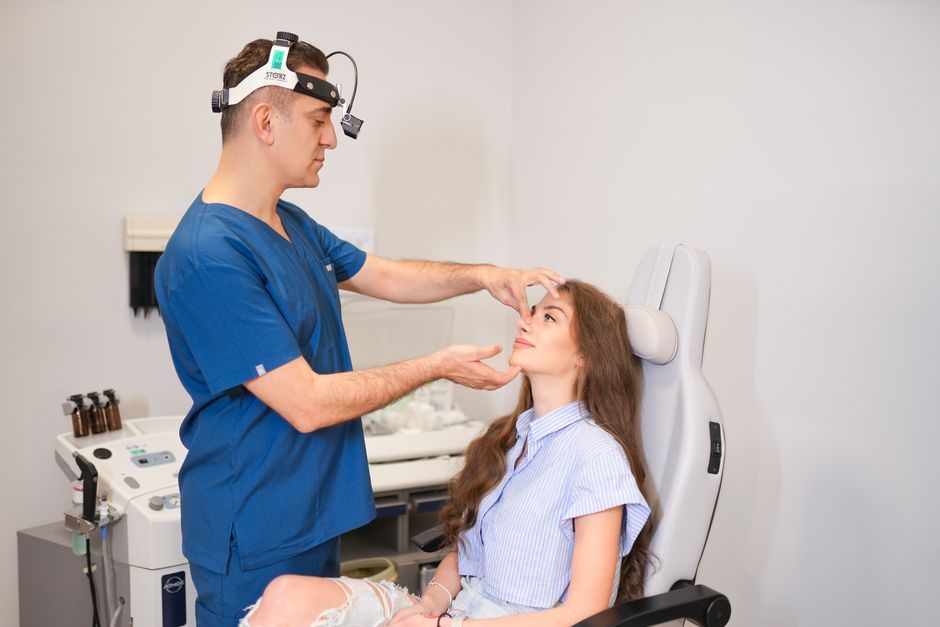
Septoplasty is an operation that raises most of its questions not before the procedure but afterwards: why the nose still does not breathe even after the packing is removed, when the crusts will go, where your sense of smell has gone and when you can get back to the gym. These are normal questions, and the answers are broadly similar for most patients, although the specific time frames in each case are set by the doctor. Below is a detailed account of how recovery after correction of the nasal septum goes, from the first hours on the ward to a return to your usual activity. This is an overview for patients, not a set of instructions: everything that concerns your nose remains a matter for your surgeon.
- What happens in the first hours after the operation
- Packing, splints and the day they come out
- The first days at home: swelling, crusts, sleep and daily life
- What to prepare at home in advance
- Nasal rinsing and care of the lining
- When breathing and smell return
- What affects the course of recovery
- Why it seems to get worse halfway through
- Restrictions: work, sport, sauna, flying
- Follow-up examinations and signs that cannot wait for an appointment
01What happens in the first hours after the operation
The first thing patients notice as the anaesthetic wears off is that the nose does not breathe, or barely does. More often than not this is an expected reaction to the operation, but only the doctor examining you can tell it apart from a complication. There is packing or silicone splints in the nasal passages, and the lining is swollen after surgery, so the air simply has nowhere to go. You have to breathe through your mouth, and it is this, rather than pain, that many patients remember as the most unpleasant part of the first days.
Mouth breathing quickly dries out the throat. Your throat feels gritty, your voice goes hoarse and you want to drink all the time. Plain water in small sips and a humidifier in the room help here. It is worth asking the nurse while you are still on the ward what you can use on your lips and whether you can suck anything for a dry throat, because this depends on what has been prescribed.
Along with the congestion, a few other sensations usually appear in the first hours. Swelling spreads to the cheeks, the bridge of the nose and the eyelids, so your face looks a little different from before the operation. More often than not this swelling goes down on its own as you heal, but only the doctor can judge whether everything is going as expected. Blood-stained discharge seeps from under the packing and gradually becomes lighter. Many people feel a dull pressure at the bridge of the nose and in the head, and the temperature sometimes rises slightly. Tell the staff about all of this: pain relief and fever medication are prescribed by the doctor, and you should not add anything to the regimen yourself, especially medicines that affect blood clotting.
How long a patient stays in the clinic after septoplasty depends on the technique, the extent of the operation, the type of anaesthesia and the rules of the particular hospital: some people are observed for a few hours, others are kept longer. This is worth finding out before the operation. After general anaesthesia or sedation you must not drive yourself, and an adult must accompany you home. This is not a matter of convenience but a safety rule: attention, reaction time and the ability to judge your own condition soberly take longer to recover after anaesthesia than patients think, and they do not notice this in themselves. That is why an escort is arranged in advance, before the day of the operation, together with whether same-day discharge is planned at all.
Another detail you are rarely warned about in advance: in the first hours the staff usually ask you to talk less, not to blow your nose and not to bend over. Blood from the nasopharynx may run down the back of the throat, and you are advised to spit it out rather than swallow it, because swallowed blood often causes nausea. If there is suddenly a lot of blood, call the nurse at once, without waiting for the ward round and without trying to judge for yourself whether it will stop.
02Packing, splints and the day they come out
What is placed in the nose after the operation varies a great deal. Classic gauze packing, haemostatic sponges (including ones that dissolve on their own), silicone splints, which are thin plates that hold the septum in its new position and often have a breathing tube inside. Sometimes the surgeon does without packing at all. What exactly has been placed in your nose and why is a simple and important question for your doctor: the answer determines whether you will breathe through your nose until the supports are removed and how long they will stay in.
These devices do different jobs, and that matters because aftercare depends on it. Silicone splints hold the straightened septum in its new position and keep the surfaces of the lining apart so that adhesions do not form between them; some splints have a tube inside, so some nasal breathing through them is possible. Gauze packing primarily presses the lining against the cartilage and stops bleeding, and it blocks nasal breathing completely while it is in place. Haemostatic sponges and dissolvable materials work mainly to stop bleeding and support the lining in the first days, and they usually do not need to be removed separately. What exactly is in your nose, why and for how long is a question worth putting to your surgeon directly.
All of these devices have one thing in common: you must never adjust, pull on or remove them yourself under any circumstances, even if it seems that something has shifted. If the packing sticks out or feels as though it has moved, tell the doctor rather than dealing with it at home.
Patients await the day the supports are removed almost as if it were a second operation. In reality it is usually a short procedure in the consulting room: the doctor moistens the packing, gently removes it and examines the nasal cavity. The sensations are unpleasant (pressure, a feeling of fullness, sometimes watering eyes and brief dizziness), but they do not last long. If sedation is planned before the supports are removed, you must not drive afterwards and will need someone to take you home; check in advance how this visit will be organised. Whether pain relief is needed before removal, and what kind, is decided by the doctor.
The main thing to be prepared for: after the packing is removed, the nose does not usually start breathing straight away. The lining is still swollen and there are clots and crusts in the passages, so air passes through poorly. The relief is often short-lived: it gets easier for a few hours, then the nose blocks up again. More often than not this wave-like pattern is an expected part of healing, but only the doctor can tell it apart from a complication, so tell them about sudden changes at an appointment or by phone rather than waiting. It is after this visit that the patient’s main job usually begins: regular care of the nose.
Not sure which clinic to start with?
A MediUkraine coordinator will help you choose a clinic and a doctor for your case, free of charge.
03The first days at home: swelling, crusts, sleep and daily life
The first days at home are a time when you simply need to leave your nose in peace. The swelling is still there, breathing is unstable, and crusts of dried blood and mucus form in the nose. Crusts are part of the healing of the lining, and they are the reason breathing may be worse than expected. Whether this is a normal course or a sign of inflammation is decided by the doctor at the examination, so if you have heavy crusting with an unpleasant smell or with pus, say so at once, without waiting for the scheduled visit. You must not pick them off with a finger, a cotton bud or anything else: there is fresh lining underneath, and injuring it easily causes bleeding.
During this period most patients prefer to sleep with the head of the bed raised, on a high pillow or half-sitting. This reduces facial swelling and makes breathing easier. Ask your doctor exactly how you are advised to sleep in your case and whether there are restrictions on lying on your side: this depends on the extent of the operation and on whether there is an external splint.
A separate note for those who use a CPAP or BiPAP machine for sleep apnoea. You must neither resume this therapy on your own after the operation nor stop it on your own for a long time. The machine creates pressure in the airways, and on a nose that has just been operated on this is no longer a neutral procedure; at the same time, a long break in apnoea treatment has its own cost. So the timing is not set by the patient: it is agreed with both the surgeon and the doctor who manages your apnoea. Both need to know about the situation in advance: tell the surgeon about the machine at the consultation, and let the doctor treating your apnoea know about the planned operation. At the same time, ask what to do about the mask and settings in the first days, and which signs mean you should phone without waiting for the scheduled visit.
Plan the first days as sick leave, not as working from home. Your head often feels heavy, your attention wanders and your sleep is broken because of mouth breathing; this is not a state in which negotiations or driving go well. A hot bath, a sauna, a long steamy shower, bending down for something you have dropped, lifting heavy things and straining all raise the pressure in the blood vessels of the head and can trigger bleeding, so they usually appear on the list of temporary restrictions. The doctor gives the specific time frames for each item at discharge; ask for them to be written down, because on the first day after anaesthesia your memory lets you down.
Eating is not particularly difficult, but in the first days soft food that is not too hot is more comfortable: hot food increases blood flow to the lining, and hard, tough food makes you chew hard, which you feel in the nose. You are usually advised to avoid alcohol while you heal: it dilates blood vessels and does not mix well with many medicines; the doctor will tell you how long to abstain. Smoking, including passive smoking, as well as smoke and dust irritate the lining and slow its recovery, so ask directly how long to avoid them too.
Another thing that is often forgotten is sneezing and coughing. After nose surgery you are usually advised to sneeze with your mouth open and without pinching your nose, so that the pressure does not hit the area that is healing. If you catch a cold and start coughing or sneezing in bouts, tell the doctor: they may adjust the regimen.
04What to prepare at home in advance
The final list is drawn up together with the doctor: it depends on what has been prescribed and on what exactly was done. But some things are easier to think about before the operation, while your head is clear, than on your first evening at home.
- A place to sleep with your head raised. A second pillow or a way to raise the head of the bed saves you hunting for support at night.
- A supply of soft tissues and something you do not mind putting under your head. Small amounts of blood-stained discharge in the first days are more often expected, and it is easier to protect your bed linen in advance.
- A humidifier, or at least a plan for keeping the air moist. During the heating season and with air conditioning, dry air noticeably increases crusting.
- Simple food and water within reach. You will not feel like cooking anything complicated in the first days, and you will need to drink a lot because of mouth breathing.
- A written list of prescriptions and an appointment schedule. Ask for them to be written down or printed at discharge, together with a contact you can reach between appointments.
- An escort on the day of the operation and an arrangement with your family for the first days. After general anaesthesia or sedation you do not go home alone, let alone drive: you need an adult to collect you. This is arranged in advance, not on the day of discharge. It helps if there is someone with you in the first days who can phone the clinic on your behalf.
Rinsing products and any drops are added to this list by the doctor. It is not worth buying them “just in case” on the advice of a forum: what suited someone else after a different operation may be contraindicated for you.
It is also worth asking in advance how the day the supports are removed will be organised (whether sedation is planned and whether you will need an escort on that day too) and roughly how many days you will be asked to stay in contact with the clinic. The rules vary, and they depend on the clinic and the type of anaesthesia.
05Nasal rinsing and care of the lining
Rinsing with a saline solution is the main care procedure during recovery. It softens crusts, washes out clots, moisturises the dried-out lining and makes breathing noticeably easier. When to start rinsing, with what and how often is decided by your surgeon. There is no single rule here: under some protocols a saline spray is prescribed while the splints are still in the nose, under others any irrigation is postponed until they are removed. So follow your own doctor’s instructions, not videos online or the experience of acquaintances after a different operation. If this item is missing from your prescriptions or is unclear, ask again rather than starting on your own initiative.
The most important point is about water. You must not use untreated tap water for the solution: neither straight from the tap nor passed through a household filter. Only sterile, distilled or previously boiled and cooled water is suitable, as well as a ready-made sterile solution from a pharmacy. This is not about how clean it tastes: tap water can contain microorganisms that are harmless when swallowed with a glass of water, because the stomach neutralises them, but which can cause a serious infection when they reach the damaged lining of the nose. The risk is small, but the consequences can be very serious, which is why this rule has no exceptions, and it applies not only to the first days after the operation. The rinsing container is washed and dried after each use, and a prepared solution is not kept open for long: the doctor or the product leaflet will tell you how to store it.
The technique also depends on what has been prescribed, not on habit. It may be a gentle spray, rinsing with a small volume, or flow-through rinsing, where the liquid goes into one nostril and comes out of the other. After some operations only a spray is allowed, and flow-through rinsing will not be prescribed during this period, so you do not choose the method yourself. If the doctor has prescribed flow-through rinsing, it looks roughly like this: lean over the sink, turn your head to the side, breathe through your mouth and introduce the solution into the upper nostril without sharp pressure, so that the liquid runs out of the lower one. A strong jet and a pinched second nostril are a typical mistake that drives the solution into the Eustachian tube and causes a blocked ear. It is best to practise the technique prescribed for you once in front of the doctor or nurse, rather than from a description.
After the procedure, do not blow your nose hard: remove mucus gently by lightly pressing one nostril, or let it drain on its own. Ask the doctor when you can blow your nose normally; until then, stick to the prescribed care. If rinsing causes pain, bleeding or a feeling that the liquid is going “the wrong way”, stop the procedure and phone the clinic without waiting for the scheduled visit.
Besides saline, the doctor may prescribe moisturising or softening products, ointments and sometimes drops or sprays with a different action. One principle matters here: after the operation, only what your doctor has prescribed goes into your nose. Decongestant drops, which many people are used to taking for a runny nose, should not be used on your own after septoplasty: they give deceptive relief and have their own limits on how long they can be used.
A separate word on crusts and cleaning the nose. At follow-up examinations the doctor usually cleans the nasal cavity under direct vision, carefully and with instruments designed for the purpose. This is much safer than attempts at home and often makes breathing noticeably easier straight after the visit. So do not skip these visits, even if you feel everything is fine.
A supporting factor that is easy to underestimate is the humidity of the air at home. Dry air, especially during the heating season or with air conditioning, dries out the lining and increases crusting. A humidifier, damp cleaning and ventilation do more for comfortable breathing than you might think.
06When breathing and smell return
The most common question after septoplasty is when the nose will finally breathe properly. The honest answer is: not straight away and not evenly. The septum itself is already in its new position after the operation, but how open the nose is does not depend on it alone: the air has to get past the swollen lining, clots and crusts. So at first breathing is worse because of swelling, then because of crusts, and after that it gets better or worse depending on the time of day, your body position and how dry the air is.
The typical pattern is this: the first clear relief after the supports are removed and the nose is cleaned, then a period of uneven breathing with gradual improvement, and only then a stable result, when you stop thinking about your nose. How long each of these stages lasts in your case depends on your starting condition, the extent of the operation, whether anything was done to the turbinates, and how you heal individually. The exact time frames should come from your surgeon, not from an article.
The story with smell is similar. In the first days and weeks many patients can barely smell anything, and this frightens them more than anything else. The cause is most often mechanical: odour molecules simply do not reach the olfactory area, because the way is blocked by swelling, packing and crusts. As the nasal passages open up, the sense of smell returns too, usually gradually and unevenly: first strong smells, then subtler notes, and food starts to taste fuller. If your sense of smell does not come back, or disappears suddenly after a period of improvement, tell your doctor without waiting for the scheduled visit and without giving yourself time to “see whether it sorts itself out”.
It is worth being honest about two separate things. Septoplasty corrects an anatomical cause, a deviated septum. But nasal congestion can also have other causes: allergies, chronic sinus inflammation, the condition of the turbinates, a reaction to dry air. If, after full healing, your breathing is still not what you hoped for, this is a reason to go back to the doctor and have further tests: there may be several causes, from residual swelling to adhesions or coexisting rhinitis, and they can only be sorted out at an examination.
07What affects the course of recovery
Patients often compare their own course with someone else’s and get frightened when it does not match. In reality, recovery after septoplasty is made up of several different stories, and each is influenced by different things.
- The extent and technique of the operation. The septum alone or the turbinates as well, endoscopic or not, with supports or without: aftercare and how quickly the nose starts to breathe both depend on this.
- The starting condition of the lining. Allergic rhinitis, chronic sinus inflammation, long-term use of decongestant drops before the operation: the lining “remembers” all of this and needs more time after surgery.
- General health and regular medication. Conditions that affect healing, a tendency to bleed, blood-thinning medicines: the doctor asks about these before the operation, and you must not keep quiet about them.
- Smoking and the air around you. Smoke, dust and dry air-conditioned air irritate the lining, and crusting increases.
- Regular care. Rinsing according to the regimen and attending visits on time affect how you feel more noticeably than most patients expect.
That is why you should not apply to yourself time frames heard from acquaintances or read on a forum. The same diagnosis in two people means different operations, different aftercare and a different speed of recovery. There is only one benchmark that matters: what the doctor who operated on you and sees your nose at examinations tells you.
08Why it seems to get worse halfway through
There is a point at which patients most often start to worry: the first relief after the supports were removed has passed, but breathing is not yet stable. The nose blocks up on one side, then the other, it is worse in the morning than in the evening, and your sense of smell has partly returned and then dulled again. On top of this comes tiredness: several nights in a row of sleeping with your mouth open, a dried-out throat, a face that is still not quite your own.
More often than not this dip is an expected part of healing: the lining recovers unevenly, the swelling goes down in waves, and crusts come and go after rinsing or a visit to the doctor. But only a doctor who sees your nose can tell uneven healing apart from a complication, so do not try to convince yourself that “this is how it should be”; it is simpler to ask. A few ordinary things help too: humidified air, rinsing according to the prescribed regimen, and expecting less of yourself during these days.
But there is a line beyond which it is no longer “just waves”. A sudden one-sided worsening with a feeling of fullness, pain that increases instead of easing, pus-like discharge or a fever are symptoms that a doctor should assess, not ones to put down to uneven healing. These things do not wait for the next scheduled visit: the list below is about them. And if you are at all unsure which of the two categories what you are feeling belongs to, phone your doctor; do not wait.
09Restrictions: work, sport, sauna, flying
The restrictions after nose surgery are not a set of universal rules but an individual list drawn up by the doctor based on the technique, the extent of the operation and how healing is going. The logic behind them is the same: anything that sharply raises the pressure in the blood vessels of the head, heats the tissues or risks a blow to the nose is put off until you have healed.
People return to work at different times. Office work without physical exertion usually becomes possible earlier than work in manufacturing, in dust, in the cold or with heavy lifting. If your work involves bending, vibration or long periods in a smoky or dusty room, tell the doctor before the operation, and plan your sick leave with some margin rather than cutting it fine.
Sport is usually reintroduced in stages, not all at once: first calm walking, then light exercise without bending or straining, and only after that strength training, running and intensive cardio. Swimming and pools are a separate matter: water, chlorine and pressure changes in the nose are not what a healing lining needs. Contact sports, martial arts and ball games are put off for longest, because a blow to the nose while the septum has not yet finally settled can undo the result of the operation. Both the sequence and the time frames for each category are set by the doctor.
A steam bath, a sauna, a hot bath, sunbathing and sunbeds act in a similar way: they dilate blood vessels, increase swelling and raise the risk of bleeding. They are usually on the list of temporary restrictions, but when they are lifted is a question for the doctor. In the same way, flying is worth discussing separately: pressure changes in the cabin are unpleasant for a nose that is healing, and if you have travelled from another city or country for the operation, it is best to agree the date of your return journey in advance, while you are still planning the trip.
Small things worth checking at discharge as well:
- when you can wear glasses, if the operation involved more than just the septum;
- from what point you are allowed to blow your nose with full force;
- when you can drive: you must not drive at all immediately after general anaesthesia or sedation, and after that the time frame depends on the painkillers prescribed and is set by the doctor;
- when and under what conditions to return to CPAP or BiPAP therapy, if you use it; this is agreed between the surgeon and the doctor who manages your apnoea;
- whether there are any restrictions on dental procedures in the near future;
- what to do if you catch a cold while you are healing;
- when you can go back to your usual cosmetic procedures on the face.
Each of these points has an answer, but it depends on what exactly was done to you.
10Follow-up examinations and signs that cannot wait for an appointment
Scheduled examinations after septoplasty are not a formality. At them the doctor assesses the position of the septum, cleans the nasal cavity, removes crusts you cannot reach at home, and spots in good time what the patient cannot see: adhesions between the lining and the septum, areas that are healing poorly, signs of inflammation. You should have the schedule of these visits in hand at discharge, together with a contact you can reach between appointments.
But there are situations in which you must not wait for the next examination. Contact your doctor or seek emergency care if any of the following appear. None of these points means you should first try something yourself and wait:
- heavy bleeding from the nose, or blood running down the back of the throat;
- a high temperature, chills, a growing sense of being unwell;
- severe pain, or pain that is increasing instead of easing;
- thick, pus-like discharge with an unpleasant smell;
- increasing swelling and redness of the eyelids, pain when moving the eyes, double vision or worsening sight;
- a sharp worsening of nasal breathing after a period of improvement, especially on one side and with a feeling of fullness at the bridge of the nose;
- a large amount of clear, watery discharge from one nostril that increases when you tilt your head;
- a severe headache with nausea, vomiting or a stiff neck;
- any reaction to the prescribed medicines: a rash, itching, facial swelling, difficulty breathing.
One item on the list deserves particular emphasis: a sudden worsening of breathing with fullness at the bridge of the nose is a reason to see a doctor quickly, whenever after the operation it appears, because blood can collect between the layers of the lining, and this condition is treated more successfully the earlier it is noticed. Do not hesitate to phone the clinic about something that seems minor. If in doubt, phone your doctor; do not wait: a question over the phone costs nothing, while delay can sometimes cost you the result.
If you are having the operation away from home, think about communication in advance: who to ask about dressings and removal of the supports, where to turn at night, whether a remote consultation is possible, who will receive your discharge summary. MediUkraine is not a clinic but an aggregator: a coordinator arranges treatment at the partner clinic in Uzhhorod, agrees the dates and finds out before the trip how post-operative follow-up will be organised and how many days you should allow for your stay. The clinic’s team communicates with international patients in English. These questions are cheaper to settle at the planning stage than on the third day after the operation. You can find out more about the procedure itself on the septoplasty (correction of the nasal septum) service page.
Related services: Septoplasty (Deviated Septum Correction) in Ukraine · Online ENT Consultation in Ukraine · Tonsil Removal (Tonsillectomy) in Ukraine
11Frequently asked questions
How long will my nose not breathe after septoplasty?+
Immediately after the operation, breathing through the nose is usually impossible because of the packing or splints and swelling of the lining. After the supports are removed, breathing improves, but it does not become normal instantly: swelling, clots and crusts get in the way, so at first it is uneven, sometimes better, sometimes worse. A stable result comes later, as the lining heals. The time frames depend on the technique, the extent of the operation and individual healing, so go by what your surgeon tells you.
Does it hurt to have the packing or splints removed?+
It is most often a brief unpleasant sensation rather than pain in the usual sense: pressure, a feeling of fullness, sometimes watering eyes and slight dizziness. The doctor usually moistens the packing before removing it so that it does not pull on the lining. Whether pain relief is needed before the procedure, and what kind, is decided by the doctor. If sedation is planned before the supports are removed, you must not drive afterwards and will need someone to take you home; check in advance how this visit will be organised.
Why has my sense of smell gone after the operation, and will it come back?+
The most common cause is mechanical: smells simply do not reach the olfactory area, because the way is blocked by swelling, packing and crusts. As the nasal passages open up again, the sense of smell usually returns gradually and unevenly: first strong smells, then subtler notes. If it does not return, or disappears suddenly after a period of improvement, tell your doctor without waiting for the scheduled visit: this needs to be assessed separately.
When can I go back to work and training?+
There is no one answer for everyone: the time frames are set by the doctor based on the technique, the extent of the operation and how healing is going. Office work usually becomes possible earlier than work involving physical exertion, dust or cold. Sport is reintroduced in stages: first calm walking, then light exercise without bending or straining, and only then strength training and running. Contact sports and swimming pools are usually put off for longest.
What should I rinse my nose with after the operation, and how?+
Rinsing with saline is the main care procedure during recovery, but when to start, with what and how often is decided by your surgeon: under some protocols a saline spray is prescribed while the splints are still in the nose, under others any irrigation is postponed until they are removed. You must not use tap water for the solution: only sterile, distilled or previously boiled and cooled water, or a ready-made sterile solution from a pharmacy, is suitable, because untreated tap water can cause a serious infection on the damaged lining of the nose. The method is also prescribed by the doctor: some people are allowed only a gentle spray, others flow-through rinsing, where the liquid goes into one nostril and comes out of the other, without a strong jet. After the procedure, do not blow your nose hard: remove mucus gently.
Can I remove the crusts in my nose myself?+
No. Under the crusts is fresh lining that is healing, and trying to remove them with a finger or a cotton bud easily causes bleeding and injures the tissue. Crusts are softened by rinsing and the products your doctor has prescribed, and anything that does not come away is removed by the doctor at a follow-up examination under direct vision. That is why you should not skip scheduled visits after septoplasty, even if everything seems fine.
What should I do if my nose starts bleeding at home?+
A little blood-stained discharge in the first days is more often expected, but whether it is within normal limits in your case is for the doctor to judge. If the bleeding is noticeable or blood is running down the back of your throat, seek help at once rather than waiting to see whether it stops. Do not pack your nose, rinse it or put anything into it “to stop the bleeding” on your own: in a nose that has been operated on, this can do harm. The doctor usually explains at discharge what you should do and which number to call; ask for this to be written down.
Will the shape of my nose change, and will there be scars?+
Septoplasty targets an internal structure, the septum, and with the endonasal approach the incisions are inside the nose. Whether there will be any effect on your appearance depends on the extent of the operation planned in your case: sometimes the surgeon works on other structures along with the septum. Discuss this with the doctor before the operation so that your expectations match the surgical plan.
Will snoring stop after septoplasty?+
Not necessarily. A deviated septum can be one of the causes of difficult nasal breathing and snoring, but not the only one: snoring is also affected by the state of the palate and tonsils, weight and sleeping position, and sleep apnoea is a separate matter that needs its own assessment. If you use a CPAP or BiPAP machine, tell both the surgeon and the doctor who manages your apnoea: you must neither stop the therapy on your own for a long time nor resume it on your own after the operation; the timing is agreed by both doctors. If snoring bothers you, tell the doctor before the operation: both the assessment plan and what you can realistically expect from the operation depend on it.