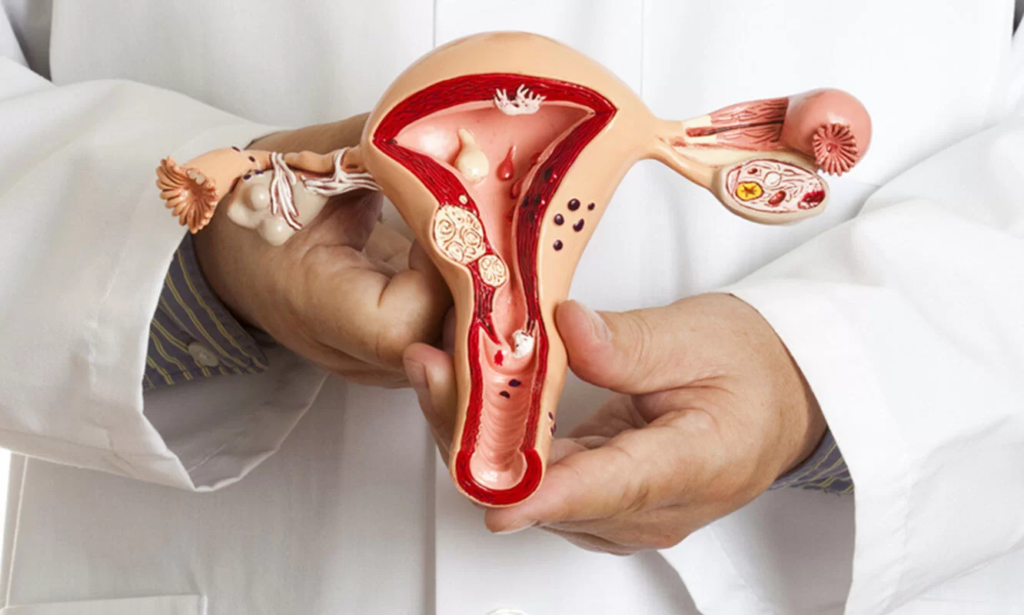
Uterine fibroids are one of the most common gynaecological diagnoses in women of reproductive age, and at the same time one of the most misunderstood. To some, the word immediately sounds like the threat of major surgery; to others, like something “harmless that almost everyone has”. Both ideas oversimplify reality.
A fibroid (myoma) is a benign growth of the muscular layer of the uterus. It is not cancer and in most cases has nothing to do with cancer. That does not mean, however, that it can always be ignored. The risk of a fibroid lies not in its name but in how it behaves: where it is, how big it is, whether it is growing, and whether it causes bleeding, pain, pressure on neighbouring organs or fertility problems. This is what determines whether monitoring is enough or treatment is already needed.
The problem is that many women get used to symptoms for years that are in fact already affecting their quality of life. Heavy periods, pressure in the lower abdomen, frequent urges to pass urine, weakness from blood loss: all of this is often put down to “just the way my body is”. Yet this is exactly how a fibroid gradually moves from a controlled condition to a problem that starts to drain the body and narrow the options for gentler treatment.
Why can uterine fibroids be dangerous?
Most often the danger of fibroids is gradual rather than acute. One of the main risks is heavy or prolonged periods, which can lead to iron deficiency and anaemia, and then to weakness, drowsiness, reduced capacity for work, palpitations and general exhaustion. If a woman loses too much blood every month, her body feels it even when she does not yet link her condition to the fibroid.
Another common problem is pressure on neighbouring organs. Large fibroids, or fibroids in certain positions, can press on the bladder or bowel, causing frequent urges to pass urine, a feeling of incomplete bowel emptying, bloating, and pressure or heaviness in the lower abdomen. In some women the abdomen visibly enlarges, not because of weight gain but because of the size of the uterus.
Fertility deserves a separate mention. Not all fibroids affect conception or pregnancy, but some can interfere with implantation of the embryo, change the shape of the uterine cavity or complicate the course of pregnancy. Mayo Clinic notes that fibroids may be associated with infertility if they affect the fallopian tubes or prevent a fertilised egg from implanting.
In other words, a fibroid is dangerous not because it is “frightening in itself”, but because it can affect blood loss, pelvic comfort, plans for pregnancy and a woman’s overall wellbeing for a long time without her noticing.
Do all fibroids need treatment?
No, and this is one of the most important things to understand. ACOG states plainly that fibroids may not need any treatment at all if they are small, cause no symptoms and pose no other risks. Simply finding a fibroid on an ultrasound scan does not automatically mean you need surgery or even medication.
That is why the modern approach starts not with treatment “just in case” but with assessing how the fibroid behaves. If it causes no symptoms, does not affect your quality of life, is not growing quickly and is not causing fertility problems, monitoring is in many cases the right approach. This is not inaction but a perfectly normal medical approach.
There is an important caveat, though: monitoring does not mean forgetting. Monitoring only works when there are regular check-ups and a clear understanding of which symptoms or changes mean the plan needs to be reviewed.
Which symptoms mean a fibroid should no longer simply be monitored?
Most often these are heavy periods, longer bleeding, bleeding between periods, pelvic pressure, pain, frequent urination, constipation or a visibly enlarged abdomen. Once a fibroid is affecting everyday life, treatment makes sense not only medically but in very practical terms. ACOG lists heavy or painful periods with anaemia, bleeding between periods, rapid growth of the fibroid, infertility or pelvic pain as possible reasons for treatment.
A situation in which symptoms are getting worse is a particular cause for concern. If your periods used to be moderately heavy and are now exhausting, if a feeling of pressure has appeared recently and is increasing, if you constantly need the toilet or your abdomen feels full, this is not something to keep explaining away for years as “just the way my body is”.
How are fibroids treated without surgery today?
Conservative treatment is used quite widely in modern gynaecology, but it is important to be honest: it more often helps to control symptoms than to get rid of the fibroid completely. Mayo Clinic and ACOG describe non-surgical options as a way of reducing bleeding, pain and some other symptoms. They include hormonal approaches, levonorgestrel-releasing intrauterine systems to control bleeding, and non-hormonal medicines such as tranexamic acid to reduce menstrual blood loss.
There are also medicines that can temporarily shrink a fibroid or control symptoms, but these regimens usually have specific indications and limits on how long they can be used, and they form part of a broader treatment plan. In other words, modern non-surgical treatment is not a “magic pill for fibroids” but an individually chosen way of reducing their impact on a woman’s life.
It is very important not to expect from conservative treatment what it does not promise. Its aim is not always to remove the fibroid completely; often it is to stabilise the situation, reduce blood loss, buy time or avoid a more radical intervention where possible.
When are procedures or surgery needed?
If the symptoms are severe, medication does not give enough control, or the fibroid is large, growing or affecting fertility, the doctor may recommend interventional or surgical treatment. It is very important to understand that modern gynaecology is not limited to hysterectomy. There are uterus-sparing operations, minimally invasive methods and procedures aimed at reducing symptoms and preserving the uterus, where this is possible and appropriate to the clinical situation.
Mayo Clinic describes several modern approaches, including focused ultrasound, radiofrequency ablation, uterine artery embolisation and surgical methods. Each has its own indications, advantages and limitations. The choice depends on the size and position of the fibroid, the symptoms, plans for pregnancy and whether the woman wants to keep her uterus.
In other words, modern fibroid treatment is not “surgery or nothing”. It is a range of options, and the aim is to choose not the most radical but the most appropriate one.
Does a fibroid always mean removing the uterus?
No, and this is one of the main fears worth putting to rest. Hysterectomy remains one of the treatment options for fibroids, but it is far from the only one and not always the first choice. ACOG and Mayo Clinic both describe uterus-sparing and symptom-control strategies before removal of the uterus is considered.
Hysterectomy is usually considered when other methods have not worked, the symptoms are severe, the fibroids are numerous or large, and pregnancy is no longer planned. But the decision must always be individual. Good clinical practice should never work on the automatic principle of “there is a fibroid, so the uterus has to go”.
Why you should not delay if you already have symptoms
Because fibroids often progress slowly, and this creates the illusion that you can live with them for a long time without doing anything. A woman gets used to heavy periods, plans her life around her cycle, considers her tiredness “normal” and puts up with pelvic pressure. But lost time here often means not just longer discomfort but fewer treatment options.
The earlier a fibroid is assessed, the better the chance that the solution will be a gentler one. Early diagnosis makes it possible to see how the fibroid is changing, keep anaemia under control, choose conservative management or move on to minimally invasive treatment in good time if it is needed. That is why, with fibroids, the wisest strategy is not to wait “until things get really bad”.
Why good coordination matters for international patients
Because fibroid treatment is almost never a single consultation but a pathway. The ultrasound needs to be assessed, sometimes anaemia needs to be checked, the position of the fibroids has to be established, and a decision has to be made on whether conservative management is possible or a procedure is needed, and whether the situation affects a pregnancy or plans for one. For a patient from abroad, without coordination this can easily become chaotic.
This is where a service such as MediUkraine plays its part. It does not just find a gynaecologist but builds a clear pathway: an initial assessment, gathering your existing test results, a consultation with a gynaecologist at the EXPERT medical network in Uzhhorod, whose team communicates with international patients in English, organisation of the tests, and then a clear treatment plan. This matters especially with fibroids, where decisions are rarely a one-liner and call for a careful choice between several scenarios.
Fibroid treatment in Ukraine
For international patients, an important advantage in Ukraine is quick access to gynaecological diagnostics and a flexible approach to organising the process. When a woman has been losing strength for months because of bleeding or living with pelvic pressure, being able to have a consultation, an ultrasound and further tests quickly and reach a clear decision has real practical value.
And if this pathway is coordinated through MediUkraine, treatment stops being a chaotic search between different clinics and opinions. It becomes a structured process, with a clear logic, a timeline and an understanding of why a particular option was chosen.
01Conclusion
A uterine fibroid is not automatically a dangerous diagnosis, but neither is it a condition that can always be safely ignored. Its real danger depends on how it affects the body: whether it causes heavy bleeding, anaemia, pelvic pressure, pain, difficulty conceiving or other symptoms. That is why fibroids call not for panic but for an accurate assessment. For some women monitoring or conservative treatment is enough; in other cases minimally invasive procedures or surgery are needed.
The strongest position here is not to get used to living with symptoms and not to be afraid of the word “fibroid”, but to understand how it behaves and act in good time. That is how modern gynaecology works. And if this pathway is organised through a coordination service such as MediUkraine, you get not just a consultation but a clear route to a decision that fits both your health and your plans for life.