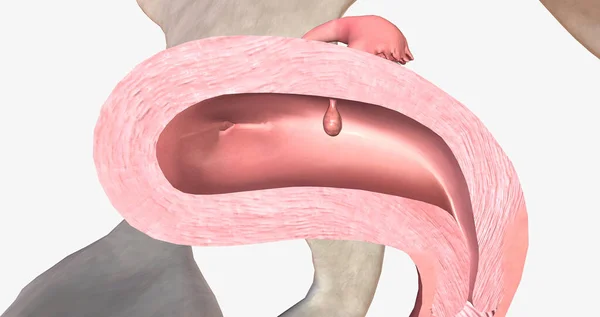
Uterine polyps are one of those diagnoses that often sound alarming before a woman has had time to understand what is actually involved. Some immediately think of surgery, some of cancer, while others reassure themselves that “it’s a common finding that lots of women have”. In reality, as is often the case in gynaecology, the truth lies neither in panic nor in ignoring the problem completely.
A uterine polyp is an overgrowth of the lining of the uterus, the endometrium. It may be small and found almost by chance, or it may cause very specific symptoms: heavy periods, spotting, bleeding between periods, difficulty conceiving. That is why the main question is not “Is a polyp dangerous or not?” but “What kind of polyp is it, how is it behaving and is it affecting my health?”
In modern gynaecology, polyps are not seen as something that always has to be removed straight away. Nor are they dismissed as a harmless trifle. Accuracy is what matters here. For one patient monitoring is enough; for another it really is better not to delay removal. Understanding this difference makes it possible to avoid unnecessary procedures without missing the point at which treatment has become the right decision.
What is a uterine polyp?
A polyp is a localised overgrowth of endometrial tissue that protrudes into the uterine cavity. It may be attached to the wall by a broad base or by a thin stalk. Polyps also vary in size: from very small ones, visible only on a careful ultrasound scan, to larger growths that already affect bleeding or fertility.
The key thing to understand is that a polyp in itself is not a diagnosis in the full sense. It is a finding that needs clinical interpretation. The same ultrasound report can carry different weight for different women. If the patient is young, has no symptoms and the polyp is small, the management will be one thing. If she has bleeding, difficulty conceiving or is going through the menopause, the approach will be different.
That is why a good doctor does not stop at “you have a polyp” but explains what it means in your particular situation.
Are all uterine polyps dangerous?
No, far from it. In most cases polyps are benign, which is why some of them can be monitored for a while without immediate treatment. But it is important not to confuse “benign in most cases” with “you can ignore it”.
A polyp becomes clinically significant not only when there is a risk of atypical changes, but also when it disrupts the normal function of the uterus. Even a benign polyp can cause persistent spotting, heavy periods, iron loss, constant worry about an irregular cycle or difficulty conceiving.
So the right question is not only “Is it cancer?” but also “Is this polyp changing my quality of life, my cycle or my chances of pregnancy?” That is where the right plan begins.
Why are polyps often found by chance?
Because some polyps cause no obvious symptoms for a long time. A woman has an ultrasound scan for another reason, for example to check her cycle, as part of a routine check-up, when planning a pregnancy or because another gynaecological problem is suspected, and that is when the doctor sees a growth in the uterine cavity.
On the one hand, a chance finding like this can be frightening. On the other, this is exactly the strength of modern diagnostics: many conditions are now detected before they reach the stage of obvious symptoms. After such a finding, though, it is very important not to go to extremes. Not every polyp found by chance means an urgent procedure, and not every polyp found by chance can simply be forgotten.
It needs to be assessed in context: what symptoms there are, the size and shape of the polyp, whether the woman is planning a pregnancy, her age and whether there are any risk factors that call for extra caution.
Which symptoms may suggest that a polyp is already affecting your health?
The most typical symptom is abnormal uterine bleeding, and it can take different forms. For some women it means heavier periods than before; for others, spotting between periods; for others still, a feeling that their periods have become longer, more irregular and unpredictable. Sometimes there is bleeding after sex.
This is where many women underestimate the problem. If there is not much blood, they assume it is nothing. If the cycle is more or less regular, it seems that nothing serious has happened. But in gynaecology it is precisely this kind of “chronic minor” problem that often turns out to be the most draining, because a woman spends months or years living with an unstable cycle, constantly waiting for the next episode of spotting and unsure whether she can plan her life freely.
Another important symptom is difficulty conceiving. A polyp can mechanically interfere with the implantation of an embryo or simply create a less favourable environment in the uterine cavity. In that case even a small growth takes on a completely different significance.
When can a polyp simply be monitored?
Monitoring is not always possible, but in certain cases it is a perfectly reasonable approach. This usually applies to a small polyp that causes no symptoms, is not accompanied by bleeding, does not look suspicious on imaging and has been found in a woman without additional risk factors.
It is important, though, to understand what “monitoring” means. It does not mean forgetting about the problem. It means having a clear follow-up plan: when to repeat the ultrasound, which symptoms to watch for and when to see the doctor again. Monitoring is just as much an active medical approach as treatment; it simply involves no intervention at the first stage.
The main mistake here is to put yourself on “watchful waiting” without any real medical reasoning. If your doctor has not explained why watchful waiting is appropriate in your case, that “monitoring” does not really exist. It is simply a postponed decision.
When does a polyp need to be removed?
Removal is most often recommended when a polyp causes symptoms. If there is bleeding between periods, heavy periods, recurrent spotting, fertility problems or a suspicion that the growth changes the uterine cavity enough to be clinically significant, waiting usually stops making sense.
Women during or after the menopause are a separate group. Here any uterine bleeding or polyp calls for closer attention. This is not because every polyp after the menopause is dangerous, but because doctors are more alert to the possibility of cancer in this group of patients, so the approach to such findings is more active.
Removal is also often chosen when a polyp is not simply there but stands in the way of a specific fertility goal. If a woman is planning a pregnancy, preparing to conceive or having difficulty with implantation, the polyp is no longer a neutral finding but a factor worth removing.
Why you should not live with bleeding for years if a polyp may be the cause
Because any chronic abnormal bleeding gradually wears you down, both physically and psychologically. A woman starts living in constant expectation of the next episode, cannot tell where her cycle ends and unscheduled bleeding begins, worries about every spot and plans her sex life, trips and work meetings around possible bleeding.
In addition, even if the blood loss does not seem large, it can gradually deplete iron stores. This leads to weakness, tiredness, poor concentration and drowsiness. Sometimes a woman is treated for “general exhaustion” for a long time without the gynaecological cause ever being found.
There is one more important point: a polyp that has been removed and sent for histological examination stops being a source of constant uncertainty. A polyp that has “just been there” for years while causing bleeding becomes a background worry that never goes away.
How are uterine polyps removed today?
The current standard is hysteroscopy. Its value lies in the fact that the doctor is not working “blind”. They see the uterine cavity from the inside, know exactly where the polyp is and can remove it precisely. This matters, because this approach is far more accurate than any blind procedure.
It matters for the patient too. Hysteroscopy is not just “having something done”: it provides diagnosis and treatment at the same time. After removal the tissue is sent for histology, so the woman gets not only the polyp removed but also a clear answer about what exactly was removed.
That is why, in modern gynaecology, removing a polyp is not only about getting rid of symptoms but also about clarity.
Can a polyp be treated without removal?
In some cases small polyps can disappear on their own, but in practice this is not a scenario to pin all your hopes on if you already have symptoms. Medication can sometimes have a temporary effect on bleeding, but it is not a universal way of getting rid of a polyp as a structural growth.
That is why, if a polyp is already causing symptoms or the doctor believes it needs to be assessed histologically, removal remains the most logical course. What matters here is not so much the word “treatment” as understanding the goal. If the aim is simply to reduce bleeding somewhat, conservative steps are sometimes possible. If the aim is to remove the source of the symptoms and find out exactly what the growth is, the most sensible decision is often removal.
Why good coordination matters for international patients
Because uterine polyps rarely call for an elaborate pathway, but they very much need the right one. You need to know whether your existing ultrasound is sufficient or a repeat scan is needed, whether there are indications for hysteroscopy, which tests are needed before the procedure, how long the diagnosis will take and how to organise everything without unnecessary delays.
This is where a coordination service such as MediUkraine is valuable. It does not just find a doctor but builds a logical pathway: an initial assessment, a review of your existing test results, a consultation with a gynaecologist at the EXPERT medical network in Uzhhorod, whose team communicates with international patients in English, and then hysteroscopy or monitoring. For you, this means much less confusion and more control over the situation.
Diagnosis and treatment of uterine polyps in Ukraine
With uterine polyps, speed and accuracy matter a great deal. No one wants to wait for months just to have an obvious problem confirmed or, on the contrary, to learn that there is no need to hurry in her case. Access to a gynaecologist, ultrasound, hysteroscopy and a follow-up plan can be organised in Ukraine without long waits.
And if the process is coordinated through MediUkraine, you get not scattered consultations and doubts but a clear medical pathway, from the discovery of the polyp to a well-understood decision.
01Conclusion
Uterine polyps do not always need to be removed, but they always need a proper assessment. If a polyp is small, causes no symptoms and raises no suspicion, monitoring is a perfectly reasonable option for some women. But if bleeding, difficulty conceiving, draining symptoms or clinical doubts about the nature of the growth appear, removal becomes the most logical and reasonable decision.
The most sensible approach is not to be afraid of the word “polyp”, but not to dismiss it either. Rather than guessing, you need to understand exactly what has been found, how it affects your body and which approach is right in your situation. And if this pathway is organised through a coordination service such as MediUkraine, you get not just a diagnosis but a clear and calm route to a decision.