| Service | 🇺🇦 Ukraine | 🇨🇿 Czech Republic | 🇹🇷 Turkey |
|---|---|---|---|
| Metal brace system | from USD 332 | from USD 3,103 | from USD 854 |
| Brace adjustment with archwire change | from USD 24 | from USD 47 | from USD 94 |
| Brace removal | from USD 38 | from USD 26 | from USD 16 |
| Retainer fitting | from USD 49 | from USD 95 | from USD 128 |
Prices in the “Ukraine” column come from MediUkraine’s partner clinics. The Czech Republic and Turkey columns show the lower bounds of prices published by clinics there (for Turkey, also the Turkish Dental Association’s recommended 2026 tariff), collected in August 2026 and converted to US dollars at the rate on the day of collection. A dash means we could not find a comparable published price. In any country, the final cost is set by the clinic after an examination.
Braces are a fixed orthodontic appliance with three parts: brackets bonded to each tooth, an archwire that runs through the bracket slots, and ligatures or built-in clips that hold the wire in place. The archwire tries to return to its original shape and pulls the teeth with it through the brackets. Braces are called metal when the brackets are made of steel; the archwire is metal in every type, including ceramic and sapphire braces.
The classic bracket material is medical-grade stainless steel, less often titanium or gold-plated steel. The base has a retention mesh bonded to the enamel with light-cured composite adhesive, and the working part is a 0.018- or 0.022-inch slot that holds the archwire. The slot is what sets steel apart: metal does not chip under load, the slot keeps its shape over years of wear, and it creates less friction with a steel archwire than ceramic or plastic.
Metal braces are chosen above all when teeth have to move a long way or along a complex path: severe crowding, where premolars are extracted and the spaces then closed; displaced and impacted canines that have to be brought into the arch; deep bite and open bite; rotated teeth; and preparation for orthognathic surgery, when hooks and intermaxillary elastics are attached to the archwire. For teenagers, reliability is another argument: steel brackets come off less often and do not crack.
In some situations bonding is postponed or another option is chosen. Braces are not fitted until decay has been treated and gum inflammation has settled: plaque builds up faster around brackets, and an untreated cavity has two years to grow. They also do not suit people who are not prepared to spend a few minutes every day cleaning around each bracket. Nickel sensitivity is a separate issue; titanium or ceramic brackets are then considered. If invisibility matters a great deal to you, sapphire or ceramic braces, lingual braces or aligners are discussed, bearing in mind that they are less predictable than steel for large movements.
MediUkraine is a treatment search and coordination service, not a clinic. We select the clinic and the orthodontist, agree visit dates and support patients, including those travelling from abroad. The orthodontist decides on the type of braces and the treatment plan after an in-person examination and a review of the X-rays.

Travel. Ukrainian airspace is closed, so there are no commercial flights. Patients reach Lviv overland, most often from Poland: Rzeszów and Kraków airports are the usual entry points, with a train, bus or private transfer onward to the border and on to the city. Lviv is roughly 70 km from the Polish border, the shortest crossing of any Ukrainian city.
Visas. Citizens of the EU, the United Kingdom and the United States do not need a visa for short stays in Ukraine. Rules depend on your citizenship, so check your own before booking.
Safety, plainly. Ukraine is at war. Air raid alerts occur in Lviv, and an appointment can be interrupted by one. Several governments advise against travel to Ukraine, and while that advice stands, ordinary travel and medical insurance is often void — confirm your cover with your insurer before you commit to anything.
Language. MediUkraine handles correspondence, scheduling, the written treatment plan and the quote in English. The clinic's team communicates with international patients in English.
Payment. You pay the clinic directly. Our coordination service is free of charge for you.
More on travel, safety and insurance: Safety and travel.
A bracket is a small attachment with three working elements. The base, with a retention mesh or laser etching, is bonded to the enamel with composite adhesive; the wings hold the ligature; the slot is a rectangular groove into which the archwire is seated. The shape and angle of the slot determine the future position of the tooth, so each bracket's position on the tooth is planned individually, not by eye.
The brackets are made from medical-grade stainless steel, the same group of alloys used to make surgical instruments. Steel does not stain from coffee, wine or turmeric, does not crack under the pull of intermaxillary elastics, and its slot does not deform over two years of wear. In practice, a steel wire in a steel slot creates less friction than in a ceramic or plastic slot, so less force is lost to sliding resistance and more goes into moving the tooth.
Depending on how the archwire is held, braces are either ligated or self-ligating. In a ligated system the archwire is secured with an elastic ring or a steel wire tie: this is cheaper and gives the doctor more control over how rigidly the tooth is tied to the archwire. In a self-ligating system the bracket has its own clip, either passive, which leaves the archwire room to slide, or active, which presses the archwire to the bottom of the slot. Self-ligating braces shorten visits and need no ligature changes, but cost more, and clinical comparisons show the difference in overall treatment time is smaller than advertising suggests.
The slot size is 0.018 or 0.022 inch. The wider slot is more common: it takes thicker rectangular archwires and is more practical when teeth have to move a long way with strong elastics. The narrower slot gives more precise control over the tilt of the crown and root in the finishing stages, because the archwire fills the slot more tightly. The orthodontist chooses the system for the clinical task, so there is no single answer to "which is better".
The angle of the slot and the thickness of the base are set in advance by the manufacturer; this is called the system's prescription. The most common prescriptions, Roth and MBT, distribute torque (tilt of the root) and angulation (tilt of the crown) differently for each group of teeth. A prescription saves time, because the appliance performs some of the movements without additional effort from the doctor, but it does not remove the need for individual bends: in real cases the orthodontist almost always adjusts the wire by hand.
Archwires are changed in sequence, from thin and flexible to thick and stiff. Treatment starts with round nickel-titanium wires of 0.012–0.016 inch: this shape-memory alloy produces a gentle constant force and aligns the teeth vertically and horizontally. Next come rectangular nickel-titanium wires of 0.016×0.022 and 0.019×0.025 inch, which start to control root position. The working phase (closing spaces, correcting the midline and using intermaxillary elastics) is done on rectangular steel archwires, because they hold their shape under load. For fine finishing, titanium-molybdenum wires of intermediate stiffness are sometimes used.
Besides the brackets and archwire, the system has auxiliary elements. Buccal tubes are bonded to the molars, or metal bands are placed when the tooth is damaged or a more reliable anchor is needed. Spaces are closed with elastic chains or nickel-titanium springs. Intermaxillary elastics, which the patient changes daily, correct the relationship of the jaws in Class II or Class III malocclusion. To make complex movements without the anchor teeth shifting, orthodontic mini-screws are placed: temporary titanium anchors in the bone that are removed once the stage is complete. Space for alignment is created either by extracting premolars or by interproximal enamel reduction, removing fractions of a millimetre of enamel from the sides of the teeth.
Steel braces remain the mainstay for complex cases precisely because of their strength. When an impacted tooth has to be brought into the arch, a tooth rotated, a 7–8 millimetre extraction space closed, or the jaws held with elastics before orthognathic surgery, the load on the brackets is high and prolonged. Under these conditions ceramic brackets chip at the wing more often, and rebonding means an extra visit and a pause in tooth movement. That is why steel is chosen more often than other materials in adolescent orthodontics and in surgical cases.
The main drawback is visibility, and people adjust to it differently. There are several ways to soften this: fitting steel only on the lower jaw and ceramic or sapphire brackets on the upper jaw, which shows when you smile; choosing smaller brackets; and, for teenagers, coloured ligatures that make the braces part of their style. Only lingual braces, bonded on the tongue side, are completely invisible, but they cost more, take longer to get used to and noticeably affect speech in the first weeks.
The second issue is hygiene. Around the base of each bracket there is an area that a toothbrush cannot reach with normal strokes: plaque is retained between the bracket wing and the gum margin and on the contact surfaces under the archwire. If it is not removed, white demineralised spots appear on the enamel within a few months and stay visible after the braces come off. That is why cleaning with braces is a different routine: a single-tuft brush goes round every bracket, an interdental brush passes under the archwire, and this has to be done after every meal, not twice a day.
For the first 3–5 days your teeth will ache: this is a normal response as the teeth start to move, not a complication. The pain is usually dull, worse when biting and most noticeable on the second day. Eat soft food during this time and take your usual painkiller if needed. In the first week the brackets rub the inside of the cheeks and lips: cover sore spots with orthodontic wax; within 7–10 days the tissues adapt.
Dietary restrictions apply throughout treatment. Do not bite on anything hard, such as nuts, rusks, ice, fruit stones, or whole apples and carrots: this is the most common reason brackets come off. Sticky foods such as toffee, chewy sweets and chewing gum pull at the brackets and clog the space under the archwire. Cut hard fruit and vegetables into pieces and take meat off the bone.
Cleaning takes about 5–7 minutes after every meal: first brush along the teeth with the orthodontic toothbrush, then go round each bracket from above and below with the single-tuft brush, then clean between the teeth and under the archwire with the interdental brush. A water flosser rinses away debris in a minute but does not replace mechanical cleaning. Have a professional clean at the clinic every 3–4 months, and use fluoride toothpaste and mouthwash daily from day one.
The first visible changes appear after 2–3 months, almost always on the front teeth, which have a single root and move faster than multi-rooted molars. This gives the false impression that treatment is nearly over, when the longest phase, correcting the bite and root positions, is still ahead.
Realistically, treatment with metal braces takes 18–24 months in a typical case, and up to 30 months with extractions, impacted canines or preparation for surgery. No orthodontist can give an exact duration before starting: the speed of movement depends on bone density, age and the response of the tissues, and only a doctor can predict the result in an individual case, after an examination and follow-up X-rays.
Once the braces come off, the retention period begins, and it lasts at least as long as the treatment itself. A fixed wire retainer is bonded behind the front teeth, and a clear night-time retainer is usually added. In the first year the clear retainer is worn for longer, then less often, but the fixed retainer stays in place for years and is checked every six months: the ligaments around the teeth keep pulling them back towards their old position for a long time.
Step 1. Consultation and diagnostics. The orthodontist examines the bite and the condition of the gums, takes a photo record, refers you for a panoramic X-ray and a cephalogram, and takes impressions or a digital scan. From this data they work out how much space is missing in the arch, whether premolar extractions are needed and how each tooth needs to move. You receive a written plan with stages, approximate timelines and a quote.
Step 2. Dental treatment and professional cleaning. Before bonding, decay is treated, fillings with overhanging edges replaced, teeth extracted if indicated, tartar and plaque removed and the enamel polished. This is not a formality: adhesive only holds on healthy, clean enamel, and inflamed gums bleed, making it hard to bond each bracket exactly where planned.
Overall: diagnostics and dental treatment take from two weeks to two months, active treatment usually 18–24 months with a visit every 4–8 weeks, and removing the braces, polishing the enamel and bonding the retainer fit into a single appointment. Between bonding and removal come levelling of the teeth on flexible archwires, correction of the bite and spaces on steel ones, and final finishing; at each visit the doctor shows you what has changed since last time.
Treatment is divided into phases, each with its own goal. The first is levelling: aligning the teeth by height and resolving crowding on thin nickel-titanium archwires. It lasts roughly 3–6 months and brings the most visible changes, which is why it can feel as though the job is almost done.
The second phase, correcting the bite and closing spaces, is the longest. The orthodontist moves on to rectangular steel archwires, closes the spaces left by extractions with elastic chains or springs, adds intermaxillary elastics and places mini-screws if needed. Here the result depends directly on your discipline: elastics only work if worn 20–22 hours a day.
The third phase is finishing: the orthodontist checks how each pair of teeth meets, aligns the midline, bends the archwire for individual teeth and sometimes rebonds brackets at a new height. This phase takes 3–4 months and may seem unnecessary because the teeth already look straight, yet it is what determines how stable the bite will be afterwards.
The fourth phase is removal and retention. The braces are removed, the enamel is polished, and on the same day a fixed retainer is bonded and a clear retainer is made. A check-up follows a month later and then every six months, when the doctor checks that the wire retainer is intact and the teeth have not shifted.
Treatment overruns for a few predictable reasons: missed adjustments, brackets coming off often because of hard food, wearing elastics irregularly and gum inflammation not treated in time. Each adds weeks to the plan. The orthodontist sees this on follow-up X-rays and should discuss the new end date openly rather than quietly moving it.
The most common complication is enamel demineralisation around the brackets: white, chalky spots. They form where plaque has sat for weeks and do not disappear on their own after the braces come off, because the enamel there has already lost minerals. Prevention is tedious, and there is no shortcut: mechanical cleaning after every meal, fluoride toothpaste and mouthwash, and a professional clean every 3–4 months. At the first signs, the orthodontist prescribes fluoride varnish or casein phosphopeptide products, and in severe cases removes the braces early.
The second risk is root resorption. Many patients have 1–2 millimetres of root shortening, which is usually clinically insignificant, but more marked resorption can occur with large movements, excessive forces or an individual predisposition. That is why a follow-up X-ray is taken not only at the start but also around 6–12 months into treatment, so the approach can be adjusted in time.
As for the gums, chronic plaque can cause gingivitis and gum overgrowth, and moving a tooth beyond the bone can cause recession, exposing the neck of the tooth. These problems are directly linked to hygiene and biomechanics, so a periodontist is involved at the planning stage if the gums are thin or there is already attachment loss.
Minor everyday problems happen to almost everyone: a loose bracket, a broken ligature, a wire end digging into the cheek, mouth ulcers in the first weeks. All are dealt with at an extra visit, and until then with orthodontic wax. Do not cut the archwire yourself or stick a bracket back on with household glue: a damaged archwire no longer works as planned, and household glues irritate the inside of the mouth.
Sensitivity to the nickel in stainless steel is rare, but it shows up as persistent contact stomatitis or a rash around the mouth. For patients with a known allergy, titanium, gold-plated steel or ceramic brackets are considered. Tell the orthodontist about any history of allergic reactions before bonding, not after symptoms appear.
Contraindications may be temporary or permanent. Temporary ones are untreated decay and pulpitis, active gum inflammation and poor hygiene: once these are dealt with, treatment becomes possible. Permanent or relative ones include severe periodontitis with loose teeth, uncontrolled general illnesses, previous radiotherapy to the jaws, and certain medicines that affect bone. Significant skeletal problems cannot be corrected with braces alone: in adults they are treated together with a maxillofacial surgeon, and braces are part of the plan, not a substitute for surgery. Only a doctor can assess which group a particular case belongs to, after an examination and a review of the X-rays.
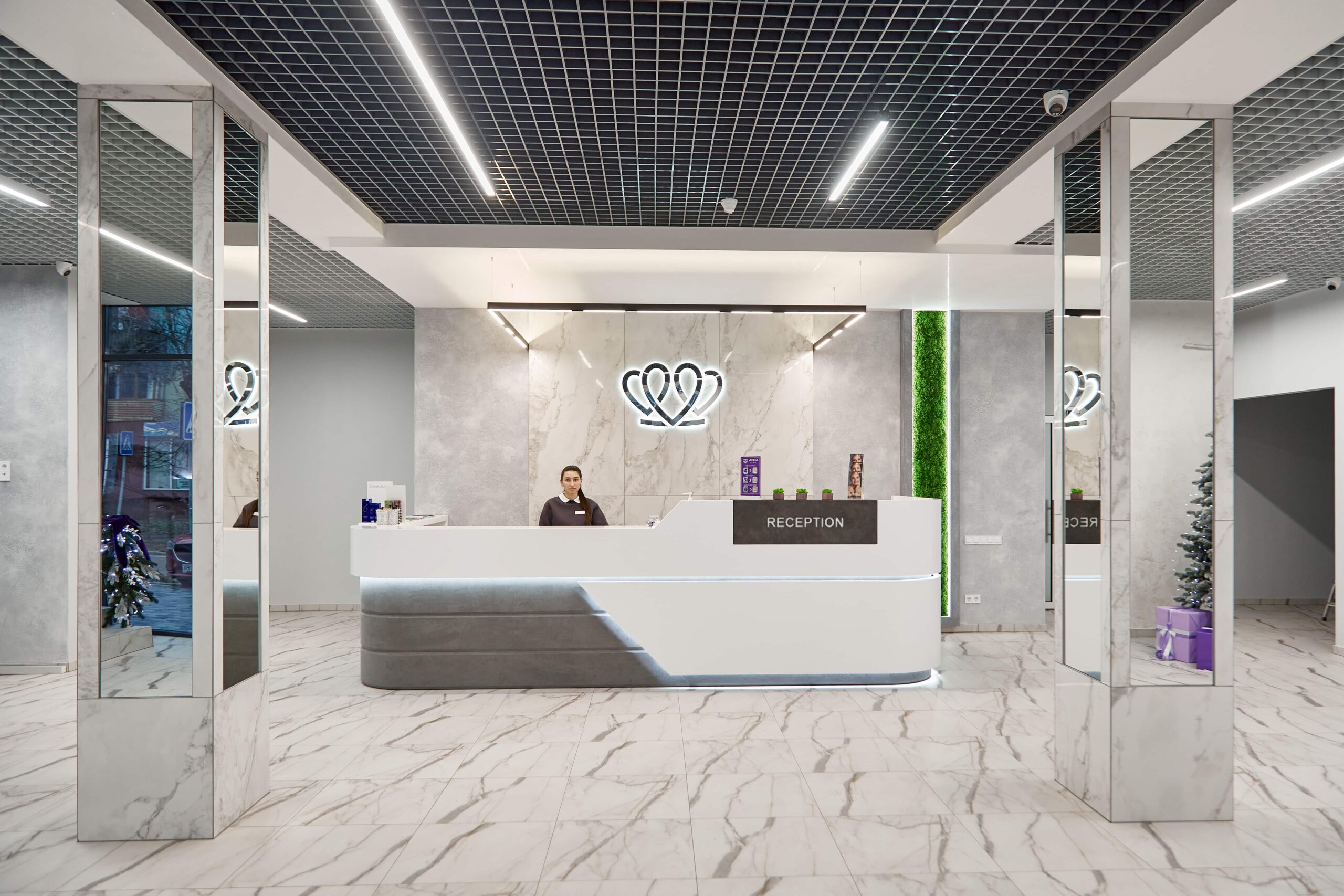
📍 Lviv, Ukraine
A dental clinic in Lviv with a separate doctor for each field: oral surgery and implants, prosthodontics, restorative dentistry, endodontics under a microscope, periodontics, orthodontics and paediatric dentistry.
The difference is the bracket material and what follows from it. Steel brackets are stronger, slimmer and create less friction with the archwire, so they cope better with heavy loads: intermaxillary elastics, closing extraction spaces, bringing impacted canines into the arch. Ceramic and sapphire brackets are less noticeable, but bulkier, more brittle at the wings and create more friction with the archwire. The archwire itself is metal in all types. A combination is often used: ceramic on the upper jaw, steel on the lower.
At MediUkraine's partner clinic in Lviv, braces for one jaw cost from USD 332. Charged separately are adjustments with an archwire change (from USD 24 every 4–8 weeks), removal of the braces (from USD 38) and fitting a retainer (from USD 49). On top of this come diagnostics (X-rays, clinical photographs, treatment planning) and any dental treatment needed before bonding. The final figure is set by the clinic after an examination: it depends on the complexity of the case and whether extractions or mini-screws are needed.
Typically 18–24 months; in complex cases with premolar extractions, impacted canines or preparation for orthognathic surgery, up to 30 months. The first visible changes appear after 2–3 months, mostly on the front teeth, but the longest phase, work on the bite, comes after that. Missed adjustments, brackets that keep coming off and irregular elastic wear all make treatment longer. No orthodontist can give an exact end date before treatment begins.
Bonding itself is painless and needs no anaesthesia: the enamel is etched and the brackets are bonded, and no tooth tissue is drilled. Aching starts a few hours after bonding and after each archwire change, lasts 2–3 days and is relieved by your usual painkiller. In the first week the brackets rub the inside of the cheeks; cover sore spots with orthodontic wax. After 7–10 days the tissues adapt, and from then on discomfort is limited to the day after an adjustment.
After every meal, for about 5–7 minutes. Brush along the teeth with a V-shaped orthodontic toothbrush, go round each bracket from above and below with a single-tuft brush, clean the gaps and the space under the archwire with an interdental brush, and use floss with a stiffened end between the teeth. A water flosser rinses away debris but does not replace mechanical cleaning. Use fluoride toothpaste every day and have a professional clean at the clinic every 3–4 months; otherwise white demineralised spots appear around the brackets.
Usually once the second permanent molars have come through, at around 11–13 years of age, depending on how the child's bite is developing. Before that, removable appliances that guide jaw growth are used. There is no upper age limit: braces are fitted at 30 and at 50 if the gums and bone are healthy. In adults teeth move more slowly, and a periodontal check is more often needed before bonding.
Straight-looking teeth and finished treatment are not the same thing. After levelling, the crowns are in place, but the roots are still tilted, the back teeth do not yet meet properly, and the midline may be off. If the braces are removed at this stage, the teeth will most likely return to their previous position within a few months. Braces are only removed early for medical reasons, for example significant enamel demineralisation. The orthodontist decides after a follow-up X-ray.
Tell us what you need: we will suggest a clinic and a doctor and send you a cost estimate.
Request a consultation →