| Service | 🇺🇦 Ukraine | 🇨🇿 Czech Republic | 🇹🇷 Turkey |
|---|---|---|---|
| Brace adjustment without archwire change | from USD 12 | from USD 47 | from USD 94 |
| Brace removal | from USD 38 | from USD 26 | from USD 16 |
| Orthodontist consultation | from USD 16 | — | — |
Prices in the “Ukraine” column come from MediUkraine’s partner clinics. The Czech Republic and Turkey columns show the lower bounds of prices published by clinics there (for Turkey, also the Turkish Dental Association’s recommended 2026 tariff), collected in August 2026 and converted to US dollars at the rate on the day of collection. A dash means we could not find a comparable published price. In any country, the final cost is set by the clinic after an examination.
A sapphire bracket is neither glass nor plastic but monocrystalline aluminium oxide, a synthetic corundum grown from a melt as a single crystal. It is transparent and lets light through, so it takes on the shade of whatever is beneath it: once bonded, the bracket partly blends into the enamel. This is what sets it apart from ceramic brackets, which are made of polycrystalline aluminium oxide: light scatters at the boundaries between the many crystals, so the material is white and matte rather than transparent.
The mechanics, however, are the same as for any fixed appliance. A bracket with a slot is bonded to each tooth, an archwire runs through the slots, and as it tries to return to its preset shape it pulls the teeth with it; the bone around the root remodels, and the tooth moves together with its socket. The bracket material changes how the braces look and some practical details; the tooth movement itself works in the same way as with metal, ceramic or self-ligating systems.
This option suits adults with light enamel best, especially those who do not want to spend a year or two in conspicuous metal braces: people in public-facing roles, those who work on camera or regularly meet clients. Clear brackets make most sense in the smile zone, that is, on the upper front teeth, and that is where they are most often placed, with metal left on the side teeth and the lower jaw. Indications for the treatment itself are the same as for any fixed appliance: crowding, gaps, a deep bite, open bite or crossbite, preparation for prosthetic treatment.
Clear brackets are not offered to everyone, or not straight away. Dark, greyish or tetracycline-stained enamel defeats the purpose: the crystal takes on its colour and starts to read as a shiny dot, whereas a matte ceramic bracket masks better. In a deep bite the lower incisors close directly onto the upper brackets; sapphire withstands this load worse than steel, so treatment either starts with a bite-raising platform or metal brackets are placed on the lower jaw. Bruxism and contact sports are also reasons to discuss metal. Untreated caries, inflammation around a root, a flare-up of periodontitis and poor hygiene postpone the start regardless of material, and in children treatment is planned once the permanent teeth have come through, usually not before the age of 11–13.
MediUkraine is a treatment search and coordination service, not a clinic. We choose the clinic and a doctor with the right specialism, arrange the dates and support you throughout, including if you are coming from abroad. Our partner clinic for this treatment is the Vidnova dental practice in Lviv, 10 Ivana-Teodoziia Kurovtsia Street. The decision on indications, bracket material and the treatment plan is made by the orthodontist after an in-person examination.

Travel. Ukrainian airspace is closed, so there are no commercial flights. Patients reach Lviv overland, most often from Poland: Rzeszów and Kraków airports are the usual entry points, with a train, bus or private transfer onward to the border and on to the city. Lviv is roughly 70 km from the Polish border, the shortest crossing of any Ukrainian city.
Visas. Citizens of the EU, the United Kingdom and the United States do not need a visa for short stays in Ukraine. Rules depend on your citizenship, so check your own before booking.
Safety, plainly. Ukraine is at war. Air raid alerts occur in Lviv, and an appointment can be interrupted by one. Several governments advise against travel to Ukraine, and while that advice stands, ordinary travel and medical insurance is often void — confirm your cover with your insurer before you commit to anything.
Language. MediUkraine handles correspondence, scheduling, the written treatment plan and the quote in English. The clinic's team communicates with international patients in English.
Payment. You pay the clinic directly. Our coordination service is free of charge for you.
More on travel, safety and insurance: Safety and travel.
Sapphire in dentistry is a synthetic material, not a mined mineral. A single crystal of pure aluminium oxide is grown from a melt at over two thousand degrees, then cut and polished into the shape of a bracket. It lacks the impurities that give the natural stone its blue colour, so the crystal is colourless and transparent. In hardness it is second only to diamond, a toothbrush and toothpaste barely scratch it, and it does not cloud over time, which is why the bracket stays transparent until the end of treatment.
Transparency works as camouflage only as long as the enamel beneath the bracket is light. The crystal has no colour of its own; it only lets light through, so what is behind it shows: on a light tooth the bracket merges with the surface and is noticeable mainly by its outline and the archwire. On greyish enamel, enamel darkened after root canal treatment or tetracycline-stained enamel, the opposite happens: the dark background shows through the crystal, the polished facets catch the light, and the bracket stands out as a shiny dot. In this situation a ceramic bracket masks better: polycrystalline ceramic scatters light, it is matte, and its shade is matched to the colour of the teeth. This is best decided at the consultation by looking at your own enamel in daylight, not at promotional photos.
Strength needs to be discussed carefully, because two different properties are easily confused. Hardness is the resistance of the surface to scratching, and in this respect the monocrystal outperforms polycrystalline ceramic: its surface stays smooth and shiny for longer. Fracture toughness, the ability not to split once a defect has appeared, is another matter. In polycrystalline ceramic a crack runs into grain boundaries and slows down; a single crystal has no grain boundaries, so a small chip on the wing of a bracket can develop into a split right through. The practical takeaway is simple: both materials are more brittle than steel, the most vulnerable point is the thin tie wings for the ligature, and brackets break mostly from biting on something hard or from being struck by the lower incisors, not on their own.
The second technical point is friction in the slot. The archwire has to slide through the slots when teeth are moved together or gaps are closed, and ceramic and sapphire surfaces hold it back more than steel does. Manufacturers address this in two ways: they insert a metal liner into the slot, or they make the sapphire bracket self-ligating, with a clip instead of a ligature. Both reduce friction, but a metal liner shows as a dark strip, so you give up some of the aesthetic benefit. How much this matters depends on the plan: with mild crowding the difference in sliding changes little; with large movements after premolar extraction it matters more.
Clear brackets are bonded with the same adhesive as metal ones, but here any imprecision is visible to the naked eye. The base of the bracket has a micro-textured or chemically treated surface to bond with the adhesive, and the orthodontist removes any excess squeezed out around it before curing. If this is not done, a matte rim of hardened adhesive remains around the bracket, which is noticeable and traps plaque. That is why bonding clear braces takes a little more chair time than metal ones.
The most common source of disappointment with clear braces is not the brackets but the ligatures. The clear or white elastic ties that hold the archwire absorb pigments: coffee, black tea, turmeric and curry, tomato paste, soy sauce, red wine and beetroot change their colour within two to three weeks, and the braces as a whole look worse than the brackets themselves. The ligatures are replaced at every adjustment visit (the visit without an archwire change, from USD 12 every 4–8 weeks). Patients who do not want this routine choose either a self-ligating appliance without elastics or grey metal ligatures, which do not stain, though they are more noticeable than clear ones.
The archwires in clear braces are the same as in metal ones, and they do the actual work. Treatment starts with thin round nickel-titanium wires: the alloy has shape memory and delivers a light continuous force that is comfortable during the alignment stage. Next come rectangular nickel-titanium wires, then steel ones, which hold their shape and allow gaps to be closed and root inclination to be controlled, and in the final stage titanium-molybdenum or steel wires with individual bends are used. White-coated archwires are also available for a near-invisible look, but be aware that the coating wears off against the slots within a few weeks and starts to look patchy.
A deep bite deserves a special mention, because it is the most common reason for advising against clear brackets on the upper incisors. If the lower incisors press directly on a bracket when the teeth close, it takes an impact every day, and chipping is only a matter of time. There is a flip side too: sapphire is harder than enamel, so with constant contact it is the opposing tooth that wears down. There are ways round this, such as temporary bite-raising platforms on the upper incisors that keep the teeth apart for the first few months, or metal brackets on the lower jaw, but this has to be decided before bonding, not after the first chip.
That is why the most common practical choice is a combined approach: clear brackets on the upper teeth in the smile zone, metal ones on the side teeth and the lower jaw. It looks discreet, costs less than fully clear braces and keeps the mechanics more predictable. As for the alternatives: ceramic brackets win on dark enamel, metal ones on strength and price, lingual ones hide the appliance on the inner side, and aligners are removable but do not work in every case and depend on disciplined wear. Which of these suits you is decided from the X-rays, not by preference.
Treatment lasts 12–30 months, and the bracket material makes no fundamental difference to this. The length depends on the complexity of the case: mild crowding without extractions goes faster, closing gaps after premolar extraction and correcting a bite with a skeletal component take longer, and in adults bone remodelling is slower than in teenagers. Clear braces can add time only through breakages: every chipped or debonded bracket means an unscheduled visit and a pause in tooth movement. Alignment does not change the shape or colour of the teeth or improve the condition of the gums and bone, and marked skeletal discrepancies cannot be corrected by braces alone: in those cases combined treatment with orthognathic surgery is discussed. Only an orthodontist can predict the result for an individual patient, after an examination and an analysis of the X-rays.
For the first three to five days after bonding the teeth ache and are painful when biting; this is a normal reaction to the start of movement, not a sign that something has gone wrong. Soft food helps, as does an ordinary painkiller if needed. During the same period the brackets rub the inside of the cheeks and lips; cover sore spots with orthodontic wax until you get used to them.
You also have to get used to how the braces look in the mirror. Freshly bonded clear brackets with new ligatures almost merge with light enamel, and patients are often surprised at how little other people notice. After two or three weeks you stop feeling the braces, and brackets on the outer surface of the teeth hardly affect speech, unlike lingual braces.
From then on, how the braces look follows the adjustment cycle. The ligatures gradually darken from drinks and spices, so the braces look their worst in the last week before a visit and neat again straight after it. This is no reason to change the elastics more often than scheduled: an unscheduled visit does nothing to speed up treatment and only adds cost. Getting into the habit of rinsing with water after coffee, tea or dishes with turmeric helps reduce staining.
The first visible changes in tooth position are noticeable after about two to three months, and the front teeth straighten fastest. This is encouraging but can be misleading: the front teeth move easily, while the main work of correcting the bite, closing gaps and controlling root inclination takes up the rest of treatment. The most tedious part comes last: at the detailing stage everything looks finished from the outside, although this is exactly when the contacts between the upper and lower arches are being refined.
Removing clear braces takes one visit, though longer than removing metal ones. The brackets are removed with special pliers, adhesive residue is ground off with a tungsten carbide bur at low speed and the enamel is polished. This is when the effects of your oral hygiene throughout treatment become visible: white demineralised spots around the former brackets, if plaque stayed there for months; they do not disappear on their own, they are reduced with remineralising therapy, and some have to be covered with a restoration. The enamel under and around the brackets may also differ in shade, so whitening is planned after removal.
The most important thing to know before you start: treatment does not end with removal. Teeth that have just moved are held by stretched periodontal fibres and immature bone, so without retention they move back, most noticeably the lower incisors. Immediately after removal a fixed retainer is fitted, a thin wire on the tongue side of the front teeth, usually combined with a clear night-time retainer. The retention period lasts two years or more, and most orthodontists advise wearing the night-time retainer indefinitely.
Step 1. Consultation and diagnostics. The orthodontist examines the bite, assesses the enamel shade and discusses whether clear braces are a good choice in your case: with a deep bite or darkened enamel they may suggest a different material. Then a cone beam CT scan or a panoramic X-ray, a lateral cephalometric X-ray, a photo record and impressions or scans of the jaws are taken. A cephalometric analysis determines where the problem lies, in the position of the teeth or in the relationship of the jaws, and you are given a plan with stages, an approximate duration and a quote.
Step 2. Dental treatment and a professional clean. Before bonding, caries is treated, old fillings with overhanging margins are replaced, teeth that are in the way are extracted according to the plan, and the shade of restorations in the smile zone is assessed: a filling under a clear bracket can no longer be redone. A professional clean is done shortly before the fitting, because a bracket will not hold on enamel with plaque. This step cannot be skipped: a tooth under a bonded bracket cannot be treated.
In total, treatment lasts 12–30 months. Between diagnostics and removal come preparatory dental treatment and a professional clean, bonding in 1.5–2 hours and roughly eight to twenty-five adjustment visits at which the ligatures and archwires are changed, followed by the working phase with gap closure and detailing. Removal of the appliance costs from USD 38 takes one visit and ends with polishing of the enamel. But it is retention, not removal, that completes treatment: a fixed retainer and a night-time retainer for at least two years, otherwise the teeth move back. No anaesthesia or hospital stay is needed at any stage.
Treatment does not progress continuously but in cycles. The archwire applies constant light pressure, the bone remodels, the tooth shifts by fractions of a millimetre, and within a few weeks the force fades because the archwire has straightened as far as it can. Then the next cycle is needed: a visit at which the ligatures or the archwire itself are changed. Hence the 4–8 week interval, and the reason treatment cannot be completed in a few visits.
These cycles add up to three phases. Levelling aligns the teeth into one arch with thin flexible wires, usually over the first few months; this is when you see rapid progress. The working phase closes gaps, corrects the jaw relationship and moves roots with stiffer rectangular archwires; it is the longest. Detailing is the final refinement of contacts, when almost nothing changes from the outside but the work continues.
With clear braces this rhythm has an extra benefit. The ligatures lose their looks in roughly the time it takes the archwire to spend its force, so a visit every 4–8 weeks both reactivates the mechanics and restores the neat appearance of the braces. Shortening the interval for the sake of appearance is not a good idea: coming back after two weeks means catching the bone in the middle of remodelling, and excessive force does not speed up movement but raises the risk of root damage. Missing two or three visits is worse: the teeth stop moving or shift in an uncontrolled way, and part of the progress has to be repeated.
The plan is reviewed along the way, which is normal. At check-up visits the orthodontist compares the actual movements with the planned ones; if a tooth is not moving as it should, the sequence is changed, anchorage is added or a previous archwire is reinstated. Roughly halfway through treatment a follow-up X-ray is taken to assess the condition of the roots and bone. The duration given at the first visit is the orthodontist's estimate, not a commitment: it is affected both by discipline with elastics and by the number of breakages.
The last stage is retention, and it is the longest. After the braces are removed, the teeth are held with a fixed retainer and a night-time retainer: the periodontal fibres return to their previous shape slowly, the bone around the moved teeth takes months to mature, and it is during this time that the risk of relapse is highest. The minimum period is two years, and most orthodontists advise keeping the night-time retainer long term. A retainer check every 6–12 months is needed because patients usually do not notice a debonded wire themselves.
The most common complication of any fixed appliance is enamel demineralisation around the brackets, the white chalky spots that become visible after removal. The mechanism is simple: plaque collects next to the bracket and ligature, bacteria produce acid, and minerals are washed out of the surface layer. This is not a minor cosmetic issue but the first stage of caries. Prevention is a daily job: brushing after every meal, interdental brushes, fluoride toothpaste and mouthwash, and a professional clean every 3–6 months. Clear brackets do have one side benefit here: plaque along the edge of the crystal is visible earlier than around opaque metal.
Caries and gum inflammation come next. With poor hygiene, gingivitis develops in the first few months, and in some patients the gums overgrow and partly cover the brackets; a professional clean is then needed, and sometimes surgical correction. Once hygiene improves, the inflammation usually resolves. With generalised periodontitis, however, moving teeth while inflammation is active accelerates bone loss, so treatment begins only after the condition has stabilised.
A complication specific to clear braces is chipping and splitting of brackets. The tie wings are thin and the material is brittle, so hard food can break a bracket in a second. Throughout treatment, nuts, seeds, rusks and crusts, ice, caramel and toffee, popcorn, bones and cartilage are excluded from the diet; hard apples, carrots and tough meat are cut into pieces rather than bitten with the front teeth. Sticky foods, such as chewing gum, nougat, halva and chewy sweets, are cut out altogether: they pull brackets off the enamel. Every breakage means an unscheduled visit and a pause in movement, so these food restrictions are not just advice but part of the treatment plan.
The hardness of the material poses a further risk. Sapphire is harder than enamel, so in a deep bite, when the lower incisors constantly close onto the upper brackets, it is the opposing tooth that wears down, while the bracket itself takes an impact load. The same applies to bruxism and night-time jaw clenching. That is why with a deep bite treatment either starts with a bite-raising platform that separates the arches for the first months, or metal brackets are placed on the lower jaw.
Removing clear brackets requires a special technique, because it is the enamel that is at risk. The right pliers break the adhesive layer rather than the bracket itself; if the bracket splits, the orthodontist removes its remnants with a bur, and that is when microcracks and enamel chips are possible, especially on teeth with large restorations. Adhesive residue is removed with a tungsten carbide bur at low speed followed by polishing. Root resorption also deserves a mention, a shortening of the root tips during movement: it shows up on X-rays in many patients but is rarely clinically significant, and the risk is higher with long treatment, large movements and excessive forces.
The most common long-term outcome is relapse, and it is predictable: without a retainer the teeth return to their previous position, and the lower incisors do so faster and more noticeably than the rest. Not following the retention regimen is the main reason patients return to the orthodontist a few years later. Contraindications are either temporary or require an individual decision. Temporary ones are untreated caries, inflammation around a root, a flare-up of periodontitis and poor hygiene: once these are dealt with, treatment can go ahead. Caution is needed in patients taking bisphosphonates or denosumab, or who have had radiotherapy to the jaw area, because bone remodelling is impaired. Less often there is an allergy to the nickel in archwires, in which case titanium or coated wires are used. The clinics MediUkraine works with hold a licence from the Ministry of Health of Ukraine to practise medicine in the relevant specialties, and the orthodontist checks contraindications individually during the examination.
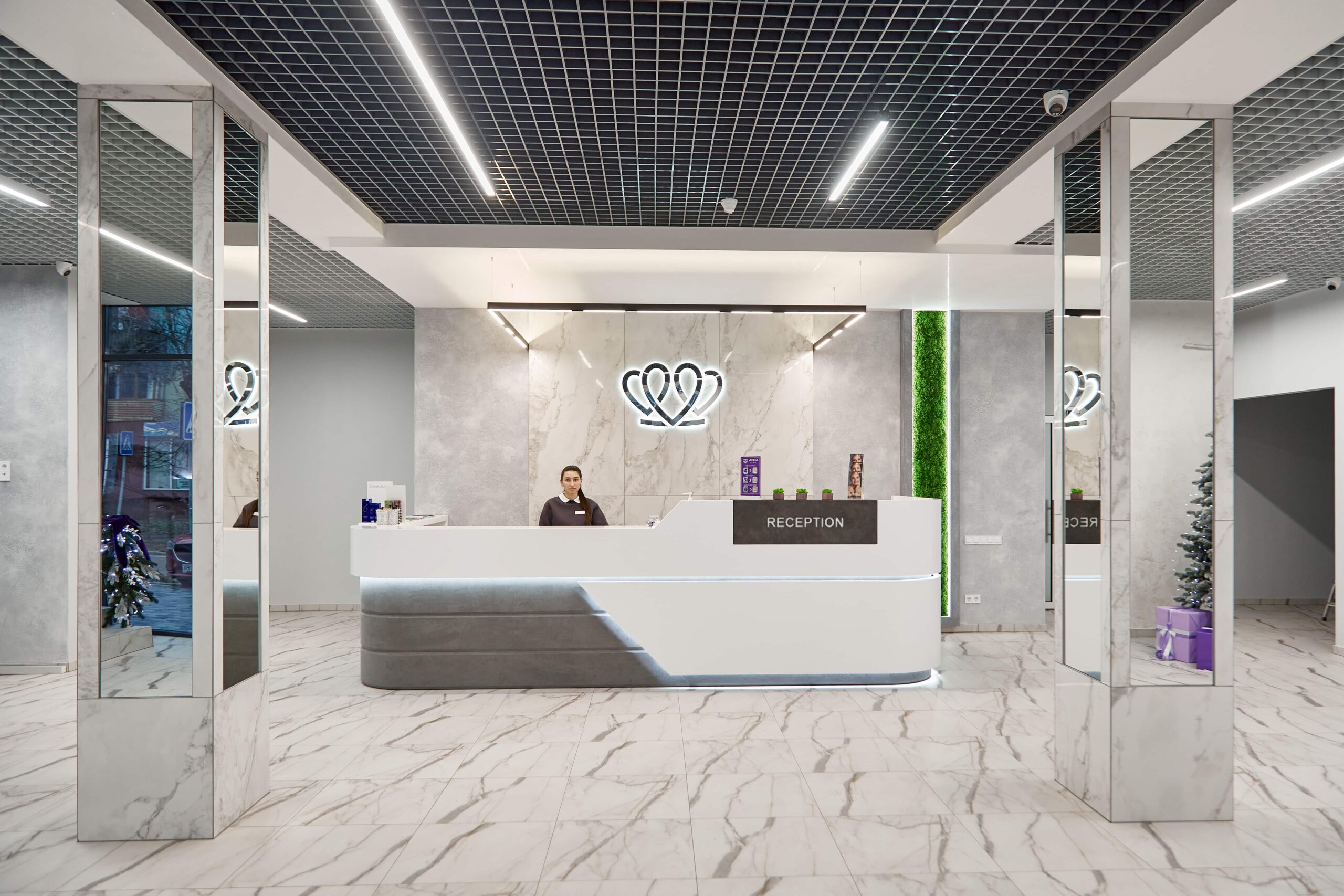
📍 Lviv, Ukraine
A dental clinic in Lviv with a separate doctor for each field: oral surgery and implants, prosthodontics, restorative dentistry, endodontics under a microscope, periodontics, orthodontics and paediatric dentistry.
In the material and how it interacts with light. A sapphire bracket is a single crystal of aluminium oxide: it is transparent, has no colour of its own and takes on the shade of the enamel beneath it. A ceramic one is made of the same oxide, but polycrystalline: light scatters at the grain boundaries, so the bracket is white and matte, and its shade is matched to the colour of the teeth. Hence the practical difference: on light enamel the clear bracket is less noticeable, on dark or greyish enamel the matte ceramic one is. Ceramic also withstands impacts slightly better, because a crack slows down at the grain boundaries.
At the clinics MediUkraine works with, the cost of the system is calculated after an examination, and it is worth checking whether it is quoted for one jaw or both. Charged separately are the orthodontist consultation (from USD 16), an adjustment visit without an archwire change (from USD 12 every 4–8 weeks) and removal of the braces (from USD 38). On top of that come diagnostics, any dental treatment needed before you start, and a fixed retainer plus a night-time retainer. The orthodontist gives the final amount after an examination, because the scope of preparation depends on the condition of the teeth.
Yes, and more noticeable than ceramic ones. The crystal is transparent, so it shows what is behind it: on greyish enamel, enamel darkened after root canal treatment or tetracycline-stained enamel, the dark background shows right through, and the polished facets catch the light, so the bracket looks like a shiny dot. On light enamel the opposite happens: the bracket almost merges with the surface, and it is the archwire that catches the eye. So the material is best chosen at the consultation, looking at your own teeth in daylight, not from promotional photos.
The crystal itself does not: it is dense and non-porous, pigments cannot penetrate it, and it stays transparent until the end of treatment. What stains are the clear elastic ligatures that hold the archwire: coffee, black tea, turmeric and curry, tomato paste, soy sauce, red wine and beetroot change their colour within two to three weeks. The ligatures are replaced at every adjustment visit, so the braces look their worst in the last week before a visit. Patients who do not want this routine choose a self-ligating system without elastics or grey metal ligatures.
They can: the material is hard but brittle, and the tie wings are thin. Throughout treatment, nuts, seeds, rusks and crusts, ice, caramel and toffee, popcorn, bones and cartilage are excluded; hard apples, carrots and tough meat are cut into pieces rather than bitten with the front teeth. Sticky foods, such as chewing gum, nougat, halva and chewy sweets, are cut out altogether, because they pull brackets off the enamel. Every breakage means an unscheduled visit and a pause in tooth movement, so the dietary restrictions here are part of the treatment plan, not just advice.
Above all, patients with a deep bite, where the lower incisors close directly onto the upper brackets: the bracket takes an impact load every day, and the hard crystal also wears down the opposing tooth. In such cases treatment starts with a bite-raising platform or metal brackets are placed on the lower jaw. Clear brackets also make no sense on dark, greyish or tetracycline-stained enamel. Metal is also worth discussing with bruxism and contact sports. Untreated caries, a flare-up of periodontitis and poor hygiene postpone the start regardless of material.
The bracket material itself makes no fundamental difference to the duration: treatment lasts 12–30 months, and the length depends on the complexity of the case, not on how transparent the braces are. Ceramic and sapphire surfaces create more friction with the archwire than steel ones, so sliding may be slower during gap closure; this is offset by a metal liner in the slot or a self-ligating design. What really lengthens treatment is breakages: every chipped or debonded bracket means an unscheduled visit and a pause in tooth movement.
Tell us what you need: we will suggest a clinic and a doctor and send you a cost estimate.
Request a consultation →