
Knee replacement is an operation whose outcome does not depend on the surgeon alone. Replacing the joint usually reduces pain and restores mobility, but it does not guarantee pain-free walking: some patients are left with pain, stiffness or limited movement. How well you make use of what the new joint can do also depends on you: every day, exercise by exercise, step by step. This article is a detailed account of what usually happens after the operation, from getting up for the first time on the ward to living with the implant years later. Everything that concerns time frames, routine and restrictions is decided by your doctor in each individual case.
- Recovery starts on the ward, not at home
- Pain and swelling: why they are managed, not endured
- Preventing thrombosis is not an add-on but part of the protocol
- Range of movement: why exercises must not be skipped
- Walking with a support: from a walking frame to independent steps
- A home ready for your return: practical aids
- What determines the pace of recovery
- Living with a new joint: what you can do, what to avoid and when to see a doctor
01Recovery starts on the ward, not at home
Many people picture rehabilitation as something that begins after discharge. In fact it begins in hospital, and usually quite early: the exact moment is decided by the care team, taking into account the type of anaesthesia, how the operation went and your condition. The staff help you sit on the edge of the bed, then stand up and take your first steps with a walking frame, under supervision and with someone ready to catch you. This is not haste for its own sake: early mobilisation is needed to support circulation, expand the lungs and keep the muscles from switching off.
The first days on the ward are made up of simple but important things. Breathing exercises. Movements of the foot and ankle, the so-called muscle pump. Tightening the quadriceps (the large muscle at the front of the thigh) without moving the knee. Attempts to lift the straightened leg. The first bending and straightening of the knee within the range the physiotherapist allows. The specific set of exercises, the number of repetitions and the moment you can move on to each of them are prescribed by the care team, not by an article or someone else’s experience. Each of these exercises looks too small to matter, and that is exactly why they are skipped most often.
At the same time, the medical staff watch the wound and dressing, assess pain, monitor your temperature and, if needed, manage the drain. How long you stay in hospital is decided by the operating surgeon: it depends on the type of implant, other conditions, your age and how you respond to activity. A general description of the operation itself and of what the programme includes is on the knee replacement service page, but the final decision on time frames is always made by the doctor on site.
Discharge is not a celebration that it is all over but a handover of responsibility. The criteria for readiness are set by the clinic: they usually look at whether you can get up on your own and walk with a support, how you manage stairs, the state of the wound, whether pain is under control and whether you understand what to do next. Before you leave, it is worth getting several things in writing:
- a list of prescribed medicines and how long to take them;
- how much weight you are allowed to put on the operated leg;
- an exercise programme for the coming weeks;
- the date of your next check-up and a list of follow-up tests;
- a contact to message or call if something goes wrong.
If you have come from another city or country, discuss the journey home separately: how long a journey is acceptable in your particular case, whether you need stops, and whether and when you can fly. This is a question of safety, not logistics: long periods of sitting still are directly linked to the risk of thrombosis. A MediUkraine coordinator can check in advance with the partner clinic, the EXPERT medical network in Uzhhorod, whether post-operative follow-up is included in the programme and how many days you are advised to allow for staying near the hospital. The clinic’s team communicates with international patients in English.
02Pain and swelling: why they are managed, not endured
Pain in the first days after knee replacement is an expected part of recovery: this is major surgery on bone, and the discomfort is noticeable. But that does not mean any pain after the operation is safe. Sudden severe pain, especially together with deformity of the leg, being unable to bear weight, or a cold or discoloured foot, may signal an acute complication. In that case you need urgent medical help, not to wait it out. At the same time, ordinary post-operative pain does not have to be endured: pain relief is usually prescribed on a schedule rather than only once the pain becomes unbearable, and several medicines are often combined. The logic is simple: movement is the treatment, and pain stops movement. A patient who holds out to the last simply bends the knee less and recovers more slowly. Which medicines, at what dose and for how long is decided by the doctor.
That is why painkillers are taken according to the prescribed schedule, not when the pain is already unbearable. This matters especially before sessions with the physiotherapist: ask your doctor separately how to time your medication around the exercises. If the prescribed regimen is not working, tell the doctor rather than increasing the dose yourself or adding medicines from your home cabinet: some painkillers do not combine well with the medicines prescribed to prevent thrombosis.
Swelling is a separate story that patients are rarely prepared for. The knee may stay enlarged, warmer to the touch and less sensitive around the incision for noticeably longer than most people expect. Bruises that gradually slide down to the shin and foot can also be part of normal recovery: more often than not this is an expected tissue reaction, but only a doctor can tell it apart from a complication. This does not mean any swelling can be ignored: what matters is how it changes over time, and that is for the doctor to judge.
- Swelling that rises and falls with your level of activity more often reflects the load, but only a doctor can tell it apart from a complication.
- Swelling that keeps increasing, together with worsening pain, redness, discharge from the wound or a fever, is a reason to contact your doctor immediately.
- If you cannot tell which of these situations applies to you, call your doctor; do not wait.
To control swelling, cold on the knee area and raising the leg while resting are used most often. Whether this suits you, how many times a day, how long to keep the cold on and what position to lie in will be advised by the physiotherapist: it depends on the state of the wound and the sensitivity of the skin. One detail is worth knowing in advance: putting a roll under the knee itself is usually not recommended. In that position the knee gets used to being bent, and the lost straightening then has to be won back.
It helps to keep a short diary for the first weeks: how you slept, how far you walked, whether there was swelling in the evening, how you coped with the exercises. At a follow-up appointment such notes are worth more than trying to remember from memory, and they help you see that there is progress even when it feels as if you are standing still.
Not sure which clinic to start with?
A MediUkraine coordinator will help you choose a clinic and a doctor for your case, free of charge.
03Preventing thrombosis is not an add-on but part of the protocol
Major orthopaedic operations on the lower limb increase the risk of blood clots forming in the veins of the leg. The reasons are clear: tissue injury, enforced immobility, swelling and changes in blood clotting. That is why preventing thrombosis is not a just-in-case suggestion but part of the post-operative protocol. What it includes and how long it lasts is decided by the doctor, and prevention often continues after discharge.
There are usually several components, and they work together. The first is movement: the same early mobilisation and foot exercises that seem trivial. The second is medication, if prescribed: the doctor chooses the medicine, the dose and the duration. This is where patients most often go wrong: they stop taking it as soon as they feel better, or miss doses once they are home. The third component is compression stockings or intermittent compression devices, if recommended; not everyone needs them, and not for the same length of time.
A few rules worth remembering after discharge:
- do not change the dose of the prescribed medicine or stop it on your own, even if nothing is bothering you; stop only as agreed with the doctor who prescribed it;
- tell any doctor or dentist that you are taking a medicine that affects blood clotting;
- do not add painkillers, supplements or herbal remedies without agreeing it with your doctor, as they can strengthen or weaken the effect of your medicines;
- do not sit still for hours: on a journey, at a desk or in front of a screen, take breaks and move your feet, unless your doctor has restricted activity;
- drink enough fluids, unless your doctor has limited the amount because of other conditions.
Medicines that affect blood clotting increase the risk of bleeding, so you need to know the signs of significant bleeding in advance. Seek medical help urgently if you notice:
- blood in your urine or stools;
- black or tarry stools;
- vomiting blood or material that looks like coffee grounds;
- bleeding that takes a long time to stop, including from the nose or gums;
- significant bleeding from the surgical wound or a dressing that is soaking through with blood;
- a sudden severe headache;
- a large number of bruises appearing for no obvious reason.
A separate word about falls. If you fall and hit your head, seek medical help urgently, even if you feel fine and there are no visible injuries. You should also tell your doctor that you have fallen. If you are unsure whether this applies to you, call your doctor; do not wait.
Signs that call not for booking an appointment but for urgent help: sudden swelling of one calf or thigh, a bursting pain in the calf, noticeable redness and local warmth of the skin. Sudden shortness of breath, chest pain, a racing heart or coughing up blood are reasons to call emergency services rather than wait until morning.
A separate word about the journey. A long trip by road or air means hours of sitting still, so your route and the timing of your return home should be agreed with the surgeon in advance, while the operation is still being planned. As an international patient, it makes sense to ask your doctor whether in your case it would be safer to spend a few extra days near the clinic rather than setting off on a long journey at the first opportunity.
04Range of movement: why exercises must not be skipped
This is the most important part of rehabilitation, and the easiest to put off until tomorrow. After the operation the knee has two tasks, and they are different. The first is bending: to sit down, stand up, climb stairs and get into a car. The second is full straightening: so that the leg straightens completely when you stand and walk.
Patients almost always underestimate straightening. A bent knee hurts less, so the leg instinctively stays half-bent: on a pillow, in an armchair, while walking. The problem is that lost straightening, according to physiotherapists, is harder to regain than lost bending, and a leg that does not straighten fully changes the way you walk and overloads the back, the pelvis and the other leg. That is why rehabilitation programmes include separate exercises specifically for straightening, and when you are lying down you are often asked to put a roll under the heel rather than under the knee.
Why timing matters
Tissues heal after the operation, and as they heal they tend to shorten and stiffen. There is a period when movement comes relatively easily, and it is best to make use of it; how long it lasts in your case is something the care team will tell you. If exercises are skipped regularly, the knee may stiffen within a limited range, and then regaining movement sometimes requires additional procedures or interventions that are far more unpleasant than daily exercise.
What it looks like in practice
Physiotherapists usually stress that regularity matters more than intensity here: several short sets during the day are easier to tolerate than one long, exhausting session. Moderate discomfort and a feeling of stretching while working on movement are more often expected, but only a doctor can tell them apart from a complication. Sharp pain during or after a session, however, is a signal to stop and contact your doctor or physiotherapist, not to push through it by force. If you are unsure whether it is the normal stretching feeling or not, call; do not wait for the next session. Some clinics use machines for passive movement of the joint in the early period, while others rely on active exercises with an instructor; the approach is decided by the care team.
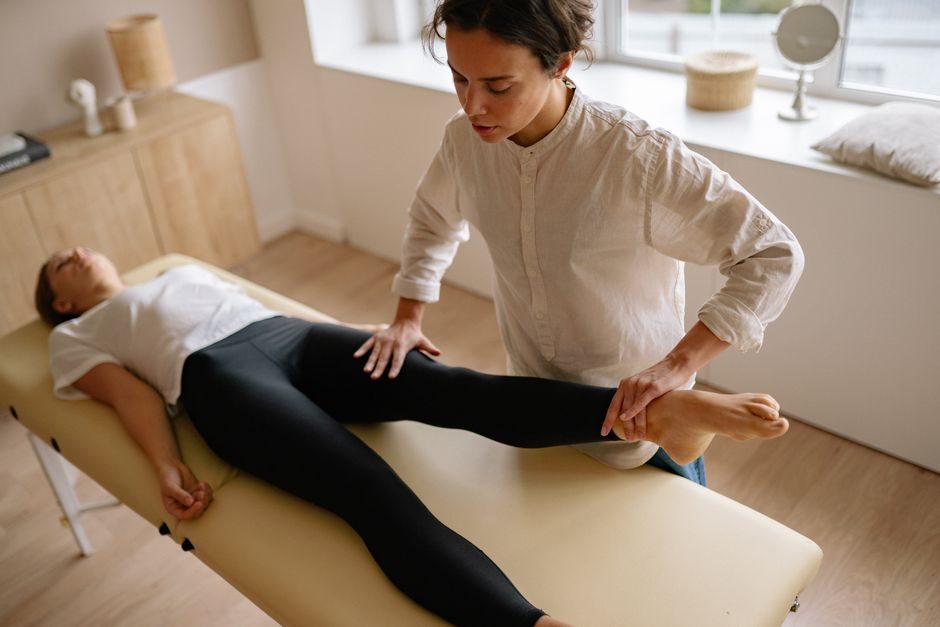
Sessions with a physiotherapist should be planned from day one, not fitted in when there is time left over. The specialist measures the angles of bending and straightening, sees compensations you do not notice in yourself and adjusts the programme. If you are going back to another city or country, it is worth agreeing in advance who will look after you from then on: a local physiotherapist, remote video sessions or a combination. The coordinator can check with the clinic whether such follow-up is offered and in what format.
05Walking with a support: from a walking frame to independent steps
A walking aid after knee replacement is not a sign of weakness but a tool. It takes load off the joint, protects you from falls and lets you walk with a proper step pattern rather than limping. The typical sequence is a walking frame, then crutches or a stick, then walking without a support. How quickly you move between them is individual and is decided by the doctor together with the physiotherapist.
A separate point about weight on the operated leg. How much weight you can put on it is the surgeon’s decision, as the surgeon knows the type of implant, how it was fixed and the state of the bone. That is why other people’s experience is no guide here: the patient in the next bed may have completely different instructions. If your discharge recommendations do not answer this question clearly, get the answer before you leave the clinic.
A few technical points that are usually taught in hospital; in any case, the physiotherapist will show you the exact technique:
- a stick is usually held in the hand on the opposite side to the operated leg;
- the support and the operated leg move together, and the healthy leg takes the next step;
- on stairs, the healthy leg usually goes first going up, and the operated leg goes first together with the support going down;
- it is better to take a shorter step but roll from heel to toe, rather than shuffle;
- turn with small steps rather than twisting the knee on the spot.
A particular risk in the first weeks is falling, and a fall is more dangerous than the load itself. Wet tiles, rugs, cables, pets underfoot and going to the toilet at night without a light are real hazards that are worth removing in advance. Tiredness in this period is not unusual: the body is spending energy on healing. More often this is an expected reaction, but only a doctor can tell it apart from a complication, so if weakness is getting worse or comes together with pain, swelling or a fever, tell your doctor; do not wait.
And the opposite typical mistake is giving up the support too early so as not to look ill. Walking without a support but with a limp fixes an incorrect movement pattern that then has to be unlearned. When exactly to put aside the crutch or stick is decided by the physiotherapist, who looks at the quality of your step, not at the fact that you are tired of carrying it.
06A home ready for your return: practical aids
The most convenient time to prepare your home is before the operation, not afterwards, when walking is hard and bending down is awkward. The idea is simple: everything you need should be within reach, and the path from the bed to the bathroom should be clear and well lit.
What to do in advance:
- remove rugs, thresholds, extension leads and anything else you could trip over;
- set up night lighting along the way to the toilet;
- put a non-slip mat in the bathroom and think about a grab rail;
- place a chair or bench in the shower so you can wash sitting down;
- prepare a place to sleep that is easy to get up from: a sofa that is too low or a soft armchair becomes a trap;
- move dishes, clothes and everyday items from the bottom and top shelves to the middle ones;
- get a backpack or trolley to carry things, leaving your hands free for your support.
Useful little things that save energy: a long-handled shoehorn, a reacher-grabber for picking things up from the floor, slip-on shoes with a firm heel and non-slip soles, and light clothes that you can put on without bending down deeply. If your home has several floors, it makes sense to discuss with your doctor whether to arrange your life on one of them for the first weeks.
Questions that depend on the clinic and on you personally are better not decided on your own but clarified before you leave:
- when you can get the wound wet and take a shower, and what to clean the stitches with;
- when the stitches are removed, or whether they dissolve on their own;
- how long to wear compression stockings, if they have been prescribed;
- what position to sleep in and whether you need a pillow between your knees;
- when you can drive and return to work;
- which everyday movements you in particular should limit in the first weeks.
The answers depend on the surgical technique, the state of the wound, other conditions and your prescriptions, not on general rules from the internet or forums.
One more thing to arrange in good time is a helper for the first days at home. Not a full-time carer, but someone who will cook, bring the shopping and be there when you take a shower for the first time. This is a matter of safety rather than comfort: household injuries in this period often happen during seemingly ordinary actions, such as reaching for a cup on a top shelf or turning round with your hands full.
07What determines the pace of recovery
Patients ask “when will I be back to normal?” more often than any other question, and the answer is always individual. There is no universal calendar, because everyone starts from a different place. The pace depends, among other things, on:
- what the knee was like before the operation: a joint that barely bent for years and a joint that kept its movement behave differently after surgery;
- the condition of the thigh muscles before the operation: the better prepared you are, the less you have to catch up;
- the type of implant and how it was fixed;
- age, weight and other conditions, including diabetes, cardiovascular and rheumatic diseases, and the state of the blood vessels in the leg;
- smoking, which affects tissue healing;
- how the wound heals and whether there are complications;
- how regularly you exercise and whether someone is there to help you in the first days.
This is why comparing yourself with other people’s stories more often does harm than good. An acquaintance may have had a different diagnosis, a different extent of surgery and different muscle condition before the operation; their time frames say nothing about yours. The guide that really works is how your own measures change over time: the angles of bending and straightening, the distance you walk, how much support you need and how much pain relief you need.
Be prepared for the curve to be uneven, too. Most patients have days when the knee bends worse than the day before: tiredness, the weather, overdoing it the day before or simply poor sleep all play a part. More often this is an expected reaction, but only a doctor can tell it apart from a complication: if things keep getting worse or come together with pain, swelling, redness or a fever, call your doctor; do not wait.
The emotional side is talked about less often, although it is also part of recovery. Disturbed sleep in the first weeks, irritation at depending on others and disappointment when progress seems slow are common in this period. If a low mood lasts a long time, or gets in the way of sleeping or doing your exercise programme, tell your doctor just as you would about pain: this is not “weakness of character” but a condition that affects the outcome of the operation.
08Living with a new joint: what you can do, what to avoid and when to see a doctor
Once the acute period is behind you, the main question appears: how to live now. The general principle orthopaedic surgeons voice is that a new joint tolerates regular moderate activity better than impact. Walking, an exercise bike, swimming once the wound has healed, exercises for the thigh and buttock muscles and gentle cycling are what usually appear in the recommendations. Jumping, running on hard surfaces, sharp twisting, contact sports and lifting heavy weights are what you are usually advised to limit. But the specific list of what is allowed depends on the type of implant, the state of the bone and how your recovery has gone, so you should get it from your own doctor rather than from someone else’s experience.
Several things help the result last:
- keep your thigh muscles strong for years, not just in the first months: they are what take the load off the joint;
- watch your body weight: the load on the implant with every step depends directly on it;
- do not skip scheduled check-ups and follow-up X-rays, even when nothing is bothering you: wear or loosening of the components often shows up on an X-ray before any symptoms appear;
- tell any doctor that you have an implant, and do not leave sources of infection untreated: an infection elsewhere in the body can reach the joint through the bloodstream;
- do not put up with strange sensations in silence: sudden instability, clicking or a feeling of the knee giving way as you step are reasons to see an orthopaedic surgeon.
A practical detail people often ask about: the metal components of the implant may set off security frames, for example at airports. What to do in that situation depends on the rules of the particular checkpoint, so it is worth finding out in advance rather than relying on a medical certificate as a universal pass.
When to see a doctor without waiting for a scheduled visit
- fever and chills;
- discharge from the wound, spreading redness or the edges of the wound coming apart;
- pain that is increasing rather than easing, and especially sudden severe pain;
- a sharp increase in swelling;
- being unable to put weight on the leg, or suddenly losing support;
- deformity of the leg, or a feeling that the knee has become unstable;
- new numbness or weakness in the foot;
- a pale, bluish or cold foot, which may be signs of impaired blood supply or nerve damage;
- the signs of significant bleeding described above, and any fall in which you hit your head;
- the signs of thrombosis described above, especially shortness of breath and chest pain.
If you are unsure whether your situation belongs on this list, call your doctor; do not wait. If you had the operation in another city or country, do not wait until your next visit: a MediUkraine coordinator will help you get in touch with your operating surgeon, who will advise whether you need to be seen in person.
And one last thing that is rarely said out loud. The best thing you can do after knee replacement is not to compare yourself with other people’s stories, to stick to your own programme and to ask your doctor questions when they arise, not when you have become really worried.
09Frequently asked questions
When will I be able to walk without a support?+
There is no universal answer: the move from a walking frame to crutches or a stick, and then to walking on your own, is decided by the doctor together with the physiotherapist. It depends on the type of implant and how it was fixed, the state of the bone and muscles before the operation, your age, weight and other conditions, and how regularly you do your exercises. The guide is not the calendar but the quality of your step: the support is put aside when your walking has become even, without a limp or fear, not when you are tired of carrying it.
Is it normal for the knee to be swollen and warm to the touch several weeks after surgery?+
Prolonged swelling and a feeling of warmth around the operated area are common. More often this is an expected tissue reaction, but only a doctor can tell it apart from a complication. Swelling that rises and falls with your activity more often reflects the load. Swelling that keeps increasing and comes with worsening pain, redness, discharge from the wound or a fever, however, should be shown to a doctor immediately. Likewise, do not wait if you develop new numbness or weakness in the foot, or if the foot becomes pale, bluish or cold. What to do about cold and the position of your leg in your particular case will be advised by the physiotherapist, and if you are in doubt, call your doctor; do not wait.
Do I have to work with a physiotherapist, or are exercises at home enough?+
Home exercises are the foundation, but they work better under supervision. A physiotherapist measures the angles of bending and straightening, sees compensations you do not notice in yourself, adjusts the load in time and notices when something is going wrong. Follow-up can take different forms: in-person sessions, remote video sessions or a combination. Whether you need it and how much, ask your doctor before discharge, especially if you are going back to another city or country.
What should I do if I have missed a few days of exercises?+
Do not give up, and do not try to make up for everything in one day. A sudden jump in load after a break usually brings pain and swelling, after which you miss even more. It is better to go back to your usual amount, split it into several short sets during the day and tell your physiotherapist about the break so they can adjust the programme. If the knee has clearly lost mobility after the break, or you have pain you did not have before, discuss it with your doctor rather than trying to overcome it on your own.
When can I drive and return to work?+
This is decided by your doctor individually. Driving depends on which leg was operated on, whether you are still taking medicines that can affect your reactions, whether you can press a pedal in an emergency and whether you can get in and out of the car confidently. The same goes for work: a desk job and work that involves long periods of standing, climbing and moving loads come back at different times. The right approach is to ask your operating surgeon at a follow-up appointment rather than relying on time frames from articles or forums.
Will my knee bend as well as it did before the illness?+
The aim of the operation is to reduce pain and restore the function needed for everyday life: walking, stairs, sitting and getting into a car. The operation does not guarantee completely pain-free walking: some patients are left with pain, stiffness or limited movement. How full your range of movement will be depends on what the knee was like before the operation (a joint that has long been restricted is harder to restore), on the type of implant, on how healing goes and on how regularly you exercise. That is why exercises in the early period matter so much: what is not worked on in time is harder to get back later. Only your operating surgeon can give a realistic forecast for your case.
Can I kneel after knee replacement?+
This is a question for your orthopaedic surgeon. In many patients, kneeling causes discomfort because of altered skin sensation around the incision: more often this is an expected reaction, but only a doctor can tell it apart from a complication. Whether kneeling is acceptable for you depends on the type of surgery, the state of the tissues and your surgeon’s recommendations; there is no universal permission or ban.
Can I exercise if my knee hurts?+
Moderate discomfort and a stretching feeling while working on movement are an expected part of the process, and you will not be able to avoid them completely. But sharp or increasing pain, or pain together with increasing swelling, is not a reason to “grit your teeth and push” but a reason to stop and contact your doctor without waiting for the next session. The programme is then reviewed with the physiotherapist. Pain relief before sessions should also be agreed with your doctor: do not add medicines on your own, not least because of possible interactions with the medicines prescribed after the operation.




