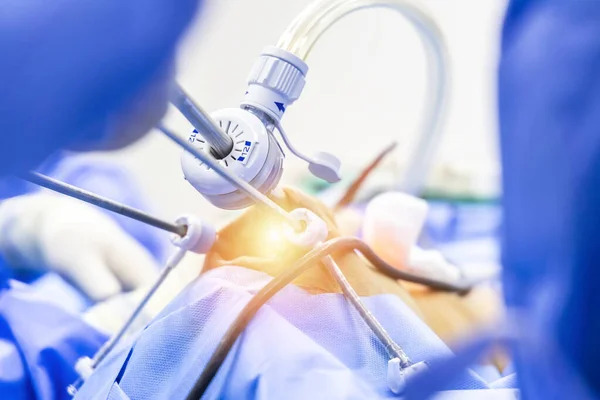
The word “surgery” is often frightening, even when it refers to a procedure after which you go home the same day. In modern gynaecology many operations are performed using minimally invasive methods: through tiny incisions or natural openings, without large wounds or a long recovery.
01What “minimally invasive” surgery means
Minimally invasive operations are procedures in which the surgeon reaches the organs without a traditional large incision. In gynaecology the two most common approaches are laparoscopy (through a few small punctures in the abdomen) and hysteroscopy (through the natural passages, with no incisions at all).
Using special equipment and cameras, the doctor sees the operating field magnified on a screen and carries out every step with instruments. The end result is the same as with open surgery, but with far less trauma for the patient.
02When laparoscopy is recommended
Laparoscopy in gynaecology has a wide range of indications. The most common are removal of ovarian cysts, treatment of endometriosis (including ovarian endometriomas), removal of fibroids (laparoscopic myomectomy), surgery for ectopic pregnancy, and removal of an ovary or the uterus (where there are indications for it). Laparoscopy is also the gold standard for diagnosis in chronic pelvic pain or suspected adhesions and endometriosis when other methods do not give an answer.
Not sure which clinic to start with?
A MediUkraine coordinator will help you choose a clinic and a doctor for your case, free of charge.
03When hysteroscopy is recommended
Hysteroscopy is the examination of, and surgery inside, the uterine cavity through the cervix, with no incisions at all. Indications include endometrial polyps, submucosal fibroids, synechiae (adhesions) in the uterine cavity, uterine anomalies (a uterine septum), endometrial hyperplasia, and investigation of uterine bleeding when the cause is unclear.
Hysteroscopy is often combined with laparoscopy on the same day if there is a problem both in the uterus and in the pelvis.
04Advantages of minimally invasive surgery
Compared with open surgery, minimally invasive approaches have significant advantages. There is less blood loss and a lower risk of complications during the operation. Recovery is shorter: a few days after hysteroscopy and usually 1–2 weeks after laparoscopy. The hospital stay is shorter, or not needed at all. The cosmetic effect is much smaller: tiny marks instead of a large scar. And there is a lower risk of adhesions forming after the operation.
05Is it painful, and is anaesthesia needed?
Hysteroscopy can be performed under local anaesthesia or intravenous sedation, depending on the extent of the procedure and the clinical situation. Laparoscopy is always performed under general anaesthesia. Both procedures are generally well tolerated by most patients; like any surgery, they carry some risks, which your doctor will discuss with you beforehand.
06Is a hospital stay needed?
Diagnostic hysteroscopy and minor operative hysteroscopy are often performed as outpatient procedures, without a hospital stay. Laparoscopic operations usually require 1–3 days in hospital, depending on their extent. Compared with open surgery, this is still considerably shorter.
07Minimally invasive gynaecological surgery in Ukraine
For patients considering treatment in Ukraine, minimally invasive gynaecological surgery is one of the more accessible options, and its cost is generally lower than in many European countries. MediUkraine helps you organise the whole pathway, from the first consultation with a gynaecologist to surgery and recovery, with the EXPERT medical network in Uzhhorod, whose team communicates with international patients in English.
08Conclusion
Minimally invasive surgery in gynaecology makes it possible to deal with serious health problems without a long recovery or large wounds. If your doctor recommends laparoscopy or hysteroscopy, it is not a reason to be afraid; on the contrary, it is good news, because this approach means less trauma and a quicker return to your usual routine.