| Service | 🇺🇦 Ukraine | 🇨🇿 Czech Republic | 🇹🇷 Turkey |
|---|---|---|---|
| DHI hair transplant, up to 2,000 grafts | from USD 1,356 | from USD 3,500 | from USD 1,600 |
| DHI hair transplant, 2,000–3,500 grafts | from USD 2,711 | from USD 5,000 | from USD 1,900 |
| Consultation with treatment planning and graft count | from USD 22 | from USD 70 | from USD 40 |
Prices in the “Ukraine” column come from MediUkraine’s partner clinics. The Czech Republic and Turkey columns show the lower bounds of prices published by clinics there (for Turkey, also the Turkish Dental Association’s recommended 2026 tariff), collected in August 2026 and converted to US dollars at the rate on the day of collection. A dash means we could not find a comparable published price. In any country, the final cost is set by the clinic after an examination.
DHI hair transplantation stands for Direct Hair Implantation: the graft is inserted into the skin with a special instrument, the Choi implanter. This is a hollow needle in a pen-like handle. An assistant loads a single follicular unit into it, the doctor positions the needle at the right spot and at the right angle and presses the plunger, so the puncture and the insertion happen in one movement.
It helps to be clear about what the term covers. DHI changes only the implantation stage; the follicles are harvested exactly as in FUE, one unit at a time with a cylindrical punch. In the classic approach the surgeon first creates all the channels in the recipient area, and the team then places the grafts into them with forceps; with the implanter these two steps are merged into one, and no channels are made in advance.
The indications are the usual ones for transplantation: androgenetic alopecia in men with thinning at the frontal and temporal areas, thinning along the parting in women, a high or asymmetric hairline, and scars from injuries or surgery that have long been stable. The method is also chosen for eyebrows and beards, where each hair has to emerge at its own angle.
It does not suit cases where the problem is not a shortage of follicles. With active alopecia areata, unstable scarring alopecia and untreated inflammation of the scalp, surgery is postponed until remission. A poor donor area is a limitation too: the implanter does not increase the number of available follicles, it only inserts them differently. If thinning is progressing quickly at the age of 20–25, the doctor first suggests medication, because otherwise within a few years the operated area will end up as an island in the middle of bare skin.
MediUkraine is a service that finds and coordinates treatment; it is not a clinic. We select the centre and a surgeon with relevant experience, agree a date that fits your travel plans and support you through to the follow-up examination. The decision on the method, the volume and whether the procedure is advisable at all is made by the doctor after an in-person examination of the donor area.

Travel. Ukrainian airspace is closed, so there are no commercial flights. Patients enter Ukraine overland, most often from Poland (Rzeszów and Kraków airports are the usual entry points), and continue to Dnipro by train. Dnipro is in the east of the country, a long journey from the border, so plan the route and timing with us before you book.
Visas. Citizens of the EU, the United Kingdom and the United States do not need a visa for short stays in Ukraine. Rules depend on your citizenship, so check your own before booking.
Safety, plainly. Ukraine is at war. Dnipro is attacked more often than western Ukraine, and an appointment can be interrupted by an air raid alert. Several governments advise against travel to Ukraine, and while that advice stands, ordinary travel and medical insurance is often void — confirm your cover with your insurer before you commit to anything.
Before you travel. The centre offers an online consultation, so the plan and the number of grafts can be estimated from photos before you decide to make the trip.
Language. MediUkraine handles correspondence, scheduling, the written treatment plan and the quote in English. The centre's team communicates with international patients in English.
Payment. You pay the centre directly. Our coordination service is free of charge for you.
More on travel, safety and insurance: Safety and travel.
The operation begins with marking. The surgeon draws the future hairline while the patient is sitting rather than lying down, checks it against the shape of the forehead, the movement of the facial muscles and the symmetry of the face, then shows the result in the mirror and agrees it with the patient. The line is deliberately not set too low: thinning continues with age, and the donor reserve has to last for decades to come. At this stage the grafts are counted by zone and the figure is recorded in writing.
Local anaesthesia comes next. First the back of the head is numbed with a ring block of lidocaine or articaine with adrenaline, then the recipient area; a tumescent solution is also injected, which firms up the tissue and reduces bleeding. The first few injections are painful, after which the patient feels pressure and touch but not pain. The dose is calculated by body weight, so "adding a bit more anaesthetic" on request is not possible.
Preparing the donor area and extraction. The back of the head and the temples are trimmed to a few millimetres, treated with antiseptic and anaesthetised, and the patient is laid face down. Follicular units are harvested one at a time with a cylindrical punch 0.7–0.9 mm in diameter, either with a micromotor or by hand. Harvesting stays within the safe zone, where the hair is not sensitive to androgens, and is spread evenly over the whole area: if a lot is taken from one spot, it will look see-through. In two to three hours the team obtains 2,000–2,500 grafts, each with one to four hairs.
Sorting and storage. The extracted units are immediately transferred into a chilled solution and sorted under a stereomicroscope by the number of hairs: single-hair grafts will go into the front line, two- and three-hair grafts further back. Time outside the body is critical for graft survival, so grafts are not stockpiled for long: most clinics begin implantation as soon as the first batch is ready.
Loading the implanters. An assistant picks up a graft with forceps and inserts it into the hollow needle so that the bulb is inside and the shaft remains outside. The tip is chosen to match the thickness of the particular graft, from 0.6 to 1.0 mm: one that is too narrow injures the follicle, one that is too wide will not hold it at the right depth. Between 6 and 15 implanters are in use at the same time, and while the doctor works with one, the team loads the next. This is what sets the pace of the whole operation.
Implantation. The doctor places the needle on the skin at the required angle, punctures it and immediately presses the plunger: the needle comes out and the graft stays in the tissue at the set depth. There is no separate stage of "placing the graft into a ready channel with forceps", so the follicle is less traumatised and spends less time outside the body. Bleeding is lower too, because the puncture matches the diameter of the needle and does not stay open. The angle and direction are set at exactly this moment, and this is what sets the method apart: when channels are made in advance, the graft lies the way the pre-made opening allows, whereas with the implanter the direction of each individual unit is set by the surgeon's hand. In the front line a hair should emerge almost parallel to the skin, at an angle of around 20–30 degrees, tilted forwards; on the crown the direction follows the whorl, and each row changes orientation slightly. An error in angle is not noticeable straight away but a year later, when the hair has grown and sticks out in the wrong direction, and by then it is difficult to correct.
The order of placement matters too. The first two or three rows get only single-hair grafts, set irregularly in a "zigzag", because a straight line looks artificial. Density is then built up: usually 35–45 follicular units per square centimetre in the front zone, 30–35 further back. More does not mean better: overly dense placement impairs the blood supply to the area, and some of the grafts fail to take.
Now for an honest comparison with FUE. The implanter has the advantage where the precision of each unit matters: a finely drawn hairline, the temporal angles, eyebrows and beards, and also densifying between existing hair, since the fine needle passes alongside your own follicles, whereas creating channels with a blade in such an area risks cutting through them. Further advantages are less bleeding and a shorter time for the graft outside the body.
On large areas, however, and where the crown is completely bald, the extra cost is usually not justified. There 3,500–4,000 units or more are needed, the work is done on bare skin, where there is no risk of catching your own hair, and channels set the angle just as well. At such volumes the implanter stretches the operation over two days and adds noticeably to the bill without making a visible difference. The best option is often a combination: the hairline is done with implanters and the rest of the area by the classic method.
Two more points that are rarely mentioned in advertising. Graft harvesting is identical in both methods, so the claim "no incisions and no marks" is a simplification: there are punctures, they are just very small, and they remain in the donor area too. And the implantation method itself does not increase donor reserves: however many follicles can safely be taken from the back of the head is how many there will be, regardless of what is then used to insert them into the skin.
Straight after the procedure the recipient area looks like a field of tiny pinpoint scabs with redness, and the donor area is covered with a dressing. On the second to fourth day some patients find the swelling moves down onto the forehead and eyelids; it is unpleasant but passes within two or three days. For the first five nights you are advised to sleep with the head raised, at an angle of about 45 degrees. The following day the patient is examined at the clinic and the dressing is removed.
The first wash is done at the clinic on the second or third day, and the technique is shown straight away: shampoo is applied with the palm without pressure, water is poured in a gentle stream, the area is not rubbed and the scabs are not picked off. After that the head is washed daily in the same way, and by day 7–10 the scabs come off on their own. Visible hair shafts may come away with them; this is not loss of the graft, the root stays in the skin.
Returning to normal social life usually takes 7–14 days. Redness of the recipient area lasts longer in fair-skinned patients, up to three or four weeks, and it is easier to wait it out at home than to cover it up. Sport, swimming pools, saunas and direct sun are put off for a month, and tight hats and hair dyeing for at least as long.
In weeks two to six the transplanted hairs fall out. This is an expected stage: the follicle itself stays in place and enters a resting phase. In densified areas some of your own hair next to the puncture sites may also fall out temporarily; it usually recovers within three or four months, and the doctor warns about this before the operation, not after.
Growth begins in the third or fourth month, roughly half of the result is visible by six months, and the result is properly assessed at 9–12 months, or closer to 18 for the crown. Comparisons should be made with standardised photos taken from the same angle and in the same lighting: day-to-day changes in the mirror are imperceptible, which often creates the false impression that nothing is happening.
One more point: the operation does not treat the cause. The transplanted follicles are taken from an area that is not sensitive to androgens and they remain, but the native hair next to them goes on thinning, so with androgenetic alopecia the doctor prescribes maintenance therapy in parallel. Some patients need a second session a year later, to densify the result or to cover an area that has thinned in the meantime.
Step 1. Examination, marking and graft count. In the morning the surgeon examines the donor area once more, measures its density, agrees the shape of the future hairline and draws it while the patient is sitting. The number of grafts by zone is recorded at the same time and the consent form for the procedure is signed. This conversation affects the result more than any later stage, so it should not be rushed.
Step 2. Anaesthesia and graft harvesting. The back of the head is trimmed, treated with antiseptic and anaesthetised, after which follicular units are harvested one at a time with a 0.7–0.9 mm punch. The stage takes two to three hours; the patient lies face down and can listen to music or doze. Then there is a break for lunch.
Altogether the day at the clinic lasts 6–9 hours, with breaks for lunch and rest. Between the morning marking and the return to the hotel come graft harvesting, sorting under the microscope, loading the implanters and the implantation itself, after which the patient receives an aftercare kit and written recommendations. No hospital admission is needed: patients go home the same evening and come back the next morning for the examination and the first wash.
A Ukrainian clinic works with a different cost structure. Rent, utilities, the salaries of non-medical staff and administration make up a smaller share of its costs, and this shows in the prices. Compare the specific figures in the table above.
The second factor is consumables and payment for the team's work. Single-use implanter tips, punches and graft storage solutions are intended for one patient, so there is no saving to be made on them. The assistants' hours, however, which make up most of such an operation, cost several times less in Ukraine, and this is where the main difference in the final figure lies.
The third factor is competition. Hair transplant centres operate across Ukraine, including Kyiv and Dnipro, and they compete for patients on price, the scope of support and their archive of results, not just on advertising.
A lower price does not mean a shorter operation. Grafts are counted in the same way, the tips remain single-use, and the duration is determined by the amount of work, not by the price. The difference lies in the cost of an hour, not in what the patient receives.
At the same time, a price that is too low for an "unlimited number of grafts" is a reason to ask who exactly will operate and how many units are actually planned. There are savings on logistics too: the examination, the operation and the follow-up take place at one centre, which means fewer days on the trip and lower costs for travel and accommodation.
The procedure is elective, so it is carried out only when the patient's condition is under control. Tests and an examination before the operation are mandatory: with uncontrolled diabetes, blood clotting disorders, an active scalp infection or a flare-up of seborrhoeic dermatitis, the date is moved. The clinics MediUkraine works with hold a licence from the Ministry of Health of Ukraine for medical practice in the relevant specialities.
The operating room works with sterile single-use instruments. Punches and implanter tips are intended for one patient: reuse blunts the cutting edge and raises the risk of damaging follicles, so you are entitled to ask for the kit to be unpacked in front of you. The scalp is treated with antiseptic, and the team works in sterile gloves.
The dose of local anaesthetic is calculated from the patient's body weight, and blood pressure and pulse are monitored throughout the day. That is exactly why anaesthetic cannot be added "on request" without calculation: exceeding the lidocaine dose causes systemic reactions. Tell the surgeon about the medicines you take, allergies and past illnesses before the start, not once you are already in the chair.
The risks are worth knowing in advance. The most common are swelling of the forehead, a temporary loss of sensation at the back of the head that passes within a few months, folliculitis in the area where the new hairs grow, and occasional ingrown hairs. Small pale dots remain in the donor area and are noticeable with a short clipper cut. Uneven harvesting gives the back of the head a "moth-eaten" look, and overly dense placement combined with smoking in rare cases disrupts the blood supply to the skin.
Most of these risks are controlled by technique. The surgeon spreads harvesting evenly and does not exceed the permissible extraction percentage, limits the placement density, shortens the time grafts spend outside the body, prescribes an antibiotic where indicated and gives written recommendations listing warning signs. If fever, increasing pain, pus or spreading redness appear after discharge, contact the clinic the same day.
The patient has the right to a second opinion. The plan with the number of grafts by zone, photos of the donor area and the hairline marking can be shown to another specialist before the operation; this is normal practice, and the clinic should not stand in the way. If needed, MediUkraine arranges a consultation at another partner centre.
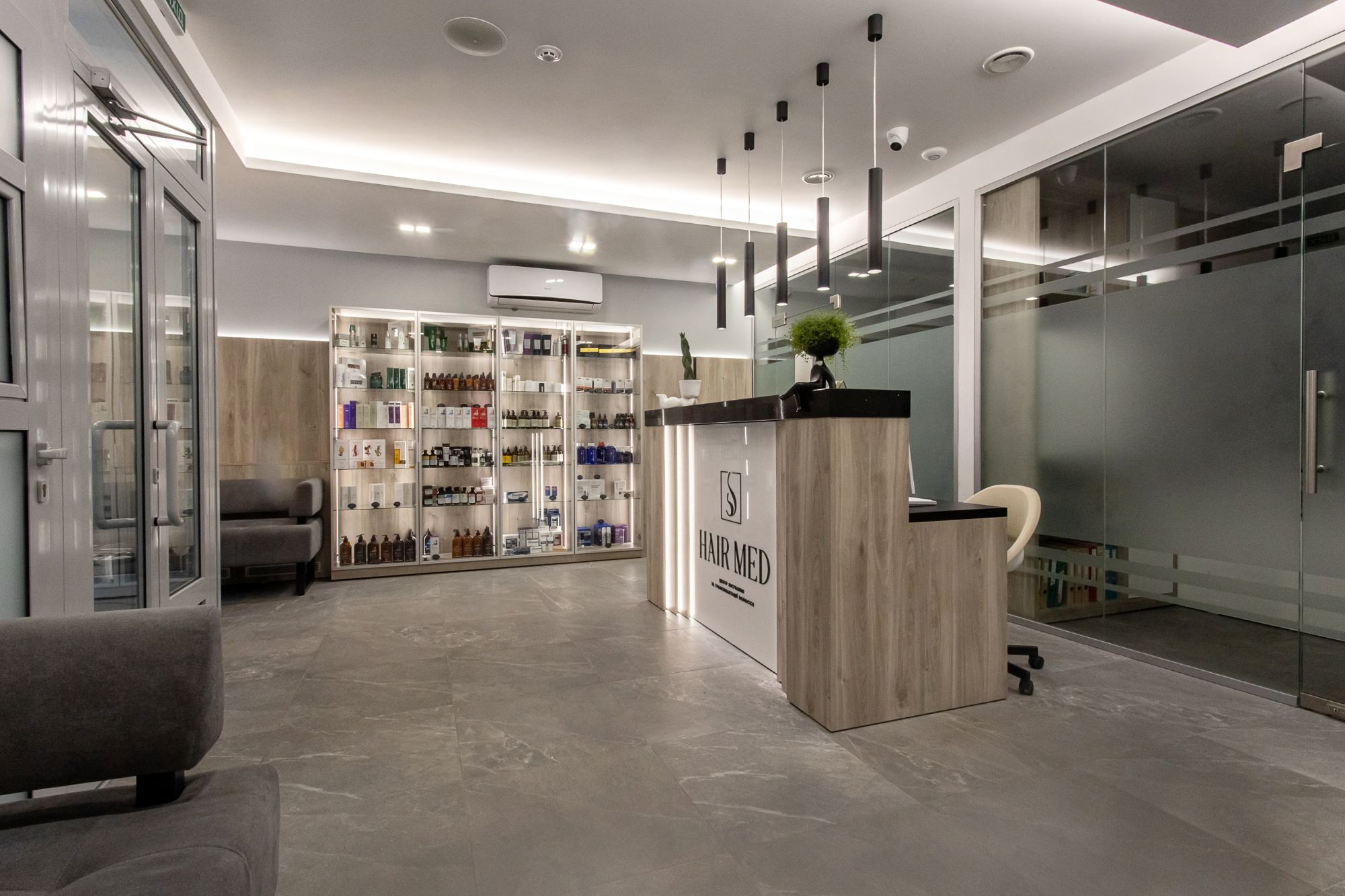
📍 Dnipro, Ukraine
A hair treatment and transplant centre in Dnipro: 430 m², two surgical zones, an SMP room and its own HairHub. Transplants are performed by Ivan Baranov, PhD (member of ISHRS and the World FUE Institute) and transplant surgeon Svitlana Nedbailo. Therapy is led by a team of trichologists and dermatologists.
Follicle harvesting is the same: in both cases units are extracted one at a time with a 0.7–0.9 mm punch. The difference lies in implantation. With classic FUE the surgeon first creates all the channels in the skin, and the team then places grafts into them with forceps. With DHI the graft is loaded into a Choi implanter, and the needle makes the puncture and inserts the follicle in one movement, with the doctor setting the angle, direction and depth at that very moment. Hence less trauma, less bleeding and better control over the hairline, but also a longer operation and a higher price.
At MediUkraine's partner clinics, a volume of up to 2,000 grafts starts from USD 1,356 and 2,000–3,500 grafts from USD 2,711. A consultation with a graft count costs from USD 22 and is often credited towards the cost of the operation. For comparison, in the Czech Republic up to 2,000 grafts starts from around USD 3,500, and in Turkey from USD 1,600. The final figure is set by the clinic after an examination, because it depends on the number of units, not on the size of the area.
As a rough guide: restoring the hairline and the frontotemporal angles takes 1,500–2,500 units, the frontal area together with the crown 3,000–4,000, a small densification of the parting 800–1,500. But these are ranges, not a calculation. The real figure comes from the doctor after measuring the density of the donor area and the size of the thinning area: two patients with the same photo may need amounts that differ by a factor of two. If donor reserves are limited, zones are covered in order of priority, starting with the one most visible when someone faces you.
During the procedure the first few injections of anaesthetic into the back of the head are painful; after that the patient feels touch and pressure. Pain relief is maintained throughout the day. In the evening, as the anaesthesia wears off, there can be an aching discomfort in the donor area; it is relieved with an ordinary painkiller prescribed by the doctor. The recipient area rarely hurts; itching during healing and swelling on the second to fourth day are more bothersome. Sharp, increasing pain is not normal and is a reason to contact the clinic straight away.
In weeks two to six the transplanted hairs fall out, while the follicle stays in place. Growth begins in the third or fourth month, roughly half is visible by six months, the result is assessed at 9–12 months, and for the crown the final appearance takes shape closer to 18 months. Compare standardised photos taken from the same angle and in the same lighting: day-to-day changes are imperceptible in the mirror, which often creates the false impression that nothing is happening.
The donor area is almost always trimmed, as otherwise the punch cannot be used. With DHI the recipient area can sometimes be left unshaven: the implanter is guided between the existing hair shafts. This option suits small volumes and sufficiently long hair of your own, takes longer and costs more, so it is agreed in advance. For volumes above 2,500–3,000 grafts clinics usually insist on a haircut: without it precision falls and the time grafts spend outside the body increases.
No. The transplanted follicles are taken from an area that is not sensitive to androgens and remain for a long time, but your own hair next to them continues to thin. That is why maintenance therapy is prescribed in parallel for androgenetic alopecia: without it, within a few years a bare zone forms around the operated area and another procedure is needed. The decision on medication is made by the doctor, because some of these drugs have restrictions related to sex and pregnancy plans.
Tell us what you need: we will suggest a clinic and a doctor and send you a cost estimate.
Request a consultation →