| Service | 🇺🇦 Ukraine | 🇨🇿 Czech Republic | 🇹🇷 Turkey |
|---|---|---|---|
| Trichoscopy within a dermatovenereologist consultation | from USD 31 | from USD 50 | from USD 40 |
| Follow-up trichoscopy to track changes | from USD 27 | from USD 35 | from USD 25 |
Prices in the “Ukraine” column come from MediUkraine’s partner clinics. The Czech Republic and Turkey columns show the lower bounds of prices published by clinics there (for Turkey, also the Turkish Dental Association’s recommended 2026 tariff), collected in August 2026 and converted to US dollars at the rate on the day of collection. A dash means we could not find a comparable published price. In any country, the final cost is set by the clinic after an examination.
Trichoscopy is an examination of the scalp and hair with a dermatoscope, an illuminated camera with magnification. The working range is roughly 10 to 70 times: at low magnification the doctor assesses the overall picture of an area, and at high magnification counts the hairs in each follicular unit and looks at what is happening around each follicle opening.
Before this method, diagnosis relied on visual examination, the hair pull test and the trichogram, in which about fifty hairs were plucked with tweezers and their roots examined under a microscope. That was painful and imprecise. Trichoscopy shows more and causes no harm: the dermatoscope is placed on the skin or simply held close to it, no hair is pulled out and no anaesthesia is needed.
The doctor looks at four things: the hair shafts (thickness, shape, breaks), the follicle openings (empty, plugged or lost), the skin around them (scaling, redness, peripilar casts) and the background with its pattern of blood vessels. It is the combination of these signs that distinguishes one type of hair loss from another.
It is important to understand the method's limits. Trichoscopy is not a test that replaces a doctor, nor a machine that produces a diagnosis. It is an examination tool: the conclusion is reached together with your medical history, test results and, in doubtful cases, a biopsy. An image without clinical context is worthless.
MediUkraine is a service that finds and coordinates treatment; it is not a clinic. We choose a clinic with a digital trichoscope and a doctor experienced in hair disorders, arrange the date and support you throughout, including if you are travelling from abroad. Diagnosis and treatment decisions are made by the doctor after an in-person examination.

Travel. Ukrainian airspace is closed, so there are no commercial flights. Patients enter Ukraine overland, most often from Poland (Rzeszów and Kraków airports are the usual entry points), and continue to Dnipro by train. Dnipro is in the east of the country, a long journey from the border, so plan the route and timing with us before you book.
Visas. Citizens of the EU, the United Kingdom and the United States do not need a visa for short stays in Ukraine. Rules depend on your citizenship, so check your own before booking.
Safety, plainly. Ukraine is at war. Dnipro is attacked more often than western Ukraine, and an appointment can be interrupted by an air raid alert. Several governments advise against travel to Ukraine, and while that advice stands, ordinary travel and medical insurance is often void — confirm your cover with your insurer before you commit to anything.
Before you travel. The centre offers an online consultation, so the plan and the number of grafts can be estimated from photos before you decide to make the trip.
Language. MediUkraine handles correspondence, scheduling, the written treatment plan and the quote in English. The centre's team communicates with international patients in English.
Payment. You pay the centre directly. Our coordination service is free of charge for you.
More on travel, safety and insurance: Safety and travel.
The main trichoscopic sign of androgenetic alopecia is anisotrichosis, a variation in hair shaft diameter. Thick hairs grow alongside thin, miniaturised ones, because androgen-sensitive follicles produce a weaker hair with each cycle. The threshold is a variation in thickness of more than 20% in men and more than 10% in women, and in a systematic review of trichoscopy for this diagnosis this variation had the highest sensitivity, around 94%.
Yellow dots are follicle openings without a hair, filled with sebum and keratin; in inherited thinning they are scattered unevenly because miniaturisation progresses in patches. The major criteria for female androgenetic alopecia are exactly these: more than four yellow dots in four images of the frontal area at 70-fold magnification, a lower average hair thickness at the front of the head than at the back, and a proportion of thin hairs above 10%.
In alopecia areata the picture is different, and it shows how active the condition is. Exclamation mark hairs, broken hairs that taper towards the base, are the most reliable sign that the disease is progressing right now. Alongside them the doctor sees black dots (hairs broken off at skin level), tapered hairs and Pohl-Pinkus constrictions. Yellow dots occur here too, but mainly in old, inactive patches.
The same signs show whether treatment is working: when it is effective, exclamation mark hairs, black dots and broken hairs disappear first, and short upright regrowing hairs appear in the patch. Yellow dots clear most slowly, so they are not used to judge progress.
Scarring alopecias are the reason trichoscopy should not be put off. The key finding is the loss of follicle openings: where openings should be, there is a smooth white or milky-pink area. Around the surviving hairs there is redness and tubular scaling that encircles the hair, sometimes with pustules; in frontal fibrosing alopecia the fine vellus hairs along the hairline disappear as well. A follicle opening that has been destroyed does not recover, so every week of delay means hair that will not grow back.
Telogen effluvium has no specific signs of its own, and it is better to say so plainly. Trichoscopy shows empty openings, a predominance of follicular units with a single hair, the peripilar sign and short upright regrowing hairs, but each of these also occurs in other conditions. The diagnosis is made largely by ruling out the patterns of other alopecias, based on the history and test results.
That is why the doctor examines not only the problem area but also the back of the head. In inherited thinning this area is affected last and serves as an internal control: if hair thickness at the front and back is the same, androgenetic alopecia is unlikely, and diffuse thinning with no difference between areas points instead to telogen effluvium. Comparing the two areas often settles the diagnosis.
Trichoscopy also picks up problems the patient did not come in with. In fungal infection of the scalp, comma hairs and corkscrew hairs are visible; these signs have a specificity of around 99–100% and allow treatment to start without waiting for a culture. In trichotillomania the hairs are broken off at different lengths with frayed ends, while traction alopecia causes thinning where the hairstyle pulls.
A phototrichogram is a different method, and the two should not be confused. Trichoscopy is qualitative: it describes what can be seen in an area. A phototrichogram measures: the hair on an area of roughly 1.8 cm² is trimmed and photographed straight away and again two to three days later, the hairs are tinted if needed, and software calculates density, growth rate and the ratio of growing to resting hairs. It takes two visits instead of one, but gives you figures to compare the result against six months later.
A digital trichoscope with an image archive differs from a hand-held magnifier not in magnification but in memory. "It seems to be falling out less" is an unreliable measure. When images are linked to specific areas and taken under the same lighting, at three and six months the doctor can put two pictures side by side and see the changes.
It is also worth being clear about what trichoscopy cannot do. It does not show the cause of a systemic disorder: iron deficiency, thyroid problems or an autoimmune process are found through blood tests. It does not replace a scalp biopsy when the picture is unclear or a scarring process is involved: histology remains decisive. And it depends on conditions: styling product residue, a device without polarisation and the doctor's experience affect the conclusion more than one might like.
You see the result of trichoscopy straight away, as the images appear on the screen during the examination. A written report describing the findings and the image files are provided the same day; ask for your own copy, even if you plan to be treated at the same clinic.
A trichoscopy description on its own is not yet a diagnosis. The doctor compares the findings with your history and test results: a full blood count, iron and ferritin, TSH and free T4, vitamin D and, for women where indicated, sex hormones. Routine test results are ready in 1–3 working days, so the follow-up consultation is usually a few days after the examination.
If a phototrichogram was done, the figures are available at the second visit, two to three days after the first. They become the baseline (density, the proportion of thin hairs and the ratio of growth phases) against which the effect of treatment is later compared.
If trichoscopy shows signs of scarring, the sequence changes. A biopsy is ordered as soon as possible rather than "if needed", the histology report takes about 1–2 weeks, and anti-inflammatory treatment starts without waiting for it.
Follow-up trichoscopy is done at three and six months, always on the same areas. Hair responds slowly: with the right treatment, the first changes appear no earlier than 3–4 months, and the effect is properly assessed at 6–12 months. The comparison is based on images and figures, not impressions.
If nothing has changed after six months, the diagnosis or the treatment plan should be reviewed rather than the same prescriptions continued. If you live abroad, part of the follow-up can conveniently be done remotely: you keep the report and images, and MediUkraine can arrange a video consultation with the same doctor if needed.
Step 1. Conversation and examination without the device. The doctor asks when the hair loss started, how it has changed, whether anything similar runs in the family, and what illnesses, surgery and medicines you have had over the past year. They then examine your head by eye, assessing the area of thinning, the width of the parting, the hairline and the condition of the skin. By the time the doctor picks up the device, they already have a working hypothesis.
Step 2. Choosing areas to photograph. The standard areas are the front, the crown and, always, the back of the head as a control, plus any separate patch or area that concerns you. The sites are marked so that the follow-up examination returns to exactly the same spots.
In total, trichoscopy takes 15–30 minutes, longer if there are many patches or images are taken in several modes. No anaesthesia, hospital stay or recovery time is needed: straight after the examination you can wash and style your hair and return to your usual activities.
The price reflects the clinic's cost structure. Rent, non-medical staff salaries, utilities and administration cost a Ukrainian clinic several times less than in Germany, Austria or the UK, and this shows directly in its prices.
Trichoscopy also uses almost no consumables. The device is a one-off purchase that lasts for years; after that, only disinfectant, single-use tips and immersion fluid are needed. So the cost of the service is mainly the doctor's time, which is cheaper in Ukraine than in the EU.
The third factor is competition. In Ukraine, including Kyiv and Dnipro, private clinics offer dermatology appointments, and they tend to include trichoscopy in the consultation rather than charge for it separately, as a way of attracting patients.
When comparing clinics, look at what the service includes rather than the price alone: how many areas are photographed, whether the back of the head is examined as a control, whether images are archived and whether you receive a written report. The clinic confirms these points before your visit, and the assessment criteria the doctor uses come from professional publications and are described in the conclusion.
Logistics also save money: the consultation, trichoscopy, phototrichogram and tests are all done at one clinic, without referrals or queues between facilities. For patients from abroad, this means fewer days of travel and lower travel and accommodation costs.
Trichoscopy is non-invasive: the skin is not broken, nothing is injected or pulled out and no anaesthesia is used. As a result, there are practically no contraindications: the examination is suitable during pregnancy and breastfeeding, for children and for people with chronic illnesses. There is no recovery period.
Hygiene comes down to a few simple measures. The probe's contact plate is disinfected between patients, single-use tips are used, and immersion fluid is applied from a single-use nozzle. If the doctor suspects a fungal infection, the examination is done in non-contact polarised mode so that the infection is not passed on to the next patient.
The clinics we offer hold a licence from the Ministry of Health of Ukraine for medical practice in dermatovenereology. You can check the licence yourself in the Licensing Register, which is publicly available.
The main risk lies not in the procedure but in how the image is interpreted. Devices that look like trichoscopes are also used in hair salons and beauty salons, where a course of ampoules or mesotherapy is sold on the strength of a picture on a screen. That is not a medical service: without a medical examination, history and tests, an image of the scalp means nothing, and money and time are spent on a procedure that does not address the cause. The examination should be carried out by a doctor trained in dermatovenereology and should end with a written conclusion.
A word on urgency. If the image shows that follicle openings have disappeared, with redness, tubular scaling or pustules around the hairs, scarring alopecia is suspected: lichen planopilaris, frontal fibrosing alopecia, folliculitis decalvans, central centrifugal cicatricial alopecia or discoid lupus erythematosus. These forms destroy follicles permanently, so the doctor orders a biopsy straight away and starts anti-inflammatory treatment without waiting for the histology. An offer to "watch for another six months" is unacceptable in this situation.
Images of your scalp are medical information, not social media content. The clinic should obtain your written consent to take and store images and must not publish them without separate permission. You receive the report and the files, so you are free to show them to another specialist; if needed, MediUkraine arranges a second opinion at another partner clinic.
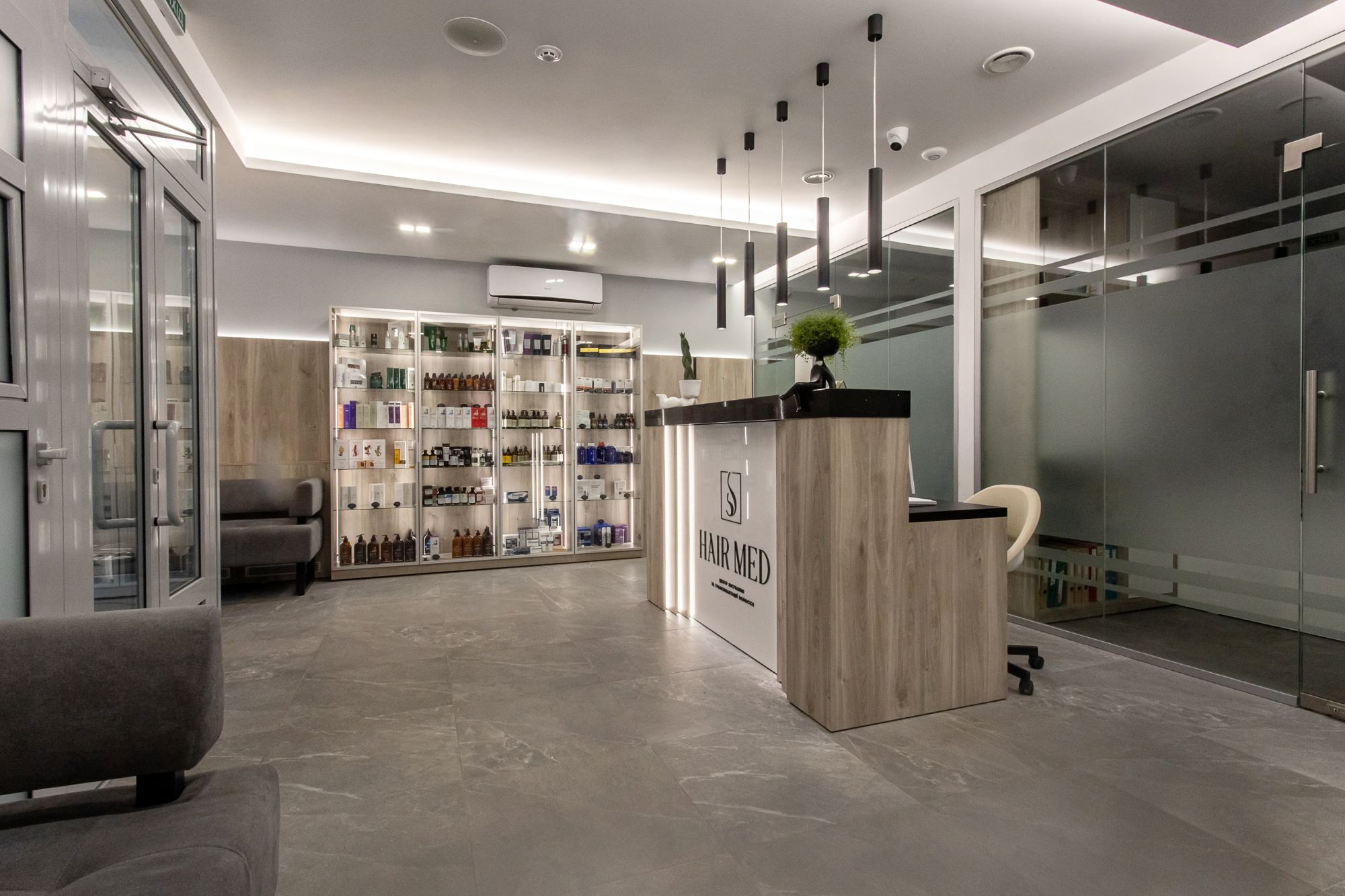
📍 Dnipro, Ukraine
A hair treatment and transplant centre in Dnipro: 430 m², two surgical zones, an SMP room and its own HairHub. Transplants are performed by Ivan Baranov, PhD (member of ISHRS and the World FUE Institute) and transplant surgeon Svitlana Nedbailo. Therapy is led by a team of trichologists and dermatologists.
At dozens of times magnification, the doctor sees what the naked eye cannot: differences in hair thickness, empty and lost follicle openings, yellow and black dots, scaling and redness around the hairs, and the pattern of blood vessels. This set of signs distinguishes inherited thinning from alopecia areata, telogen effluvium and the scarring forms. The examination takes 15–30 minutes and needs no anaesthesia.
Trichoscopy describes what can be seen in an area and is done in a single visit. A phototrichogram measures: a small area is trimmed and photographed straight away and again two to three days later, and software calculates hair density, growth rate and the ratio of growing to resting hairs. The first answers the question "what is it?", while the second gives figures to compare the effect of treatment against six months later. In Ukraine, trichoscopy is usually included in an appointment from USD 31.
No to both. The probe is simply placed on the skin through a transparent plate while the doctor parts the hair with their fingers; it feels like a comb touching your scalp. Nothing needs to be shaved. A small area is trimmed only for a phototrichogram, and the spot is chosen so that the surrounding hair covers it. After the examination you can wash your hair straight away and return to your usual activities.
At the clinics MediUkraine works with, it is usually included in the first dermatovenereologist appointment, from USD 31. A follow-up examination to track progress costs from USD 27. For comparison, a similar examination costs from around USD 40 in the Czech Republic and from USD 30 in Turkey. The clinic confirms the final cost.
Not always. For some conditions the picture under magnification is almost conclusive: comma hairs and corkscrew hairs in fungal infection have a specificity of around 99–100% and allow treatment to start even before a culture. But telogen effluvium has no specific signs, and scarring forms require histology. That is why trichoscopy is interpreted together with your history and test results and, in unclear cases, supplemented by a scalp biopsy.
The standard is follow-up examinations at three and six months, photographing the same areas. Earlier checks make little sense: the hair cycle is measured in months, and with the right treatment the first changes appear no earlier than 3–4 months. If the images show no change after six months, the diagnosis or treatment plan is reviewed rather than the same prescriptions extended.
No. A phone camera provides neither the magnification nor the polarised light needed, so follicle openings, peripilar casts and variation in hair diameter simply cannot be seen in such a photo. Remote opinions based on selfies are a common cause of lost time in scarring alopecias, where weeks decide the outcome. A completed report and images from the clinic's archive can reasonably be discussed remotely, but the first examination should be in person.
Tell us what you need: we will suggest a clinic and a doctor and send you a cost estimate.
Request a consultation →