| Service | 🇺🇦 Ukraine | 🇨🇿 Czech Republic | 🇹🇷 Turkey |
|---|---|---|---|
| Scalp PRP therapy, one session | from USD 56 | from USD 150 | from USD 100 |
| PRP course, 4 sessions | from USD 222 | from USD 550 | from USD 350 |
| Trichologist consultation with trichoscopy | from USD 31 | from USD 50 | from USD 40 |
| Follow-up trichoscopy to track progress | from USD 27 | from USD 35 | from USD 25 |
Prices in the “Ukraine” column come from MediUkraine’s partner clinics. The Czech Republic and Turkey columns show the lower bounds of prices published by clinics there (for Turkey, also the Turkish Dental Association’s recommended 2026 tariff), collected in August 2026 and converted to US dollars at the rate on the day of collection. A dash means we could not find a comparable published price. In any country, the final cost is set by the clinic after an examination.
Platelets do more than help blood clot. Their alpha granules contain growth factors: platelet-derived (PDGF), vascular endothelial (VEGF), transforming (TGF-beta) and insulin-like (IGF-1). In tissue they trigger the same processes as after a microtrauma: the growth of small blood vessels, cell division and the synthesis of the extracellular matrix.
The idea is to concentrate platelets from the patient's own blood to several times their baseline level and inject them into the scalp dermis, at the depth where the follicles lie. The expected effect is a better blood supply to the dermal papilla, a longer growth phase of the hair and thickening of hair shafts that have already become thinner.
The indications are fairly narrow: early and intermediate androgenetic alopecia, when the follicles have shrunk but are still alive; chronic telogen effluvium, as an addition to dealing with its cause; and support for the area after a hair transplant. In women the method is used on the same basis as in men, and there are no sex-specific restrictions.
What the method does not do is just as important. PRP therapy does not restore hair where the follicle has already died: in scarring alopecias and on areas that have long been bald there is no point injecting plasma. Nor does it replace minoxidil or finasteride: it is an addition to an evidence-based regimen, not an alternative to it.
MediUkraine is a service that finds and coordinates treatment; it is not a clinic. We select the medical centre and a doctor with the right expertise, agree the schedule of sessions and support patients, including those travelling from abroad. The decision on whether the procedure is appropriate is made by the doctor after an in-person examination and trichoscopy.

Travel. Ukrainian airspace is closed, so there are no commercial flights. Patients enter Ukraine overland, most often from Poland (Rzeszów and Kraków airports are the usual entry points), and continue to Dnipro by train. Dnipro is in the east of the country, a long journey from the border, so plan the route and timing with us before you book.
Visas. Citizens of the EU, the United Kingdom and the United States do not need a visa for short stays in Ukraine. Rules depend on your citizenship, so check your own before booking.
Safety, plainly. Ukraine is at war. Dnipro is attacked more often than western Ukraine, and an appointment can be interrupted by an air raid alert. Several governments advise against travel to Ukraine, and while that advice stands, ordinary travel and medical insurance is often void — confirm your cover with your insurer before you commit to anything.
Before you travel. The centre offers an online consultation, so the plan and the number of grafts can be estimated from photos before you decide to make the trip.
Language. MediUkraine handles correspondence, scheduling, the written treatment plan and the quote in English. The centre's team communicates with international patients in English.
Payment. You pay the centre directly. Our coordination service is free of charge for you.
More on travel, safety and insurance: Safety and travel.
It all begins with venepuncture: 10–20 ml of blood is drawn, sometimes up to 30–60 ml if a large area needs treating. The blood goes straight into a tube with an anticoagulant, most often sodium citrate, which binds calcium and stops the platelets from activating prematurely. EDTA tubes are not used for this.
Tubes differ in more than the anticoagulant. Some systems have a gel separator, a dense gel that after centrifugation forms a barrier between the red blood cells and the plasma and makes it easier to draw off the required fraction. Other kits work without gel: the doctor takes off the plasma with a pipette, guided by the boundary between the layers. The system determines how many times the platelet concentration exceeds the baseline, from twofold to five- or sixfold.
Centrifugation can be single-stage or two-stage. One cycle, about 3–5 minutes, gives a less concentrated plasma with some white blood cells mixed in; two cycles give a denser platelet pellet, which is then resuspended in a smaller volume of plasma. The speed, the time and the number of cycles are set by the kit manufacturer, and this is where the protocols of different clinics diverge most.
Two more parameters are worth asking about: white blood cell content and activation. Plasma can be leukocyte-poor or leukocyte-rich; for the scalp the former is chosen more often, because white blood cells amplify the inflammatory response. Not every clinic activates the plasma with calcium chloride or calcium gluconate: some doctors believe that the collagen of the dermis activates the platelets without additional reagents. There is no single standard here, and that is the main criticism of the method.
The plasma itself is injected superficially, into the dermis at a depth of about 2–4 mm, at the level where the follicles lie. The doctor works along a grid with a spacing of about 1 cm, injecting 0.05–0.1 ml per point; small papules remain on the skin and resolve within a few hours. The thinning area is treated together with 1–2 cm of healthy skin around it. Some clinics combine the injections with microneedling, using the punctures as a delivery route; so far there is little evidence that such a combination is better.
Pain relief is usually not needed: the injections can be felt, but they are brief. If the patient wishes, a topical lidocaine cream is applied 20–30 minutes beforehand, or the skin is cooled immediately before the session. In total the visit takes 30–40 minutes, of which centrifugation takes 10–15 minutes and the injections themselves about 15.
The standard course is 4 sessions at intervals of 3–4 weeks. After that, if there is a response, patients move on to maintenance sessions every 3–6 months. There is no point assessing a course of one or two sessions: the hair cycle is measured in months, and changes physically do not have time to appear. If after the full course and six months of observation trichoscopy shows no change, it is not worth continuing.
Now to the evidence, which calls for honesty. Randomised trials and meta-analyses do show an increase in hair density compared with placebo in androgenetic alopecia, but the samples are mostly small, follow-up is short, and the protocols for preparing the plasma differ so much that the results are hard to compare. For this reason the method is not part of the core recommendations as a stand-alone treatment: its place is as an addition to minoxidil or finasteride, not a replacement for them. Some patients do not respond to the therapy at all, and this cannot be predicted in advance.
The comparison with scalp mesotherapy is what patients ask about most often, because technically the procedures are similar: the same grid of superficial injections, the same interval. The difference lies in what is injected. In mesotherapy it is a factory-made cocktail of vitamins, amino acids, peptides and trace elements whose composition varies from manufacturer to manufacturer, and systematic reviews describe small unblinded samples and conclude that there is not enough data for a recommendation. Plasma is the patient's own material, so there will be no reaction to a foreign substance, and there is noticeably more research on it in hereditary thinning, although the results are contradictory. The prices of the procedures are comparable, so the choice is more between "a little more data" and "less data" than between something that works and something that does not.
Finally, the limits of the method. Plasma does not work on areas where the follicle openings have already been lost: in scarring alopecias, on areas that have long been bald, in late stages of hereditary thinning. There a transplant is discussed, and plasma is considered at most as support for the transplanted area. A doctor who offers a course without prior trichoscopy is in effect selling the procedure blind.
Immediately after the session the scalp is red, small papules are visible at the injection sites, and sometimes there is swelling around the forehead. This is an expected reaction: the redness passes within a few hours, the papules sooner. Some patients feel a heaviness in the head or a mild headache on the first evening.
Washing your hair is usually allowed after 24 hours, with warm water and without vigorous massaging of the scalp. Saunas, swimming pools, intensive workouts and direct sun are put off for 2–3 days; hair colouring is postponed for at least a week. These restrictions apply to every session of the course, not just the first.
The effect cannot be assessed after one session, and the clinic should warn you of this before you pay. Hair responds on a scale of months: patients usually notice the first subjective changes, less hair on the comb and short new hairs appearing, after the third or fourth session, that is, 3–4 months after the start of the course.
An objective assessment means a repeat trichoscopy of the same areas after 6 months, with a phototrichogram where possible. Density and the proportion of thin shafts are compared, not the overall impression from a photo taken in the bathroom: lighting and styling change the picture more than any therapy.
The effect lasts for a limited time. Without maintenance sessions and without core therapy, density usually returns to its previous level within 6–12 months, because the procedure does not remove the cause of thinning: the follicles' sensitivity to androgens does not go away. That is why plasma is prescribed together with medication, not instead of it.
There are also patients who do not respond to treatment: after six months trichoscopy shows neither an increase in density nor thickening of the shafts. In that case the course is not continued, and the doctor goes back to the diagnosis and reviews the regimen. For patients from abroad, MediUkraine arranges a follow-up examination or a video consultation with the same doctor.
Step 1. Consultation and trichoscopy. Before the first session the doctor examines the scalp under digital magnification, assesses the density and diameter of the shafts, determines the type of thinning and records baseline images. Without this starting point it will not be possible to assess the result of the course later. The tests are checked at the same visit and the contraindications are gone through once more.
Step 2. Blood draw and centrifugation. 10–20 ml of blood is drawn from a vein into a tube with an anticoagulant, which is labelled with the patient's surname and placed in the centrifuge for 5–15 minutes depending on the protocol. The blood of two patients is never processed at the same time without labelling, and the tube is not left unattended: this is a basic rule of working with autologous material. The doctor draws the finished plasma into a syringe in the patient's presence.
In total the visit takes 30–40 minutes: after the blood draw come 10–15 minutes of centrifugation, treatment of the skin with antiseptic and, if wished, topical pain relief, then about 15 minutes of the injections themselves and a short conversation about aftercare. No hospital admission is needed and there is no recovery period: you leave the clinic straight away and return to your usual activities, putting off only saunas, swimming pools and workouts for 2–3 days. The next session is scheduled 3–4 weeks later, and the follow-up trichoscopy six months after the start of the course.
A Ukrainian clinic operates with a different cost structure: rent, salaries of non-medical staff, utility bills and administration make up a smaller share of its costs. These costs are built into every procedure, so the difference shows in the prices; compare the specific figures in the table above.
The second factor is the cost of consumables. A certified kit with a tube, anticoagulant and separator costs less in Ukraine because of lower distributor margins and lower logistics costs, although the manufacturers are the same. A centrifuge is bought once, and with a larger flow of patients it pays for itself faster.
The third factor is competition. In Ukraine, including Kyiv and Dnipro, private clinics have trichology departments, and they compete on price and service, not only on reputation.
A lower price does not mean a shorter procedure. The volume of blood, the centrifugation settings and the number of injection points are the same as those specified by the kit manufacturer, and the course protocol is based on the same publications. The difference lies in the cost of an hour of the clinic's work, not in what the session contains.
There are savings on logistics too: the consultation, the tests, all four sessions and the follow-up trichoscopy take place at one medical centre, without referrals or queues between institutions. For a patient from abroad that means fewer days of travel, and therefore lower spending on getting there and on accommodation.
In terms of risk, the main point here is that the material is the patient's own. The plasma is not mixed with foreign substances, so there is no allergic reaction to a product and no rejection. The risks are linked not to the plasma but to the procedure itself: pain during the injections, a haematoma at the venepuncture site, swelling and, less often, infection of the scalp.
Sterility starts with the tube. Single-use vacuum systems registered for use with blood are used, along with single-use needles and syringes, and the skin is treated with antiseptic. The tube is labelled with the patient's surname immediately after the blood is drawn: a mix-up with autologous material is unacceptable, so the blood of two patients is never placed in the centrifuge without labelling.
Tests are mandatory before the course: a complete blood count with a platelet count, a coagulation panel, and screening for hepatitis B and C, HIV and syphilis. This is not bureaucracy: the platelet level determines whether the plasma will be concentrated at all, and the clotting results warn of a risk of haematomas.
The list of contraindications is short but strict. The procedure is not performed in clotting disorders and thrombocytopenia, in active scalp infection (folliculitis, pustules, herpes, fungal infection), in haematological cancers, while taking anticoagulants and antiplatelet drugs, in sepsis or in severe liver disease. Pregnancy and breastfeeding are usually also considered grounds for postponing sessions, not because of proven harm but because of a lack of research in this group.
A word on anticoagulants: do not stop them on your own in order to "get through the course". The decision is made by the doctor who prescribed the drug, and in many cases the answer will be not to have the procedure. The same applies to an active autoimmune process, which is first brought into remission.
The clinics MediUkraine works with hold a licence from the Ministry of Health of Ukraine to practise medicine. You receive a written protocol stating the system used, the blood volume and the number of sessions, as well as the trichoscopy images, and with these documents you can seek a second opinion from another specialist. If needed, we arrange a repeat consultation at another partner clinic.
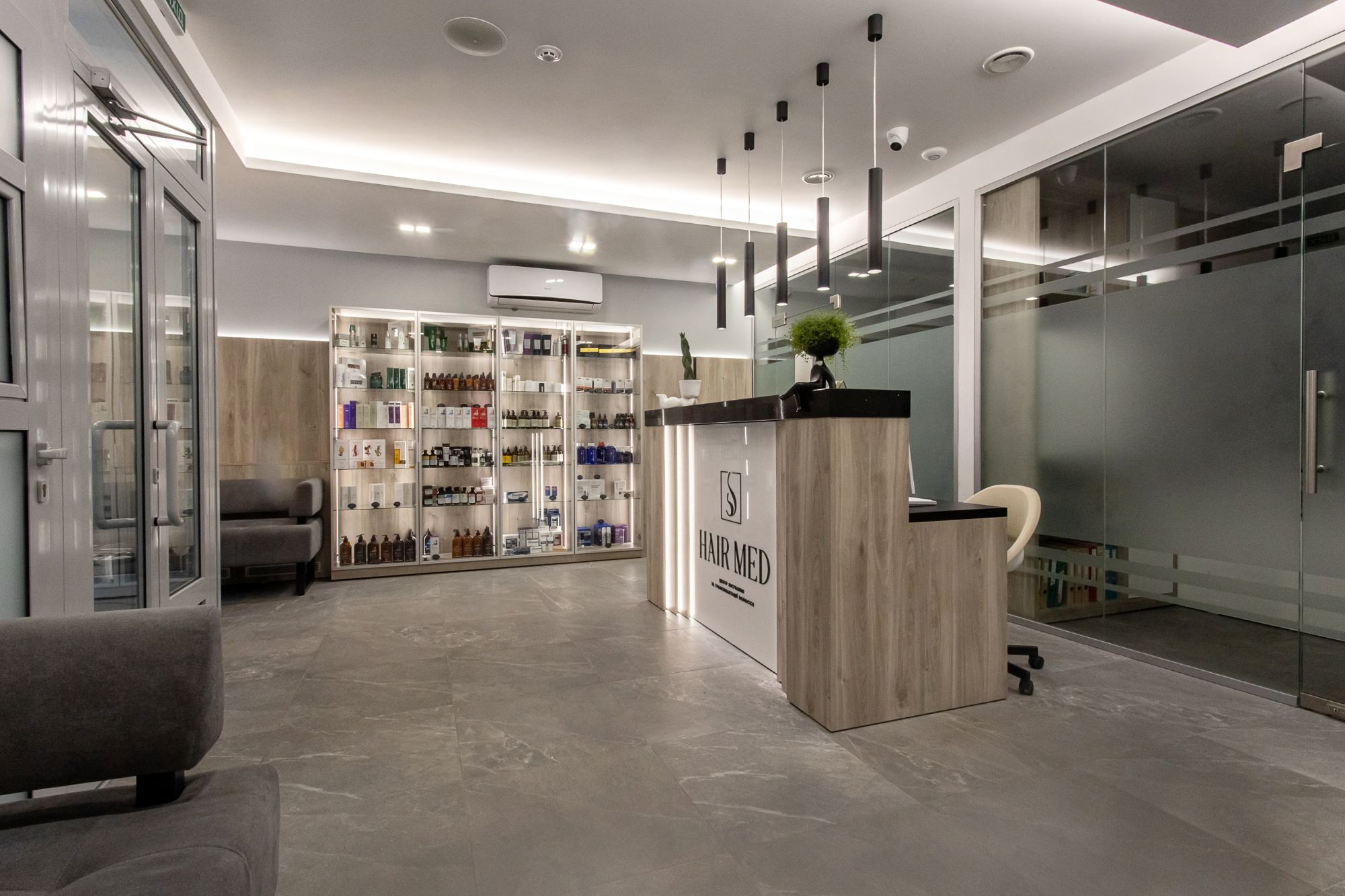
📍 Dnipro, Ukraine
A hair treatment and transplant centre in Dnipro: 430 m², two surgical zones, an SMP room and its own HairHub. Transplants are performed by Ivan Baranov, PhD (member of ISHRS and the World FUE Institute) and transplant surgeon Svitlana Nedbailo. Therapy is led by a team of trichologists and dermatologists.
It is a course of injections of platelet-rich autologous plasma: 10–20 ml of the patient's own blood is drawn and centrifuged, and the resulting plasma fraction is injected into the scalp to a depth of 2–4 mm. The platelets carry growth factors that support the blood supply to the follicle and lengthen the growth phase of the hair.
The method is considered an addition to core therapy in early and intermediate hereditary thinning, and a way to support the area after a transplant. It is not a stand-alone treatment.
One session at the clinics MediUkraine works with starts from USD 56, and a course of four sessions from USD 222. A trichologist consultation with trichoscopy is charged separately, from USD 31, and a follow-up trichoscopy from USD 27; tests are paid for at the laboratory. For comparison, one session starts from around USD 150 in the Czech Republic and from USD 100 in Turkey. Please confirm the final cost with the clinic.
The standard course is four sessions at intervals of 3–4 weeks. After that, if trichoscopy shows a response, patients move on to maintenance sessions every 3–6 months. There is no point assessing a course of one or two sessions: the hair cycle is measured in months, and changes physically do not have time to appear. The exact number of sessions is set by the doctor after an examination, depending on the area of thinning and the stage.
Patients usually notice subjective changes after the third or fourth session, that is, 3–4 months after the start of the course. The effect is assessed objectively after six months, by a repeat trichoscopy of the same areas.
Without maintenance sessions and without core therapy, density usually returns to its previous level within 6–12 months: the procedure does not remove the cause of thinning. Some patients do not respond to treatment at all, and this cannot be predicted before the course begins.
The injections can be felt, but they are brief: 0.05–0.1 ml is injected at each point, the needle is fine and the depth is shallow. Most patients go through the session without pain relief. If wished, a topical lidocaine cream is applied 20–30 minutes before the procedure, or the skin is cooled immediately before the injections. The next day the scalp may be tender to the touch; this passes on its own.
It is not performed in clotting disorders and thrombocytopenia, in active scalp infection such as folliculitis, pustules, herpes or fungal infection, in haematological cancers, while taking anticoagulants and antiplatelet drugs, or in severe liver disease. Pregnancy and breastfeeding are considered grounds for postponing the procedure because of a lack of research in this group.
Scarring alopecias are a separate case: there the follicle openings have already been lost, and there is no point injecting plasma.
Technically the procedures are similar: the same grid of superficial injections and the same interval. The difference lies in what is injected. In mesotherapy it is a factory-made cocktail of vitamins, amino acids and peptides whose composition varies from manufacturer to manufacturer, and systematic reviews regard the available data as insufficient for a recommendation.
Plasma is the patient's own material, so there will be no reaction to a foreign substance, and there is noticeably more research on it in hereditary thinning, although the results are contradictory. Both methods remain supplementary to the main treatment regimen.
Tell us what you need: we will suggest a clinic and a doctor and send you a cost estimate.
Request a consultation →