| Service | 🇺🇦 Ukraine | 🇨🇿 Czech Republic | 🇹🇷 Turkey |
|---|---|---|---|
| Consultation with shape sketch and graft count | from USD 22 | from USD 70 | from USD 40 |
Prices in the “Ukraine” column come from MediUkraine’s partner clinics. The Czech Republic and Turkey columns show the lower bounds of prices published by clinics there (for Turkey, also the Turkish Dental Association’s recommended 2026 tariff), collected in August 2026 and converted to US dollars at the rate on the day of collection. A dash means we could not find a comparable published price. In any country, the final cost is set by the clinic after an examination.
An eyebrow transplant moves your own hair follicles from the back of the head to the brow area. Donor material is taken from the occipital area, where hair is genetically resistant to loss, divided into grafts of one hair each and implanted into micro-channels made at the required angle. No new follicles are created: the existing ones are redistributed.
The most common reason to seek treatment is years of plucking. The thin brows fashionable in the nineties and early two-thousands eventually stop regenerating: constant trauma to the follicle leads to permanent hair loss, and after 15–20 years of such shaping the brow no longer grows back.
Other causes are scars after injuries and burns, hairless patches after unsuccessful permanent make-up or laser pigment removal, the effects of alopecia areata, congenitally sparse brows, and hair loss after chemotherapy. In each of these cases the first step is to establish whether the underlying process has stopped: grafts are not transferred to an area with active inflammation or unstable alopecia.
The method is not suitable while the cause persists. With trichotillomania, stable remission is needed, otherwise the transplanted hair will be pulled out in the same way. With a scarring process in its active phase, remission is achieved first, and even then graft survival in a scar is lower than in healthy skin, so two stages about a year apart are sometimes planned.
MediUkraine is a service that finds and coordinates treatment; it is not a clinic. We select the medical centre and a surgeon with the relevant expertise, agree the dates and support patients, including those coming from abroad. The decision on indications, scope and shape is made by the doctor after an in-person examination.

Travel. Ukrainian airspace is closed, so there are no commercial flights. Patients enter Ukraine overland, most often from Poland (Rzeszów and Kraków airports are the usual entry points), and continue to Dnipro by train. Dnipro is in the east of the country, a long journey from the border, so plan the route and timing with us before you book.
Visas. Citizens of the EU, the United Kingdom and the United States do not need a visa for short stays in Ukraine. Rules depend on your citizenship, so check your own before booking.
Safety, plainly. Ukraine is at war. Dnipro is attacked more often than western Ukraine, and an appointment can be interrupted by an air raid alert. Several governments advise against travel to Ukraine, and while that advice stands, ordinary travel and medical insurance is often void — confirm your cover with your insurer before you commit to anything.
Before you travel. The centre offers an online consultation, so the plan and the number of grafts can be estimated from photos before you decide to make the trip.
Language. MediUkraine handles correspondence, scheduling, the written treatment plan and the quote in English. The centre's team communicates with international patients in English.
Payment. You pay the centre directly. Our coordination service is free of charge for you.
More on travel, safety and insurance: Safety and travel.
The donor area is at the back of the head, in a band above the hairline, where hair is genetically resistant to loss and keeps that resistance after transplantation. For brows, finer shafts are selected from it: a coarse scalp hair sticks out in the brow and looks out of place, so the assistants sort the material under magnification and reject grafts that are too coarse. In some patients more suitable hair is found in the area behind the ear.
The main difference from scalp work is that each graft contains exactly one hair. On the scalp, natural bundles of two or three hairs are transplanted, because that is how they grow there. In a brow, two hairs coming from one point are visible to the naked eye, so the bundles are split, and this lengthens the sorting stage.
The second difference is the implantation angle. On the scalp the channel is made at an angle of about 40–45 degrees to the skin; in the brow it is almost parallel to it, approximately 10–20 degrees. The hair should lie on the skin rather than rise above it: it is the angle that distinguishes a neat brow from a "brush", and it is precisely the angle that cannot be corrected once the grafts have taken.
The third difference is the direction of growth, which changes along the length of the brow. At the head of the brow hair grows almost vertically upwards, in the body sideways and slightly outwards, in the tail downwards and outwards. In addition, the upper row points downwards and the lower row upwards, and they meet in the middle. This means the channels are not made to a single template: the surgeon changes the tilt and direction literally every few millimetres.
That is why the pattern is agreed before the operation. The shape is drawn in pencil with the patient sitting up, eyes open and forehead relaxed; symmetry is checked against facial landmarks, and the drawing is photographed and shown to the patient in a mirror. Once the channels have been made, the outline can no longer be changed. The number of grafts is calculated from the same drawing: one brow usually takes 150–250, two take 300–500, and where hair is completely absent or there is a large scar the requirement rises to roughly 400 per brow. Density is planned lower than natural so that the brow does not look artificially thick.
Technically, the sequence is as follows: the donor area is trimmed in a narrow strip and anaesthetised, the grafts are extracted with a 0.7–0.8 mm punch using the FUE method and sorted under magnification in a chilled solution, micro-channels are made with a blade or needle at the required angle, and the grafts are implanted with forceps or an implanter. Altogether this takes 3–4 hours under local anaesthesia, as an outpatient procedure.
Healing follows a predictable course. The scabs around each hair come off within 7–10 days, and after 2–4 weeks the transplanted hair falls out; this is an expected stage, and the follicle stays in place. New growth begins from month 3–4, the shape becomes readable at around the sixth month, and the final result is assessed after 9–12 months. Some grafts always fail to take; if density is lacking after a year, a small additional session is planned.
It is worth comparing this honestly with permanent make-up and microblading, because they are fundamentally different. Permanent make-up, powder brows and microblading are pigment in the upper layers of the skin: it lasts from one to three years, gradually fades and changes shade, and needs repeat touch-ups, but it is done in an hour to an hour and a half, without surgery and with no recovery period. Transplanted hair is permanent and gives real volume and shadow that do not read as a drawing up close, but it requires surgery, several months of waiting and lifelong care.
So the choice comes down to this. If most of your own hair has survived and you only need to define the outline or cover a small gap, it is cheaper and simpler to start with pigment. If the area is bare because of a scar, a burn or years of plucking and what you need is volume, pigment will not provide it. The two can also be combined: transplantation first, and a year later, once the hair has grown in, light powdering for an even tone. The reverse order is inconvenient, because fresh pigment gets in the way of planning the shape.
A word on what most often disappoints patients. A transplanted hair remains a scalp hair and keeps its growth cycle: it will not switch to the short eyebrow cycle, so the brows will need trimming roughly once every 2–3 weeks, for life. In the first months the hair grows noticeably faster and lies less well; over time some shafts become finer and behave more like brow hair, but this never happens completely. Anyone not prepared for regular trimming should consider pigment.
For the first three days the brow area swells, and sometimes the swelling moves down to the eyelids; this is a reaction to the fluid injected under the skin, not a complication. Sleeping on a high pillow is advised, and the face should be kept dry until the doctor says otherwise.
A small scab forms around each transplanted hair. Washing the area starts on day 3–5 according to the clinic's regimen: wet it without rubbing and let the water run off. The scabs must not be picked off, because the graft comes out with them; they come off on their own within 7–10 days.
The area returns to its usual appearance in 7–10 days: the redness subsides, the scabs are gone, and the donor strip at the back of the head is covered by hair. This is the period worth allowing for the trip if you do not want to appear at work with visible marks.
After 2–4 weeks the transplanted hair falls out almost completely. This can be alarming, but it is a normal phase: the shaft falls out, while the follicle remains in the skin and enters a resting phase. There is no need to start any additional treatment at this point.
New growth starts from month 3–4, by the sixth month the shape is already readable, and the final result is assessed after 9–12 months. Do not draw conclusions or plan a correction any earlier. A check-up is usually scheduled for day 10, then by photo at 3, 6 and 12 months.
Restrictions for the first month: no sport or bending forward for two weeks; no sauna, swimming pool, sunbed or sunbathing for a month; no decorative cosmetics on the brow area for two weeks. The brows can be tinted, but no sooner than a month after the operation. And the main long-term point: they will need trimming roughly once every 2–3 weeks, because the hair keeps the growth rate of the donor area.
Step 1. Consultation and shape sketch. The surgeon examines the area, assesses how much of your own hair has survived and draws the outline together with the patient: sitting up, with eyes open, checking symmetry against facial landmarks. The drawing is photographed and shown in a mirror, after which the number of grafts is counted. This is the only moment when the shape can still be changed, so it should not be rushed.
Step 2. Day of the operation: anaesthesia and graft extraction. The donor area at the back of the head is trimmed in a narrow strip that the rest of the hair covers, and anaesthetised. Grafts are extracted one at a time with a punch 0.7–0.8 mm in diameter; this stage takes up most of the time. The patient is conscious throughout and can talk, listen to music and take breaks.
Altogether the day at the clinic takes 3–4 hours: between the anaesthetic and going home, the grafts are sorted under magnification, the channels are made at the required angle and direction, and the hairs are implanted one at a time. No hospital admission is needed: the patient goes home the same day, comes back the next day for a check-up and the first wash, and then has a check-up on day 10 and by photo at 3, 6 and 12 months.
A Ukrainian clinic operates with a different cost structure: rent, salaries of non-medical staff, utility bills and administration make up a smaller share of its costs, and this is reflected in the price.
The second factor is the cost of the team's work itself. In hair transplantation the main component of the price is not equipment but hours: the surgeon and two or three assistants are occupied for 3–4 hours straight, extracting and sorting several hundred grafts by hand. The clinic buys punches, blades and implanters from official suppliers and, on request, names the manufacturer and gauge; the difference in the final price arises almost entirely from the cost of labour hours.
The third factor is competition. Hair transplant centres operate across Ukraine, including Kyiv and Dnipro, and they compete for patients on price, portfolio and service.
A lower price does not mean a smaller scope of work: the number of grafts is counted from the same drawing, the operation lasts just as long, and the instruments and extraction technique are the same. The difference lies in the cost of an hour of work, not in what the procedure includes.
There are savings on logistics too: the consultation, the operation and the first follow-up examination can fit into a single trip, and MediUkraine coordinates the dates of every stage. For a patient from abroad this means fewer days of travel, and therefore lower costs for transport and accommodation.
This is a minimally invasive but nonetheless surgical procedure, so it is performed in an operating room under sterile conditions. Punches, blades, needles and implanters are single-use, the skin is treated with antiseptic, and the solution for storing the grafts is prepared immediately before the work begins.
The clinics MediUkraine works with hold a licence from the Ministry of Health of Ukraine to practise medicine in the relevant specialties.
Before the operation the patient has a complete blood count, a coagulation panel, a glucose test and infection markers. This is not a formality: clotting disorders, uncontrolled diabetes, an active skin infection in the treatment area, a tendency to keloid scarring, pregnancy and breastfeeding are grounds for postponing or declining the procedure. The doctor asks separately about anticoagulants and retinoids and about any allergy to anaesthetics.
Anaesthesia is local: an anaesthetic solution is injected into the brow area and the donor site and repeated during the operation if needed. Only the first injections are felt; after that the patient feels touch and pressure but not pain. The most common reactions to the anaesthetic injection are swelling that moves down to the eyelids and small haematomas; these resolve within a few days.
Complications are discussed before the operation, not after. Those that do occur include folliculitis in the implantation area, occasional ingrown hairs, temporary numbness in the donor strip, small pale dots where grafts were extracted, keloid scars in patients prone to them, and some grafts failing to take. Asymmetry is also a possible outcome, and it is most often built in at the sketch stage, which is why that step is given a separate visit.
You receive a written protocol stating the number of grafts, the extraction area and the technique, as well as before and after photos. The right to a second opinion remains at any stage: you can take the sketch and the calculation to another surgeon before the operation. If needed, MediUkraine will help arrange such a consultation.
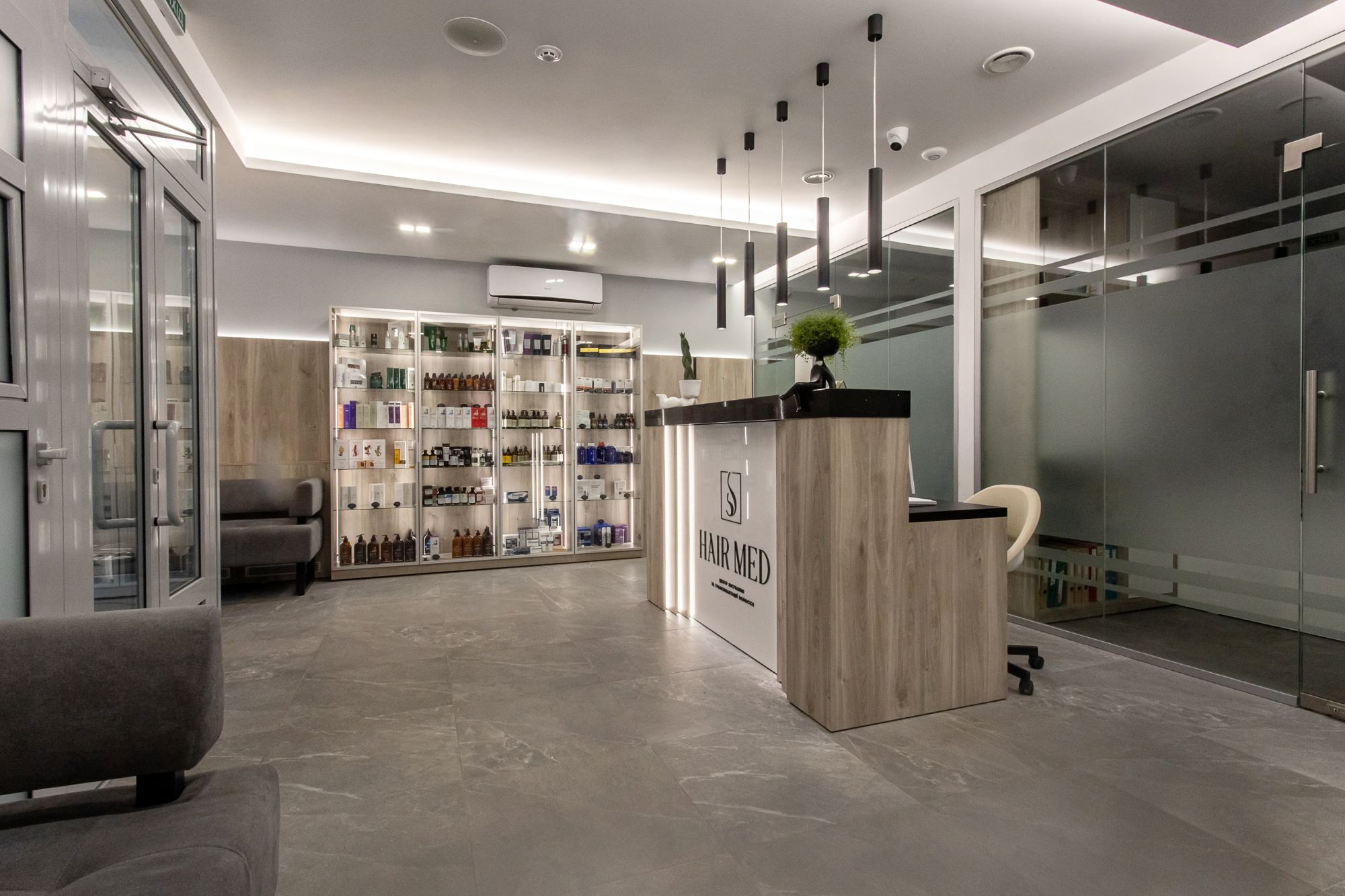
📍 Dnipro, Ukraine
A hair treatment and transplant centre in Dnipro: 430 m², two surgical zones, an SMP room and its own HairHub. Transplants are performed by Ivan Baranov, PhD (member of ISHRS and the World FUE Institute) and transplant surgeon Svitlana Nedbailo. Therapy is led by a team of trichologists and dermatologists.
The transplanted follicles stay in place permanently: they come from the occipital area and keep its resistance to hair loss. But along with that resistance they also keep their growth rate: the hair will not switch to the short eyebrow cycle, so the brows will need trimming roughly once every 2–3 weeks, and always will.
This is the most common cause of disappointment, so it is worth weighing up before the operation, not after. In the first months the hair grows faster and lies less well; over time some shafts become finer and behave more like brow hair, but this never happens completely.
A consultation with a sketch and a graft count costs from USD 22, and at some clinics it is credited towards the cost of the operation. The final amount is given by the clinic after an examination, because you pay for the number of follicles transferred, not for the procedure as a whole.
Roughly 150–250 grafts per brow, that is 300–500 for both. If there is no hair at all or a scar covers the area, the requirement rises to about 400 per brow.
The exact number is given once the outline has been drawn: what is counted is not the brow as a whole but the gaps within the agreed shape. Density is planned lower than natural: an overly thick brow looks artificial, and reducing it later is harder than adding grafts a year on.
The scabs come off within 7–10 days, and at this stage the brows look almost finished. Then, after 2–4 weeks, the transplanted hair falls out; this is an expected phase, and the follicle stays in the skin.
Real growth begins from month 3–4, by the sixth month the shape is already readable, and the final result is assessed after 9–12 months. It is worth comparing photos taken in the same lighting and from the same angle, rather than impressions under different light.
Yes, but not straight away. Fresh pigment makes it hard to assess the real boundaries and density of your own hair, and the skin is still recovering after the procedure, so waiting several months is advised. If the pigment was removed by laser, the surgeon assesses the condition of the skin separately: after several removal sessions it can be denser, and this affects graft survival.
It is more convenient the other way round: transplantation first, and a year later, once the hair has grown in, light powdering for an even tone if you wish.
There is no pain during the procedure, as local anaesthesia is used; only the first injections are felt, and after that you feel touch and pressure. After the operation there may be discomfort in the brow area, which is relieved with an ordinary painkiller.
It will be noticeable for the first 7–10 days: swelling in the first days, redness and small scabs around each hair. The donor strip at the back of the head is covered by your own hair. If you do not want to appear at work with visible marks, plan your trip around this period.
It is not performed with active alopecia areata or with a scarring process in an acute phase: stable remission is needed first. With trichotillomania the operation makes no sense without control over the plucking habit itself: transplanted hair gets pulled out in the same way.
It is also postponed in cases of clotting disorders, uncontrolled diabetes, an active skin infection in the treatment area, pregnancy and breastfeeding. A tendency to keloid scarring is discussed separately. The final decision is made by the surgeon after an examination and an assessment of the donor area.
Tell us what you need: we will suggest a clinic and a doctor and send you a cost estimate.
Request a consultation →